
Winter sports enthusiasts looking for the right skis will find them – that much is certain. However, it is also clear that buying skis is not always a quick process. In most cases, many skiers already have a few questions after their initial research: Which ski is the right one for me? Is it better to buy new or second-hand skis? And where is the best place to buy my piste equipment? SnowTrex addresses these questions below and provides 7 tips for buying skis.
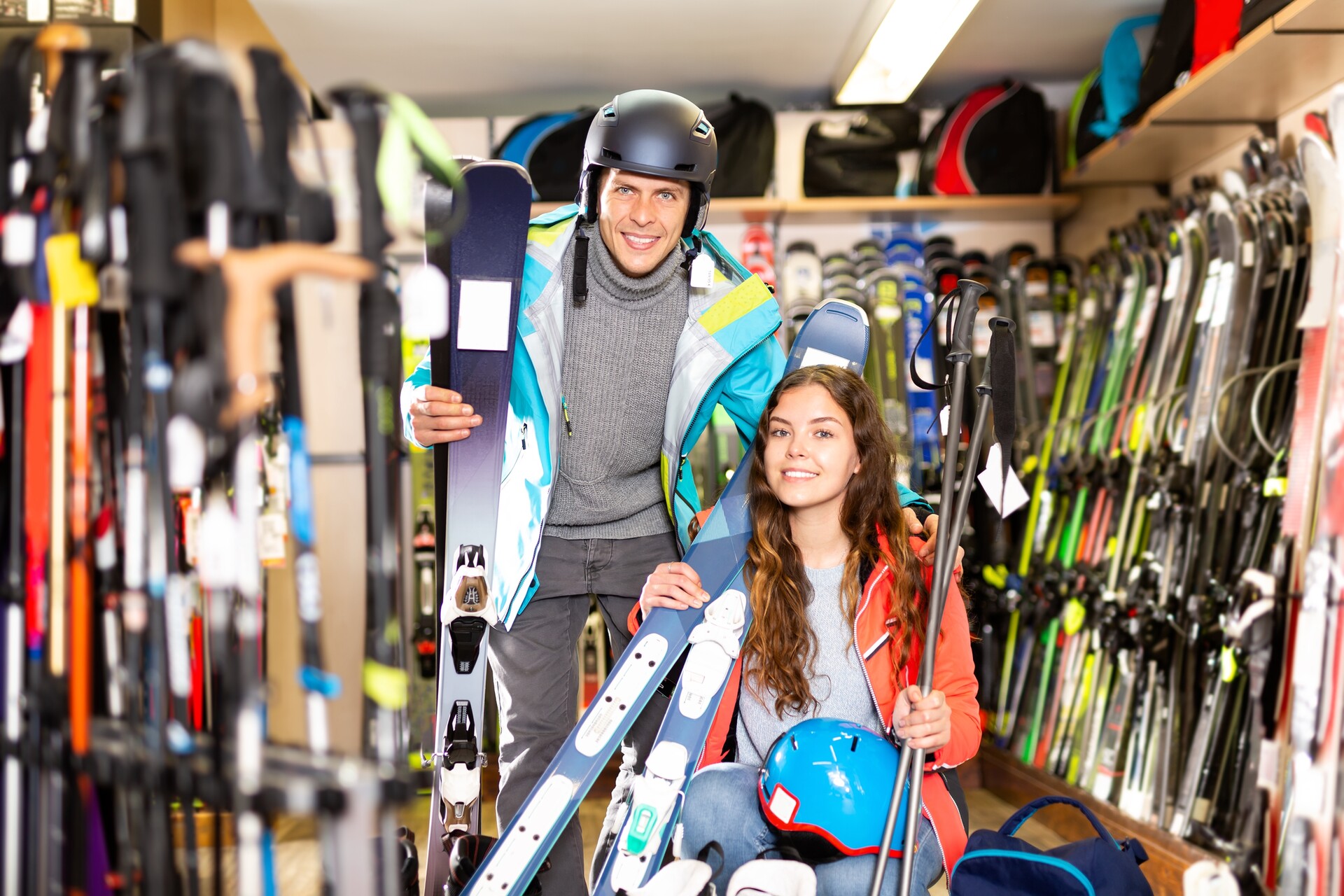
1. Deciding on a ski model and ski equipment
- Determine your skiing ability and intended use: It is important to choose a ski model that suits your ability and the terrain. Beginners benefit from all-round carving skis, whilst experts benefit from slalom or race carving skis.
- Consider technical factors: These include sidecut, flex, core material, weight, and technologies such as rocker-camber, twin-tip or damping systems. Sustainability can be an additional criterion.
- Choose a model based on intended use: All-mountain skis for groomed slopes and deep snow, freeride skis for powder snow, touring skis for ascents and descents, freestyle skis for tricks, and women’s skis, which are specially designed for women.
“Which ski is right for me?” When winter sports enthusiasts are looking to buy or hire ski equipment, they should first be clear about where the new skis will be used in the ski resort. Furthermore, skiers must be honest with themselves and realistically assess their ability in advance. Anyone looking to buy skis, especially beginners, will have little fun, for example, if they struggle down a perfectly groomed slope on slalom or race carvers. Experienced winter sports enthusiasts or even World Cup athletes, on the other hand, feel right at home on these two ski models. For beginners, all-round carvers are the ski equipment of choice. With their comfortable ride characteristics, they are the best option for beginners looking to enjoy relaxed days on the slopes. It’s also worth taking a look at the technical specifications, which play a key role in handling and comfort – such as ski bindings, sidecut, flex, core material and weight. For sporty skiers, modern all-mountain and freeride technologies such as rocker-camber profiles, twin-tip designs or special damping systems, for example with titanium inserts, may also be of interest. Sustainability aspects, such as the use of recycled materials, can be a further deciding factor for many buyers when comparing the different types of skis.
| Ski model | Ski level | Terrain |
|---|---|---|
| Allround carvers | Beginners & leisure skiers | Piste |
| All-mountain skis | All types, particularly for good skiers with occasional off-piste runs | Piste & Off-piste |
| Slalom carvers | Experienced skiers with precise technique | Piste |
| Lady skis | Specifically for female skiers | Piste & Off-piste |
| Race carvers | Extremely sporty skiers | Piste |
| Freeride carvers | Deep snow & terrain skiers | Off-Piste |
| Freestyle skis | Snow park & ski trick fans | Piste & Snow park |
| Touring skis | Ski tourers | Off-piste |
Once you’ve gained confidence in your ski equipment, you might then consider switching to all-mountain skis. As the name suggests, these skis are suitable both for precise turns on the piste and for cruising through deep snow. Away from the groomed slopes, advanced skiers can confidently opt for freeride skis and kick up plenty of powder snow. Touring skis offer similar all-terrain capability; thanks to special bindings and ascent systems, such as frame or pin bindings and skins, they also allow for independent ascents up the mountain. Days spent in snow parks or half-pipes are far more spectacular, though no less physically demanding. Freestyle skis are perfectly suited for innovative tricks and spectacular jumps. Thanks to their curved tips, they can even be ridden forwards and backwards with ease. In principle, all ski models can be used by both women and men. However, there is now also a special version for women: the so-called ladies’ skis. These are constructed slightly lighter and the binding is mounted a little further forward for better control. What is the anatomy of a ski? You’ll find the answer to this question in this video series:

Please also note that by using our services and integrating the YouTube API Services, the YouTube Terms of Service and the YouTube API Services Terms apply and your use of our website is deemed to be acceptance of these terms.
2. Research prices before buying skis
- Clarify your needs and budget: decide on the intended use, your skiing ability and your price range – for example, under €300 for all-round skis or from €500 for high-performance models.
- Compare prices: check last year’s models, enquire about new prices at specialist retailers and compare current offers with the market value.
To help keep costs down, winter sports enthusiasts are advised to clarify exactly what type of equipment is suitable for them before buying skis. The main factors to consider here are where the skis will be used and what your skill level is. In addition to the location and your skiing ability, it’s worth developing a budget strategy. Rather than just citing broad price ranges, it can be helpful to have specific examples: for instance, that solid all-round skis can often be found for under 300 euros, whilst high-performance models or the very latest technologies are available from 500 euros upwards. The advantage of this approach is that it immediately provides much greater clarity on the price range within which the desired skis fall. However: depending on the model, manufacturer and year of production, prices can vary significantly. For skis that have been on the market for a year or two, it is worth asking at your local specialist shop what the original price was at the time. Based on this, you can quickly assess whether the current price on offer – whether in-store or online – is realistic for the product you want, or whether it is actually a bit overpriced.
3. Don’t shy away from used ski equipment
- Check the quality: Safety is the top priority. When buying second-hand, you should use a checklist to identify any damage, such as delamination or cracks.
- Choose reliable sources: Only buy second-hand skis from reputable online shops or specialist retailers who professionally recondition the equipment and ensure quality standards are met.
When it comes to equipment, the perfect condition of skis is always the top priority. After all, the skis are absolutely crucial for safety during high-speed action on the slopes. In this regard, brand-new skis from well-known manufacturers are the first choice for guaranteed quality. Nevertheless, winter sports enthusiasts looking for a bargain on equipment should not shy away from second-hand skis. It is important to be aware of potential risks: a short checklist for quality checks helps to identify damage such as delamination, cracks in the core or damaged binding plates.

However, caution is often advised when dealing with online sellers. In particular, private listings on classifieds websites should always be scrutinised carefully. With verified online shops that explicitly offer second-hand skis, customers can be confident that the used equipment on offer meets a high standard of quality. The same applies to local sports shops and specialist retailers located directly in the ski resorts. They regularly purchase used skis and can therefore offer sound advice, particularly if you subsequently entrust them to the care of their own specialist staff. Before the skis are put back on sale, the base, edges and bindings are reconditioned by experts. As a result, the equipment is almost on a par with brand-new items in terms of quality. And usually at a significantly lower price.
4. Online retail scores well when buying skis thanks to large selection
- Take advantage of the wide online selection: Manufacturers offer the latest models, whilst sports retailers often stock good-quality, discounted models from the previous year.
- Plan your purchase carefully: Use reviews and comparison websites to help you choose, check delivery times and order in good time to avoid delays before your skiing holiday.
A major advantage of shopping online for skis is the virtually unlimited choice available 24/7 with just a few clicks. However, it is precisely this variety that can quickly become overwhelming. Manufacturers always stock the latest models in their online shops, often featuring state-of-the-art technology, but these are generally priced higher. Those looking to save money will often find reduced-price models from the previous year in good quality at well-known sports retailers. To keep track of the vast range of products, it is worth checking reviews from independent consumer organisations or comparison websites. These help to narrow down the selection effectively. Buyers should also bear in mind that not every model is available for immediate delivery. Longer delivery times can disrupt your planned skiing holiday, particularly if the skis you’ve ordered only arrive whilst you’re already at the ski resort. Ordering in good time prevents such disappointments.
5. Specialist dealers provide the expertise when buying skis
- A range tailored to the ski resort: Specialist retailers offer the right models for each region – from all-round carvers and children’s skis in family-friendly resorts to race carvers and freeride skis in more challenging resorts.
- Compact selection: Limited storage capacity ensures a focused product range optimised for local conditions.
The range offered by specialist retailers in ski resorts is often more limited, as their storage space is restricted and they need to make room for ski boots, clothing and snowboards as well as skis. However, this range has one key advantage: it is specifically tailored to the conditions of the particular ski resort. In family-friendly regions with predominantly gentle slopes, the focus is therefore primarily on beginner-friendly models such as all-round carvers or children’s skis. In ski resorts known for steep runs, challenging slopes or spectacular snow parks, on the other hand, sportier models such as race carvers and freeride skis are more common. This allows retailers to ensure that the equipment on offer is perfectly suited to the typical local requirements.
6. Unlimited skiing fun thanks to personalised advice
- Personalised advice in-store: Specialist retailers can help you choose the right model, check the fit and condition, and make any necessary adjustments or deal with complaints on the spot.
- Try before you buy: You can often hire skis in advance. If you go on to purchase them, the hire costs will be deducted from the price, ensuring that winter sports enthusiasts get the best equipment for their needs.
Without the right ski equipment, even the most beautiful day on the slopes can quickly lose its appeal. That is why staff in specialist shops are on hand to offer customers expert advice and tailored recommendations when they are looking to buy skis. During a personal consultation, models that do not suit the skier’s ability or preferred terrain are ruled out from the outset. During the fitting, any issues can be addressed straight away, such as if the ski boot doesn’t fit into the binding, the skis seem too long, or there are signs of wear and tear such as scratches and scuffs. Thanks to the trained staff’s ability to respond quickly, adjustments and complaints can be dealt with immediately.
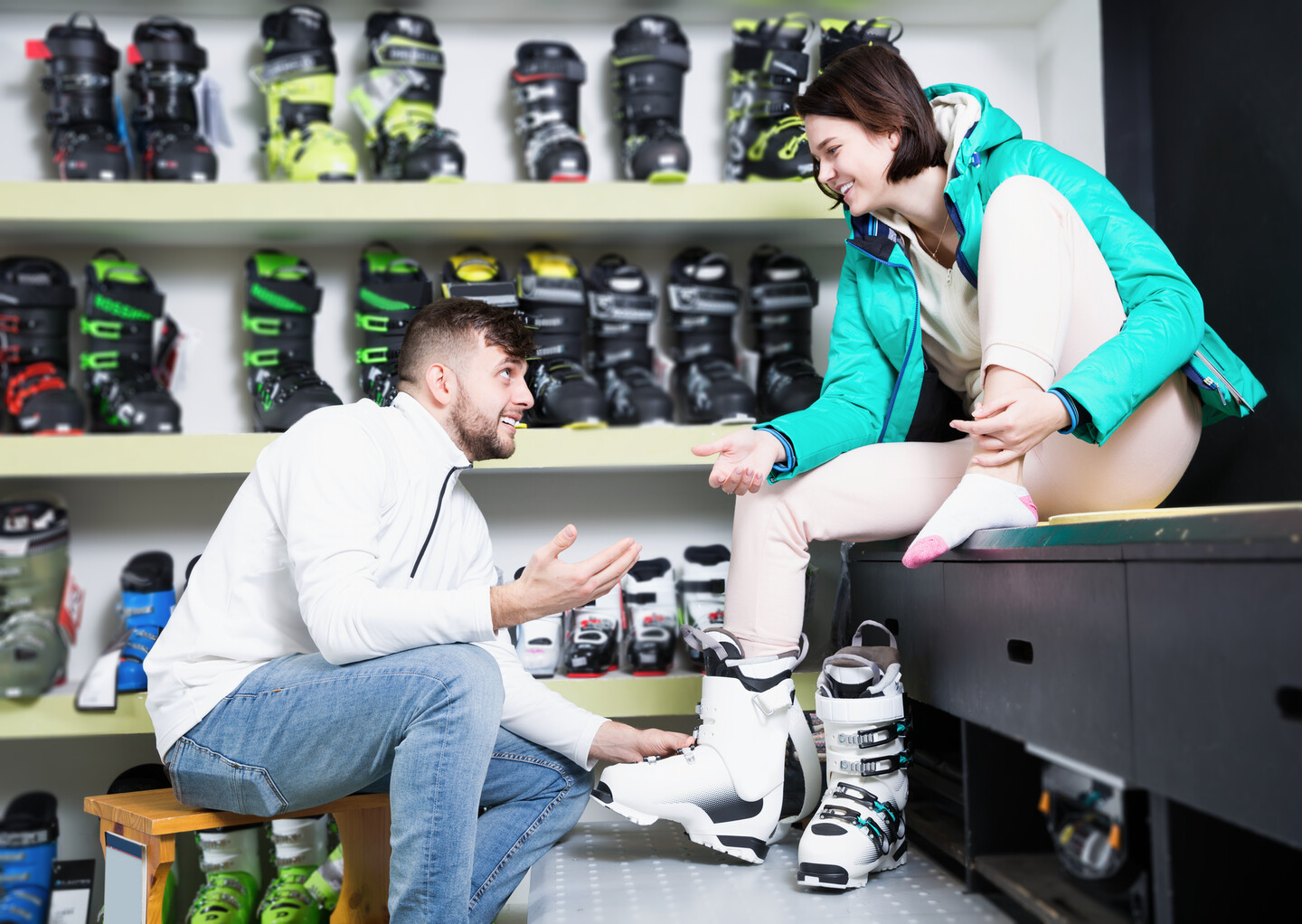
Many specialist retailers in ski resorts also allow customers to hire their chosen equipment first and test it in real-world conditions. If the skier is happy with the skis and goes on to buy them, the hire costs are usually deducted from the purchase price. This gives winter sports enthusiasts the assurance that they are using equipment that is perfectly suited to their needs – and allows them to enjoy their day’s skiing to the full against a stunning mountain backdrop.
7. Ski experts ensure safety on site
- Ensure your equipment is perfectly matched: your skis, boots and bindings must be perfectly matched. It is therefore best to have them fitted by experts at the resort rather than doing it yourself.
- Safety through the correct Z-setting: once your weight and foot measurements have been taken and the bindings have been professionally adjusted, the risk of injury can be minimised.
Safety when skiing is the be-all and end-all for a worry-free day on the piste – for every winter sports enthusiast. In addition to choosing the right skis, the other components of the ski equipment must also fit the skier. Boots and bindings can be adjusted in just a few simple steps. However, if you want to be on the safe side, the ski experts on site in the ski resort are the right people to talk to.

The shop staff can weigh the skier in the shop or measure their feet. With this data, the ski boots and the ski bindings can be optimised for each other. The perfectly adjusted Z-value triggers the binding in an emergency and releases the ski to prevent injuries as far as possible.
FAQ’s on buying skis
How much do good skis cost?
Reliable all-round skis are often available for beginners from around €300, whilst high-performance models featuring the latest technologies usually cost €500 and upwards. The price depends heavily on the model, brand, construction and year of manufacture. Previous year’s models can be significantly cheaper whilst offering the same quality, particularly when they are sold at the end of the season by sports retailers or specialist shops.
When are skis too old?
Skis are considered ‘too old’ if there is material fatigue or safety issues, such as cracks in the core, delamination, deep damage to the base or edges, or faulty bindings. Even with good maintenance, skis lose their tension and performance characteristics after around eight to ten years, particularly with intensive use. Binding standards also change over time, which can affect safety.
Can winter sports enthusiasts ski normally on the piste with freeride skis?
Yes, freeride skis can also be used on groomed pistes. Due to their width and soft flex, they are ideal in deep snow; however, on hard pistes they offer less grip and manoeuvrability than carving or all-mountain skis. For predominantly piste skiing, all-mountain or carving models are therefore often the better choice.
Is it worth buying second-hand skis?
Yes, provided they come from trustworthy sources and are in perfect technical condition. Specialist retailers and reputable online shops professionally recondition second-hand skis, including base and edge grinding as well as binding checks. Caution is advised when buying from private sellers. In such cases, a quality control checklist should definitely be used to identify damage such as delamination or cracks. In terms of price, second-hand skis are usually significantly cheaper than new models.
Is it advisable to buy skis online?
Buying online offers a huge selection and often lower prices, particularly for last year’s models. However, when buying skis online, it is important to ensure that the retailers are reputable and that product reviews and delivery times are suitable. As skis need to fit the individual, it is advisable to seek advice or try them out in a specialist shop beforehand. Anyone buying online should ensure that the returns and service options are clearly set out.

