
From the stunning cross-country trails in the Zillertal to the traditional routes in Scandinavia: cross-country skiing has evolved from a niche sport into a truly popular winter sport for all age groups. After all, like downhill skiing, this endurance sport combines a winter experience in nature with sporting challenges. Away from the hustle and bustle of the ski resorts, SnowTrex knows what matters when it comes to cross-country skiing. After all, if you want to enjoy the peace and quiet on the trail, there are a few things to bear in mind. From the right equipment, to knowledge of classic or skating techniques, right through to the perfect cross-country skiing destinations.
That’s why cross-country skiing is becoming increasingly popular
What is cross-country skiing?
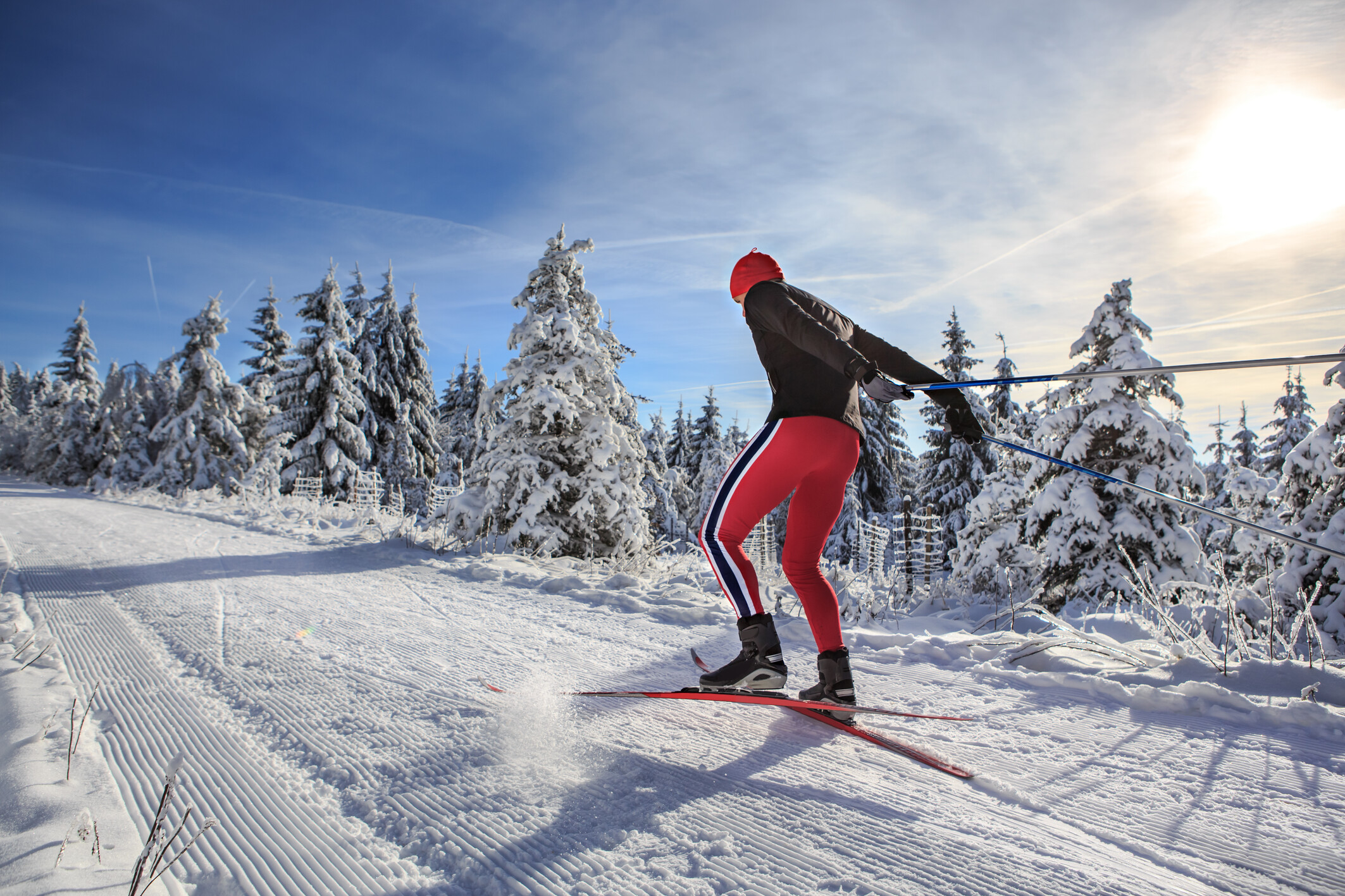
Cross-country skiing involves propelling yourself forward using your own strength across flat or uphill terrain, and occasionally on downhill sections. Narrow, lightweight cross-country skis and long poles enable you to glide across the snow using the diagonal stride or skate stride, also known as freestyle or skating. Winter sports enthusiasts use specially groomed trails for this, which are rolled out across snow-covered landscapes as a kind of winter hiking trail, often with narrow tracks for classic-style cross-country skiers. Unlike downhill skiing, cross-country skiing requires hardly any lifts or steep descents, nor does it require skis with steel edges. In the premier discipline of Nordic skiing, the smooth, rhythmic movements engage almost all major muscle groups, which is why cross-country skiing is considered a particularly efficient full-body workout.
History of cross-country skiing
The origins of cross-country skiing date back thousands of years, to a time when prehistoric peoples in Scandinavia and Asia used ski-like devices for hunting and travel in winter. In Sweden, for example, ‘primitive skis’ have been found which experts have dated to around 2,500 BC. Norway, however, is regarded as the cradle of modern cross-country skiing, where the first competitions took place in 1843, such as the Holmenkollen Ski Marathon, first held in 1892. By the end of the 19th century, this Nordic winter sport had also established itself in Central Europe, where German cross-country skiing pioneers such as Fritz Breuer contributed to its spread. Thanks to its growing popularity, cross-country skiing became an Olympic sport for the first time in 1924. Initially, the Winter Games were dominated by long-distance races in the classic style, before sprint formats and skating races were later added. Freestyle developed in the 1970s and is now regarded as the second main discipline of cross-country skiing.
Cross-country skiing and health
Cross-country skiing is considered one of the healthiest winter sports. This is because the steady movement engages virtually all muscle groups, such as the legs, arms and core, making it an effective full-body workout. In cross-country skiing, the leg thrust and use of poles build strength and endurance, which in turn strengthens the heart and circulation. Depending on the intensity, up to 800 calories can be burned per hour. Because the impact is very gentle on the joints and the body is not exposed to hard impact forces on the trail, cross-country skiing is also suitable for older winter sports enthusiasts. Furthermore, many cross-country skiers report a meditative effect on the trail, where the rhythmic gliding reduces stress and promotes physical well-being. Overall, cross-country skiing is described as a comprehensive fitness programme in the great outdoors, as studies show that it can lower blood pressure and improve heart health.
Cross-country skiing techniques
Classic technique
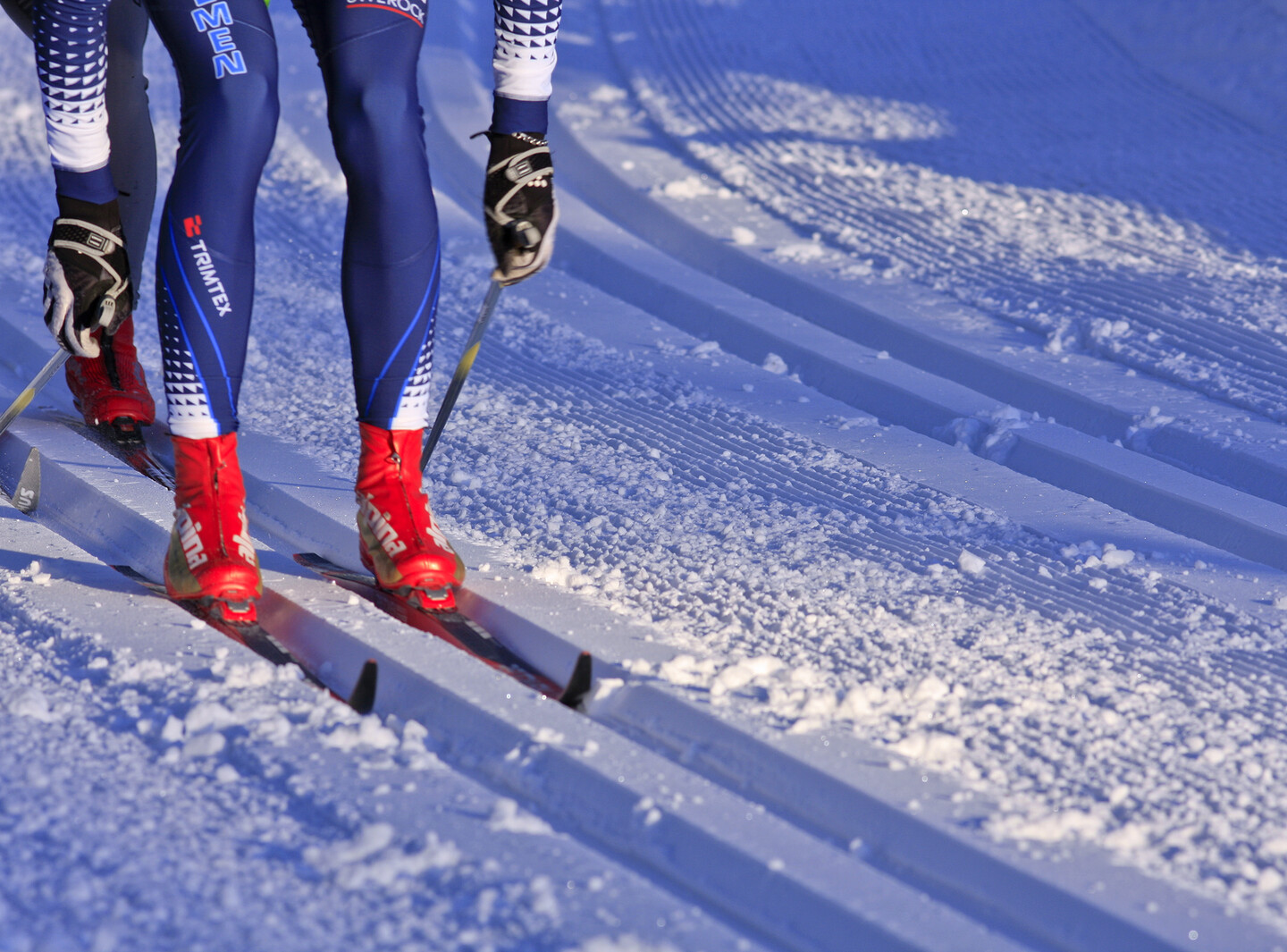
The classic technique is the original cross-country skiing style and resembles walking or running, but on skis. Skiers move forwards using a diagonal stride along two parallel tracks on the trail, pushing off with the right ski whilst simultaneously pushing the left pole forwards, and vice versa. This allows one ski to glide whilst the other is pulled forwards. Overall, the technique is easy to learn because the track guidance is stable and therefore ideal for beginners. A classic cross-country ski is about 20 to 30 cm longer than the skier’s height and features a climbing zone on the base that provides grip during the push-off, which can be further enhanced by wax, scales or skins.
Skating technique
The skating technique, also known as freestyle, is a relatively recent variation of cross-country skiing. It emerged in the 1970s and, with its sideways push-off movements, resembles ice skating. It is practised on wide, flat-rolled trails without grooved tracks. Skiers plant their skis at a V-angle, with propulsion generated by a powerful sideways push-off using the inner edge, accompanied by synchronised pole planting. This makes timing and coordination crucial, as both speed and balance are required. In skating, the legs, core and upper body are put under intense strain on the trail, enabling high speeds of up to 30 km/h. To accommodate this, skating skis are shorter and more torsionally rigid, whilst the boots feature a higher shaft and ankle support.

So, if you’d like to get started with cross-country skiing and are looking for a gentle, smooth movement that’s easy on the joints, the classic technique is just the thing for you. Winter sports enthusiasts who, on the other hand, love speed and are looking for a sporting challenge will probably find skating more to their liking. However, it always helps to try out both styles, perhaps on a cross-country skiing course, to get a feel for the differences between the two techniques. When deciding on your personal favourite discipline, however, you should first ask yourself the question: “What type of cross-country skier are you?”
Cross-country skiing disciplines and competitions
Touring cross-country versus competitive sport
Recreational cross-country skiing involves skiing for leisure over longer distances at a steady pace. The focus is on enjoying the natural surroundings and the personal challenge, rather than direct competition. Many winter sports enthusiasts simply enjoy gliding along for hours on long trails, which can be compared to a winter hike on skis. Multi-day tours from hut to hut are also very popular here. Competitive sport, on the other hand, as the name suggests, is highly performance-oriented, with speed, technical perfection and strategy playing the leading roles. And whilst touring skiers can take a break whenever they like, cross-country athletes are always pushing themselves to the limit, whether in a 1.5 km sprint or a 50 km mass start.
Olympic disciplines and World Cup formats
Sprint: Here, an explosive start and technique at high speed are key, as athletes race on a short 1.2 to 1.5 km loop in the qualifiers, followed by the quarter-finals, semi-finals and final in a knockout system, alternating between classic and freestyle techniques from event to event.
Team sprint: In this competition, tactics and quick changes play a major role, as two skiers per team take turns completing several short laps, usually six times 1.5 km.

Please also note that by using our services and integrating the YouTube API Services, the YouTube Terms of Service and the YouTube API Services Terms apply and your use of our website is deemed to be acceptance of these terms.
Individual: Over 10 km (women) or 15 km (men), the athletes compete in an interval start, using either classic or skating technique. The athletes usually set off at 30-second intervals, and because this event is all about achieving the best time, a sense of pace and tactics are required alongside endurance, as the competitors are out on the track alone.
Mass start: The premier events are the 30 km for women and the 50 km for men, where all athletes start together for the marathon distance, which demands extreme endurance and the best tactics in the field.
Skiathlon: This combination of two 7.5 km legs (women) and two 15 km legs (men) is the newest cross-country event at international championships, where the first half of the course is skied in classic style and the athletes then swap skis and poles in the transition zone to tackle the second half in skating style.
Relay: In classic cross-country skiing relays, teams from each nation consist of four athletes who must complete four 5 km legs (women) and four 10 km legs (men). Typically, the first two runners use the classic technique and the last two the skating technique, whilst the baton is passed from athlete to athlete via a touch in a transition zone.
These core disciplines are also part of the Cross-Country World Cup, which takes place every winter between November and March. Athletes collect points based on their finishing positions, with crystal globes awarded at the end of the season for the overall victory as well as for sprint and distance classifications. The highlight of the World Cup is the Tour de Ski stage race, held around the turn of the year. In addition to the professional races, public races attract thousands of amateur cross-country skiers every year. Well-known examples include the Vasaloppet, a 90 km classic-style race held in Sweden since 1992, the Engadin Ski Marathon in Switzerland, a 42 km freestyle race, and the 54 km Birkebeiner in Norway, which is skied in classic style.
Cross-country skiing equipment
Classic or freestyle skis
Classic skis are usually 20 to 30 cm longer than the skier’s height. Beneath the binding lies the climbing zone, which provides grip during the push-off thanks to a fish-scale base, an integrated skin or climbing wax, whilst the gliding zones at the front and rear of the classic ski generate speed. In addition, the climbing zone is loaded by a special camber during the push-off and unloaded during gliding. Overall, these ski models are slightly wider at the tip, which provides greater stability on the trail.
Skating skis must be 5 to 15 cm longer than the skier’s height, making them shorter than classic skis. Instead of a climbing zone, the base consists solely of a gliding zone, which makes them very fast on hard snow. Their torsionally stiff construction withstands lateral forces, and a stronger camber reduces the contact area, which improves the gliding phase. This makes skating skis particularly suitable for wide, groomed trails.
Bindings, boots and poles
- Cross-country bindings connect the boot to the ski and are movable at the front, allowing a free heel for the push-off on the snow. The most popular binding systems are NNN (New Nordic Norm) and SNS (Salomon Nordic System), with NNN being the standard today. And because boots fit the binding, NNN boots do not fit an SNS binding. There are separate binding models for the two skiing techniques, classic and skating. Classic bindings have a softer flex, which makes rolling the foot easier, whilst skating bindings are stiffer and thus provide more stability during the lateral push-off.
Classic boots resemble lightweight hiking boots or sturdy trainers. Their shaft usually extends just above the ankle, allowing for mobility in the ankle joint. The sole is soft and flexible in the forefoot area, so that the foot can roll cleanly during the push-off. There is no lateral ankle support, making the boots lighter and more comfortable.
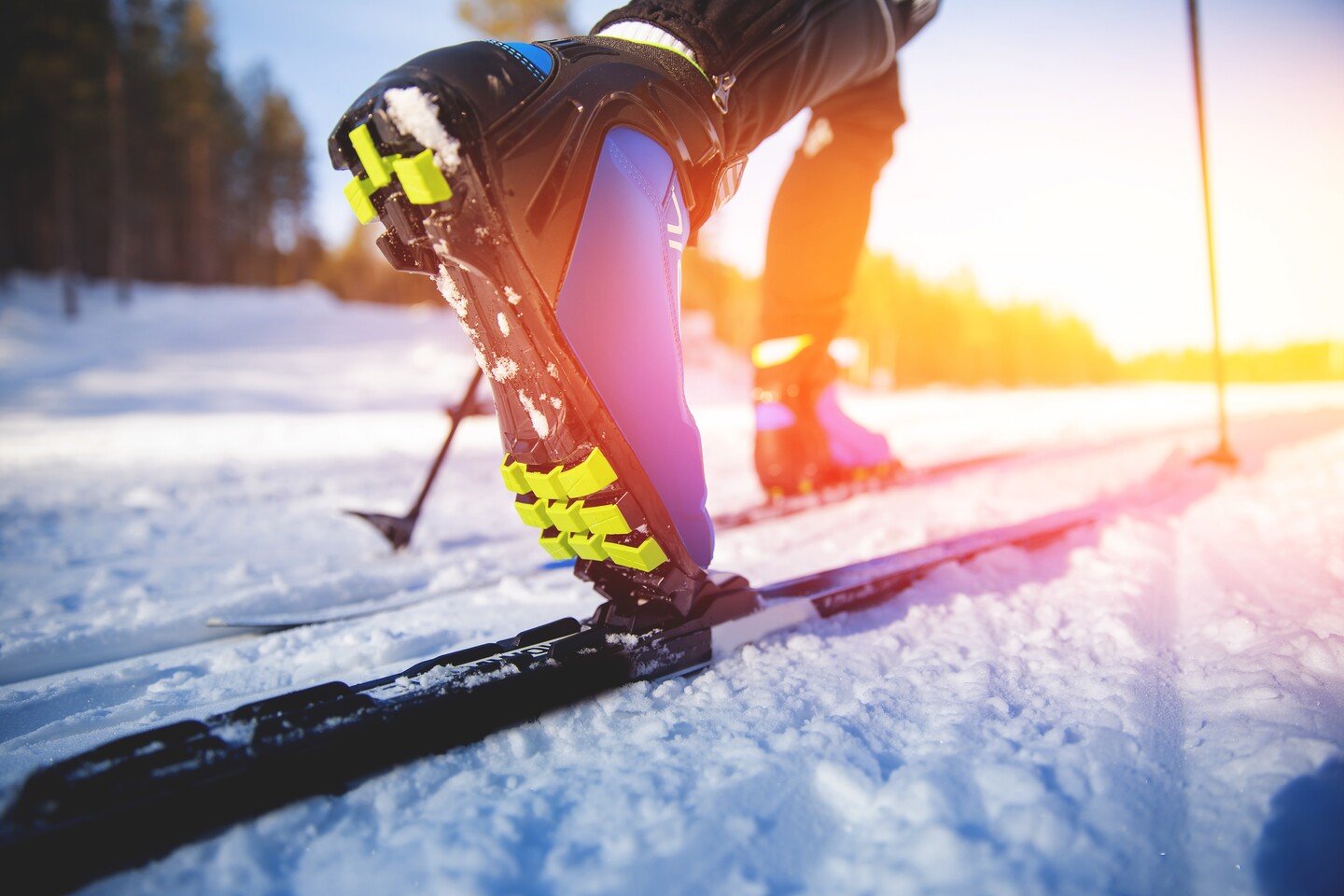
Skating boots resemble lightweight ski boots or sturdy hiking boots. They have a high shaft with ankle support or a cuff, which is often fitted with a Velcro fastening or a buckle. These secure the ankle and provide stability during lateral push-offs. Many models use a plastic or carbon construction to ensure stability whilst keeping the weight down. This makes skating boots slightly heavier than classic boots, but they offer more support.
- Cross-country ski poles are long and lightweight because they are made from aluminium, carbon or a mixture of carbon and fibreglass. As a general rule, the length of classic-style poles corresponds roughly to the athlete’s shoulder height, whilst skating poles are measured from chin height. A skier who is 1.80 m tall would therefore use poles around 1.30 m long for the classic style and just under 1.50 m long for the skating technique. The long poles enable a powerful double-pole push. Appropriate wrist straps allow for efficient power transfer, and overall, the baskets on cross-country poles are smaller than those on alpine models.
Clothing and other cross-country skiing accessories
Underwear: Cross-country skiing clothing should be worn according to the three-layer principle. The first layer consists of breathable functional underwear made from polyester functional fibres or merino wool, which wicks sweat away from the body. Cotton garments are unsuitable here as they retain moisture.
Insulation layer: A thin fleece jumper or a cross-country shirt with a zip is then worn over the functional underwear. These serve to retain body heat but are also breathable. To keep the torso warm, many cross-country skiers also sometimes use thin softshell vests. In mild temperatures, the insulating layer can be omitted or supplemented with a second thin layer if it is very cold.
Outer layer: For cross-country skiing, this consists of a jacket and trousers made from thin softshell or windstopper material. The front is windproof, whilst the back is breathable and has an elasticated fit. Overall, cross-country skiing jackets are significantly thinner than alpine skiing jackets and are usually only lightly lined or even unlined. The trousers are constructed in the same way and often feature zips to make them easier to put on and take off. In the event of rain or very wet snow, a water-repellent outer layer may also be advisable.
Accessories: A hat or headband is essential for cross-country skiing, as up to 40 per cent of body heat can be lost through the head. Thin, windproof gloves are also a must. A scarf or a Buff provides additional protection against the cold. Finally, sports or cross-country skiing goggles are recommended to protect the eyes from UV radiation, wind and snow.
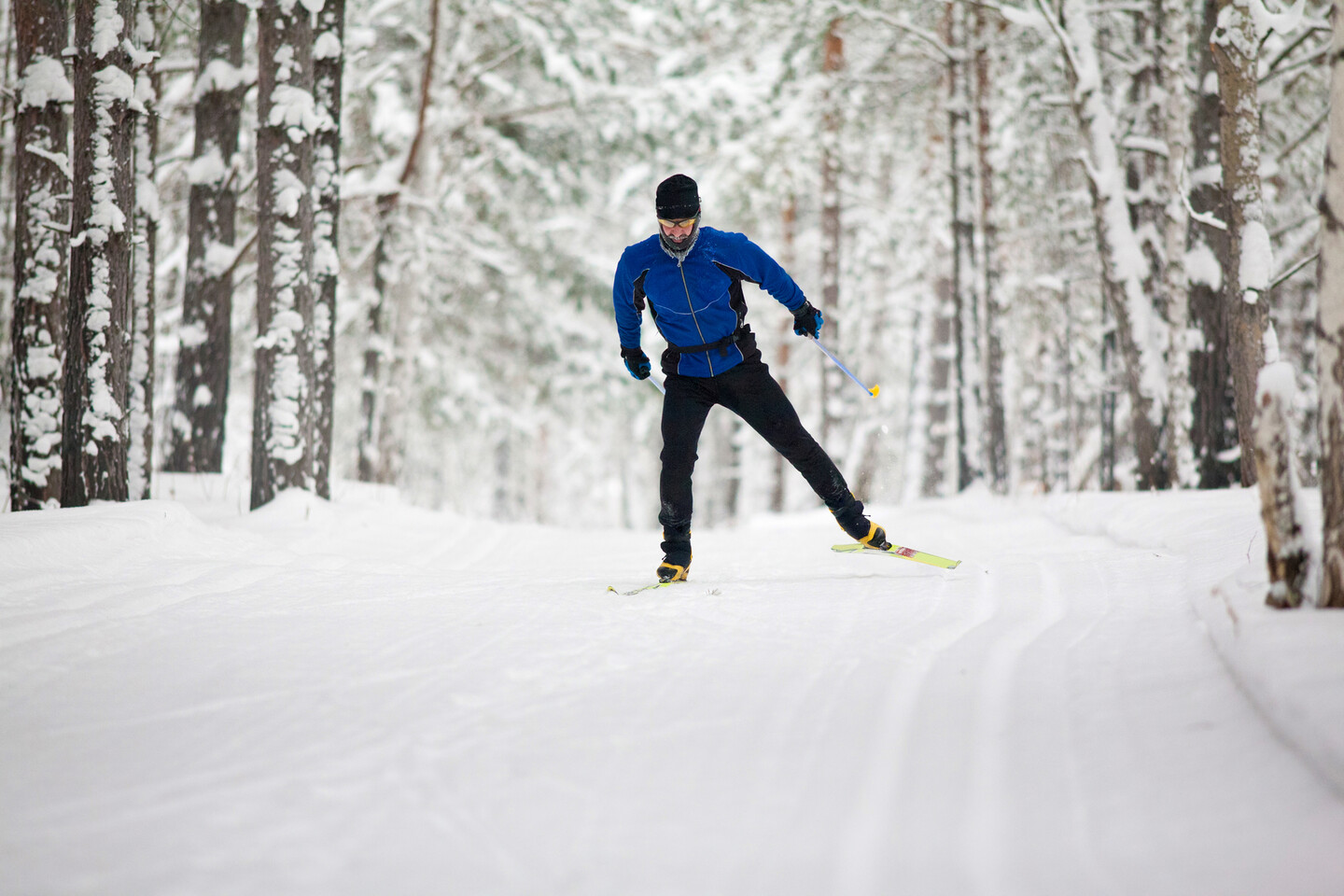
Tips for beginners: Many newcomers should bear the following cross-country skiing tips in mind, as most tend to dress too warmly for the trail. It is therefore important to wear clothing that insulates even when damp and wicks away sweat effectively. To start with, existing running or cycling gear, a functional shirt and a light windbreaker are often sufficient. However, those who hit the trails more frequently should opt for specialist cross-country skiing clothing that is breathable and windproof, thus offering optimal freedom of movement.
- Safety tips: When cross-country skiing, winter sports enthusiasts should always carry a mobile phone and a trail map for orientation in case of emergencies. A rucksack or a hydration belt is useful for carrying water, energy bars and your smartphone.
Preparation and training
Fitness training
Jogging or running: Regular running training strengthens the heart and circulation, with just two to three 30-minute sessions per week significantly improving basic endurance. Alternatively, Nordic walking is also a good option here, as it uses and strengthens the legs and arms in a similar way to cross-country skiing.
Cycling: Riding a bike trains the leg muscles and improves endurance without putting strain on the joints. Mountain biking on hilly terrain, in particular, closely mimics the physical demands of cross-country skiing.
Swimming or rowing: As holistic forms of endurance training, they also build up fitness and, in some cases, arm strength, which is helpful for cross-country skiing.
Roller skis or inline skating: In principle, roller skis are cross-country skis on wheels for the summer, allowing you to practise the skating or classic technique on tarmac. Inline skates also allow you to train similar muscle groups to those used in skating cross-country skiing and strengthen your balance as well as your leg and gluteal muscles.
- Strength endurance: This is particularly crucial for the arms, shoulders and core when using the double-pole push. Effective exercises include planks, push-ups, pull-ups, crunches and back extensions. Exercises using resistance bands also simulate the use of poles and train the pulling movement central to cross-country skiing.
Technique training and courses
A cross-country skiing course is highly recommended for beginners, as cross-country instructors teach the correct posture, weight transfer and coordination of arm and leg movements. This allows basic techniques such as the diagonal stride, the double-pole push or the skating rhythm to be learnt quickly. Those who do not wish to attend a course, however, can also learn the technique on their own, for example using videos or books.

Please also note that by using our services and integrating the YouTube API Services, the YouTube Terms of Service and the YouTube API Services Terms apply and your use of our website is deemed to be acceptance of these terms.
It is important to start on a flat trail for exercises such as gliding on one ski, push-off exercises without poles or the double-pole push. When it comes to skating, it is advisable to start with the ice skate stride without using your arms, to get the hang of the leg movement. This also applies to braking and turning techniques, where classic skiers need the snowplough to brake and the plough turn for turns, whilst skaters can practise the stop stride or the half-plough on gentle slopes. Advanced cross-country skiers, on the other hand, tend to focus on improving their efficiency during technique workshops or through video analysis, as even small adjustments – such as a flatter ski angle or a longer push-off – can enhance their technique.
Warm-up and stretching
As with many sports, even a light warm-up helps to prevent injuries. Before setting off on the trail, 5 to 10 minutes of light jogging, jumping jacks or high-knee runs in cross-country boots are sufficient to get the circulation going. Afterwards, the arms and legs are mobilised with circles and squats. Specifically for cross-country skiing, leg swings are also suitable for loosening the hips and thighs. Lunges with a springy movement also stretch the thighs and groin. On the trail, the first few metres at a slow pace are ideal for adjustment, such as double-pole pushes without using the legs.
After cross-country skiing, the muscle groups that have been worked should be stretched, including the calves, quadriceps, hamstrings, glutes, triceps, and the shoulder and neck areas. Here, 15 to 20 seconds per muscle group is sufficient. Classic stretching exercises such as the lunge with a straight leg for the calves and hip flexors, or pulling the foot towards the buttocks whilst standing for the front of the thighs, are best for this.
Safety and behaviour when cross-country skiing on the trail
FIS rules of conduct for cross-country skiers
Consideration for others: As in the 10 FIS rules for skiers, cross-country skiers must behave in such a way that they do not endanger or harm anyone on the trail. In particular, slower or inexperienced skiers must not be rushed.
Signage and direction of travel: Markings, signs and trail instructions must be strictly observed, whilst on signposted circuits or one-way trails, the prescribed direction of travel and the specified skiing technique must be adhered to.
Choice of lane: On trails with multiple lanes, skiers must always use the right-hand lane, and groups must ski one behind the other, not side by side. The same rule applies to skating trails: keep to the right, especially in the presence of others.
Overtaking: Overtaking is permitted on both the right and the left, but the skier ahead has right of way and the skier being overtaken is not obliged to give way, though they should do so if it is possible without risk.
Oncoming traffic: When meeting head-on, both parties should give way to the right. Those travelling downhill have right of way over those travelling uphill, as those going downhill are less able to give way.
Pole handling: When overtaking, being overtaken or meeting others, poles should be kept close to the body to avoid injuring anyone.
Adjusting speed: Every cross-country skier must adapt their speed and skiing style to their own ability, the terrain, the volume of traffic and visibility. In addition, a sufficient safety distance must be maintained and, if necessary, it is better to fall yourself than to risk a dangerous collision.
Keep the tracks clear: Anyone who stops should step out of the track and take their breaks at the edge of the track or at designated areas so that skiers behind can pass unhindered. Furthermore, skiers who have fallen must clear the track as quickly as possible.
Assistance: In the event of accidents, cross-country skiers, like all sportspeople, are obliged to provide assistance. This means: administering first aid, providing warmth and – if necessary – calling for professional help.
Obligation to provide identification: Anyone involved in an accident, whether as the person responsible, a participant or a witness, must subsequently provide their personal details. This means that in the event of an accident on the trail, cross-country skiers should remain at the scene and exchange their details or wait for the ski patrol.
Correct behaviour in the event of accidents
Keep calm: Do not panic; instead, check whether anyone is injured.
Secure the accident site: If someone falls on a downhill trail, following cross-country skiers must be warned. Warning signs could include poles arranged in a cross in the snow above the accident site, or a skiing partner waiting a few metres ahead of the accident site to slow down oncoming skiers.
Administer first aid: As is the case everywhere, first aid must be administered in the event of injuries. Many cross-country skiers have basic first-aid knowledge. This enables them to treat bleeding wounds or place an unconscious person in the recovery position. In winter conditions, injured people must always be kept warm and protected from hypothermia.
Call the emergency services: In most cross-country skiing regions, trails are signposted with their numbers and emergency points. Using a smartphone, the emergency services must be alerted via the emergency number 112, and the location and condition of the injured person must be described in detail.
Stay with the injured person: Injured people must not be left alone until further help arrives. Leaving them alone is only acceptable if a cross-country skier has to go and get help and there is no one else on site.
Accident report: In the event of major accidents, such as where there are injuries following a collision, a brief report should be made at the scene. This means exchanging personal details and describing exactly what happened.
Europe’s best cross-country skiing regions
The choice of trails ranges from the German low mountain ranges and the Alps to Scandinavia, covering several thousand kilometres. Reason enough for SnowTrex to highlight which routes are suitable for beginners, families or the more ambitious, and where the cross-country skiing regions in Europe can be found.
How to make your cross-country skiing holiday a success
Travel planning and accommodation
The first step in planning a relaxing cross-country skiing holiday is, of course, choosing your destination. So if you’re looking for an extensive network of trails, cross-country skiing centres such as Seefeld, the Engadin or the Allgäu are the right choice. Smaller cross-country skiing areas, on the other hand, offer peace and quiet and a family-friendly atmosphere. For guaranteed snow, the high-altitude regions of the Alps are naturally always a good choice, whilst low mountain ranges such as the Ore Mountains score points for lower prices and less hustle and bustle. Furthermore, the journey itself is a crucial factor, as many places are accessible not only by car but also by bus and train. The Engadin in Switzerland, for example, is easily reached by panoramic trains.
When it comes to accommodation, winter sports enthusiasts should also look into hotels and guesthouses specialising in cross-country skiing. Some of these are located right next to the trails and offer ski-in/ski-out facilities, waxing rooms, drying facilities and guided tours. And, of course, these accommodations can also be booked via SnowTrex. Generally speaking, cross-country skiing holidays are also cheaper than downhill skiing holidays, as there is no need to buy ski passes. When booking, fans of Nordic skiing should also be sure to check the current time of the season, as popular cross-country skiing destinations, particularly in the Alps, are in high demand during the Christmas holidays and in February. In contrast, quieter conditions and better deals are available in January or March.
In the cross-country skiing regions, there are many ski hire shops, sports shops and trail centres with changing rooms and showers. And although trail fees may apply in some places, these are included in day or week passes. In Scandinavia, as well as in many parts of Austria and Germany, however, use is free of charge, as it is funded by tourism levies. Combined tickets or guest cards are particularly handy here. As well as access to the trails, these also include use of buses or entry to swimming pools. It is also advisable to plan in rest days or alternative activities, such as winter walks, toboggan runs or a change of scenery in ski resorts.
→ Find accommodation for your cross-country skiing holiday with SnowTrex now
Equipment on site – hire and purchase
If you don’t own a full set of cross-country skiing equipment yourself, you’ll face a decision: hire or buy. For beginners, we recommend hiring locally to start with. This offers many advantages, such as being able to try out different types of skis and boots without having to invest in your own equipment straight away. It also means you don’t have to transport bulky skis in your car or on the train. Ultimately, rental companies always offer well-maintained equipment in sets comprising skis, boots and poles at reasonable prices.
On the other hand, anyone who wants to hit the trails regularly should definitely consider buying their own equipment. And it is precisely for this purpose that winter sports shops in cross-country skiing regions offer a wide selection of equipment and expert advice. In some cases, winter sports enthusiasts can test the cross-country skis there directly before the sales assistant deducts the hire fee from the purchase price. Those who decide to buy skis can store their cross-country equipment upright in a dry place in the cellar. What’s more, it’s easier to transport than alpine skiing equipment. This means that when buying cross-country skiing equipment, you should pay particular attention not only to the correct sizes of poles and skis but also to the boots and how they fit. As winter sports enthusiasts wear their boots for many hours at a time, they should be comfortable and offer sufficient room for the toes. High-quality insoles or warm socks are also a sensible addition, whilst pressure points should be avoided at all costs.
When it comes to cross-country skiing clothing, athletes can purchase essentials such as base layers, gloves or hats in advance at reasonable prices. Sports shops in cross-country skiing centres offer a wide selection of jackets and trousers. However, these are often more expensive than online offers or specialist retailers back home. Yet, those who value expert advice or need to buy additional items will also find suitable options locally.
Other winter activities besides cross-country skiing
Alpine skiing and snowboarding: In most destinations such as Seefeld, Oberstdorf or the Pillerseetal, there are excellent ski resorts alongside the cross-country trails. This means that both alpine and Nordic enthusiasts can get their money’s worth in the immediate vicinity, hitting the slopes for a few runs in the morning and enjoying a leisurely cross-country session in the afternoon. Some resorts offer combined ski passes for this, where use of the cross-country trails is often included free of charge or at a discount.
Winter walking and snowshoeing: Cross-country skiers who fancy exploring the winter landscape without skis can also take a stroll along cleared winter walking trails in the ski resorts or trudge cross-country on snowshoes. This is the perfect complement to cross-country skiing, as it works different muscle groups and brings you closer to nature.
Sledging: A proper sledge ride is fun for the whole family, and so there are sledge runs in many places, some of which can be reached by gondola or on foot, offering a rapid descent of several kilometres into the valley. In the evenings, the runs are usually lit up, allowing you to combine them with a cosy stop at a mountain hut away from the cross-country trails.
Trying out biathlon: In cross-country skiing strongholds such as Oberhof or Seefeld, winter sports enthusiasts have the chance to get a taste of biathlon for themselves. They can, for example, take part in a taster course using a laser rifle or small-bore rifle at a guest biathlon shooting range. It is an exciting experience, particularly for cross-country skiers, to do more than just hit the trails on skis.
Relaxation and wellness: After strenuous kilometres on the trails, relaxation is just what the doctor ordered, and cross-country skiers are sure to find it in hotels with wellness facilities. Alternatives include public water parks, saunas or thermal spas, such as the Aqua Dome in Längenfeld in the Ötztal (Tyrol) or the Erlebnistherme Fügen in the Zillertal. After all, a proper sauna session or a hot bath is particularly effective at helping the muscles, strained by cross-country skiing, to recover.
Cultural excursions: A cross-country skiing holiday doesn’t always have to be 100 per cent about sport if there’s an interesting museum or a place worth seeing, such as a monastery or a historic old town, waiting along the trail. This means you can plan half a day for culture or shopping. In the Zillertal, for example, there are show dairies or the Erlebnistherme, and in the Allgäu the famous royal castles.
FAQ on cross-country skiing
What equipment do cross-country skiing beginners absolutely need?
To get started, all you need are cross-country skis with bindings, suitable boots and poles, which can be hired in almost all regions. To complement this basic kit, cross-country skiers should wear functional winter clothing based on the ‘layering’ principle: breathable base layers, a mid-layer, and a windproof jacket and trousers. This also includes a hat, gloves and, if necessary, sports goggles. Beginners do not need to buy expensive competition skis; hire equipment or models with scales or skins are sufficient. For their first attempts, cross-country skiers can also wear normal winter clothing. However, it is important not to dress too warmly, as cross-country skiing is an intense and sweaty activity.
Classic or skating style – which is easier to learn?
The classic technique is generally easier for beginners. This is because it resembles natural walking and the track provides stability. Skating, on the other hand, requires more coordination and stamina, as the sideways skating stride is more demanding. Many therefore start with the classic technique and switch to skating later, once they have built up basic fitness and a feel for the technique. Those with sporting ambitions can also start directly with skating, ideally by taking lessons. If you’re unsure, it’s best to try out both styles. One variation is Nordic cruising, where wider skis provide greater stability. Classic skiing is about experiencing nature and enjoyment, whilst skating is about speed and a sporting challenge.
How strenuous is cross-country skiing compared to downhill skiing?
Cross-country skiing is more strenuous than downhill skiing, as you have to propel yourself forward continuously using your own strength and there are no breaks on the lifts. You also keep moving downhill, albeit at a slower pace. The intensity can be adapted to your fitness level. This means you can glide leisurely along flat trails or train intensively on hilly terrain. For beginners, even 5 to 10 km is challenging, whilst experienced skiers regard 20 km as a normal training session. Cross-country skiing is considered one of the most effective endurance sports; it burns plenty of calories and strengthens the heart and circulation. The classic style in particular, with its smooth, rhythmic movements, provides a pleasant sensation without being too demanding.
Can winter sports enthusiasts also go cross-country skiing with alpine ski poles and clothing?
Alpine poles are too short for cross-country skiing, as they usually only reach up to the armpit. For the classic technique, the poles should reach up to the shoulder; for skating, up to the chin or nose. Furthermore, the straps and baskets differ. Cross-country skiers can use alpine poles for the first few metres, but should ideally choose specialist equipment or hire poles. There are also differences in clothing: alpine ski jackets and trousers are often too thick and not very breathable. Softshell or running jackets, as well as thermal running trousers with thin overtrousers, are more suitable. Cross-country skiers can use hats and gloves from alpine skiing, but should ensure that they provide sufficient grip for prolonged use of the poles.
Do winter sports enthusiasts have to pay trail fees, and where can they find information on trail conditions?
Whether a trail fee applies depends on the region. In many German low mountain ranges and parts of the Alps, local authorities provide the trails free of charge and finance them partly through visitor’s tax. In top cross-country skiing centres, fees are often charged or passes are offered. Examples include the “Loipenpass Schweiz” (for 160 Swiss francs per season) or day and week passes in places such as Seefeld. Tickets are available online, in sports shops or from ticket machines at the trailhead. Information on trail conditions can be found on tourist information websites, via traffic light-style trail reports or on online platforms. Apps, information boards and tips from locals or equipment hire shops also help with navigation.

