
Ski touring appeals to outdoor enthusiasts, winter sports enthusiasts, mountaineers and nature lovers alike. This unique winter sport combines physical challenge with the tranquillity and beauty of untouched winter landscapes. From gentle hills to challenging peaks, ski touring offers the right challenge for every fitness level. As an expert in winter sports holidays, SnowTrex provides comprehensive information in this article about the basics, the necessary equipment and helpful tips for a safe and enjoyable ski touring adventure.
Basics of ski touring
What is ski touring?
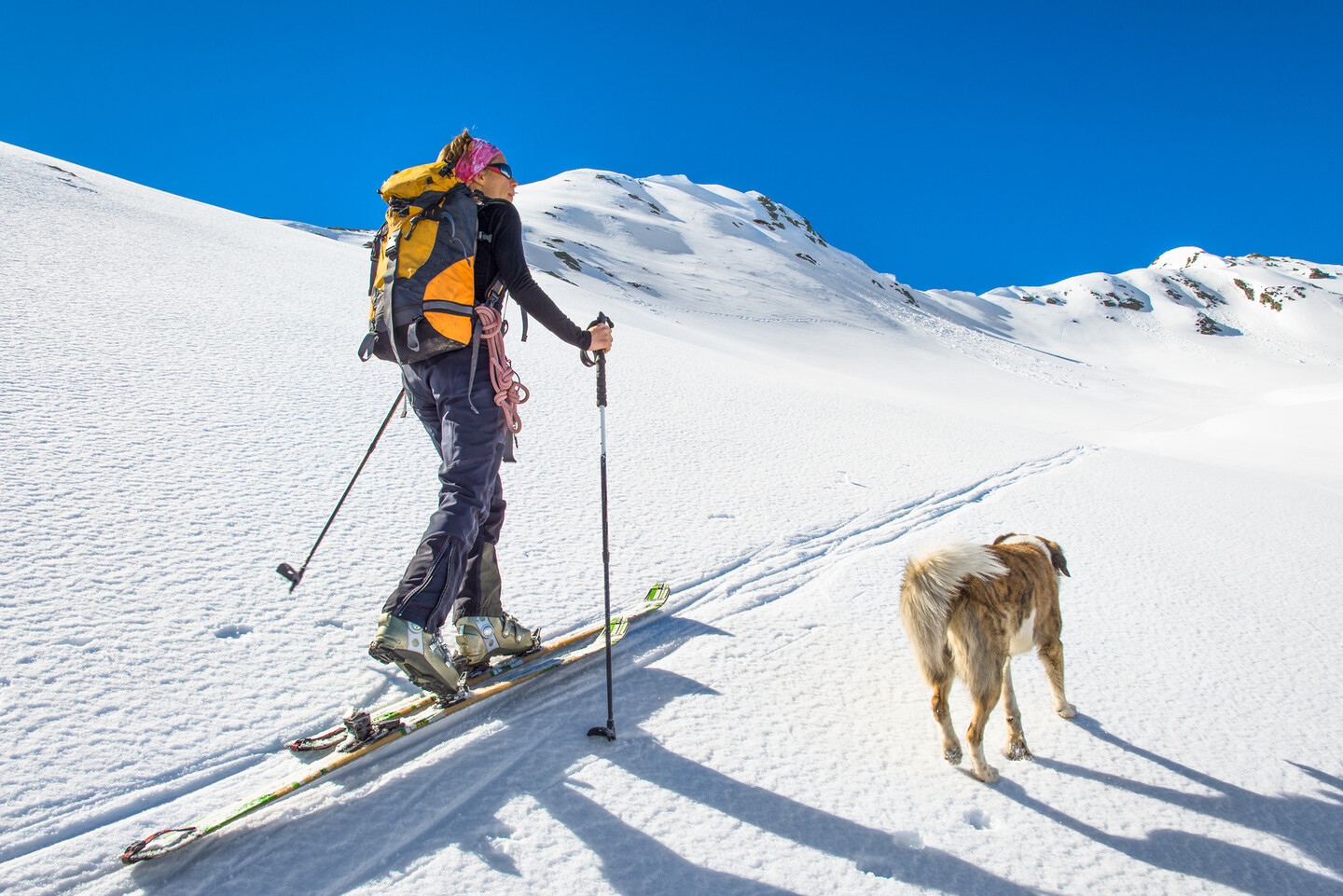
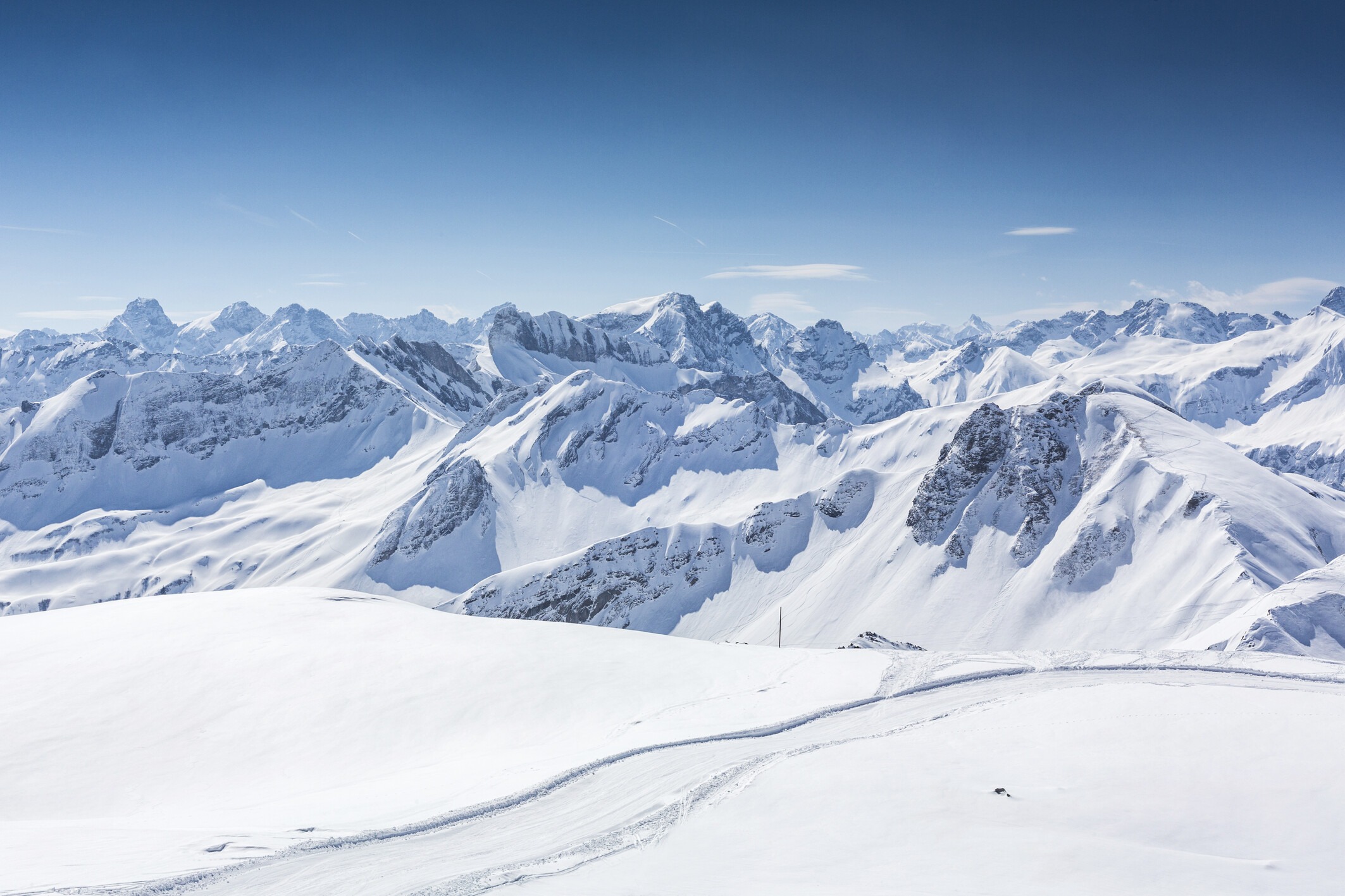
In contrast to classic alpine skiing, ski tourers venture away from groomed slopes. The ascent is done under your own steam with touring skis and special climbing skins, and the descent is usually in untouched terrain. The special appeal of ski touring lies in the feeling of absolute freedom. At the same time, this nature-oriented winter sport is environmentally friendly, as no lifts are required. For many, consciously foregoing infrastructural aids presents a new challenge that is rewarded with a unique sense of achievement.
Trend ski touring
Ski touring has developed into a real trend sport in recent years. Winter sports enthusiasts who are looking for peace and quiet and an experience of nature in particular will find an alternative to crowded ski slopes here. According to the German Alpine Club (DAV), there are now over 600,000 active ski tourers in Germany alone (as of 2024) – impressive proof of the growing popularity of this sport. What is particularly fascinating is climbing in the snow with the aim of experiencing an untouched deep-snow descent. The concept of sustainability also plays a role here, as many ski tourers appreciate this environmentally friendly way of travelling.
Advantages and challenges
The advantages of ski touring lie in the combination of sporting activity and an intense experience of nature. The conscious decision not to use lifts makes this sport sustainable and environmentally friendly. At the same time, however, ski touring also places demands on technique, fitness and safety awareness. In particular, orientation in open terrain and dealing with changing snow conditions require experience. In addition, team spirit is strengthened as the group assesses risks and makes decisions together.
Safety aspects and risk management
Safety plays a central role in ski touring. Carrying avalanche equipment (avalanche transceiver, shovel, probe) is just as mandatory as knowledge of avalanche warning levels and weather conditions. Beginners in particular benefit from ski touring courses or being accompanied by experienced mountain guides. Courses on how to use the equipment and avalanche awareness are essential to ensure safety. It is also important to be able to interpret snow profiles correctly and recognise danger spots.

Fitness requirements and preparation
Good physical condition and strength endurance are important prerequisites for ski touring. Regular training such as jogging, hiking or cycling, as well as ski gymnastics, are the best way for winter sports enthusiasts to prepare for a tour. Beginners should start with short, easy tours to slowly get used to the physical demands. In addition, it is advisable to incorporate specific strengthening exercises for the legs and core into your training plan to ease the strain during ascents and descents.
The right equipment for ski touring
The right equipment is crucial for ski touring and can save lives in an emergency. An avalanche transceiver, shovel and probe are part of the basic equipment, as there is a risk of avalanches both during the ascent and descent. An avalanche airbag rucksack provides additional protection by minimising the risk of being buried. In addition, a mobile phone and a first aid kit should be carried to be prepared for emergencies. Suitable ski touring poles and a helmet are also essential to ensure safety and stability in demanding terrain.
Touring skis and bindings
Touring skis are lighter than conventional downhill skis and equipped with special bindings that make climbing easier. A maximum weight of 1.5 kg per ski is ideal to prevent your legs from tiring quickly, especially on longer tours.
The shape of touring skis is also crucial: a waist width of 85-95 mm is considered optimal, as it allows for balanced handling in both deep snow and on hard surfaces. Wide tips provide good floatation in powder, while a narrower waist increases stability. These characteristics make them versatile and ideal for different types of terrain.
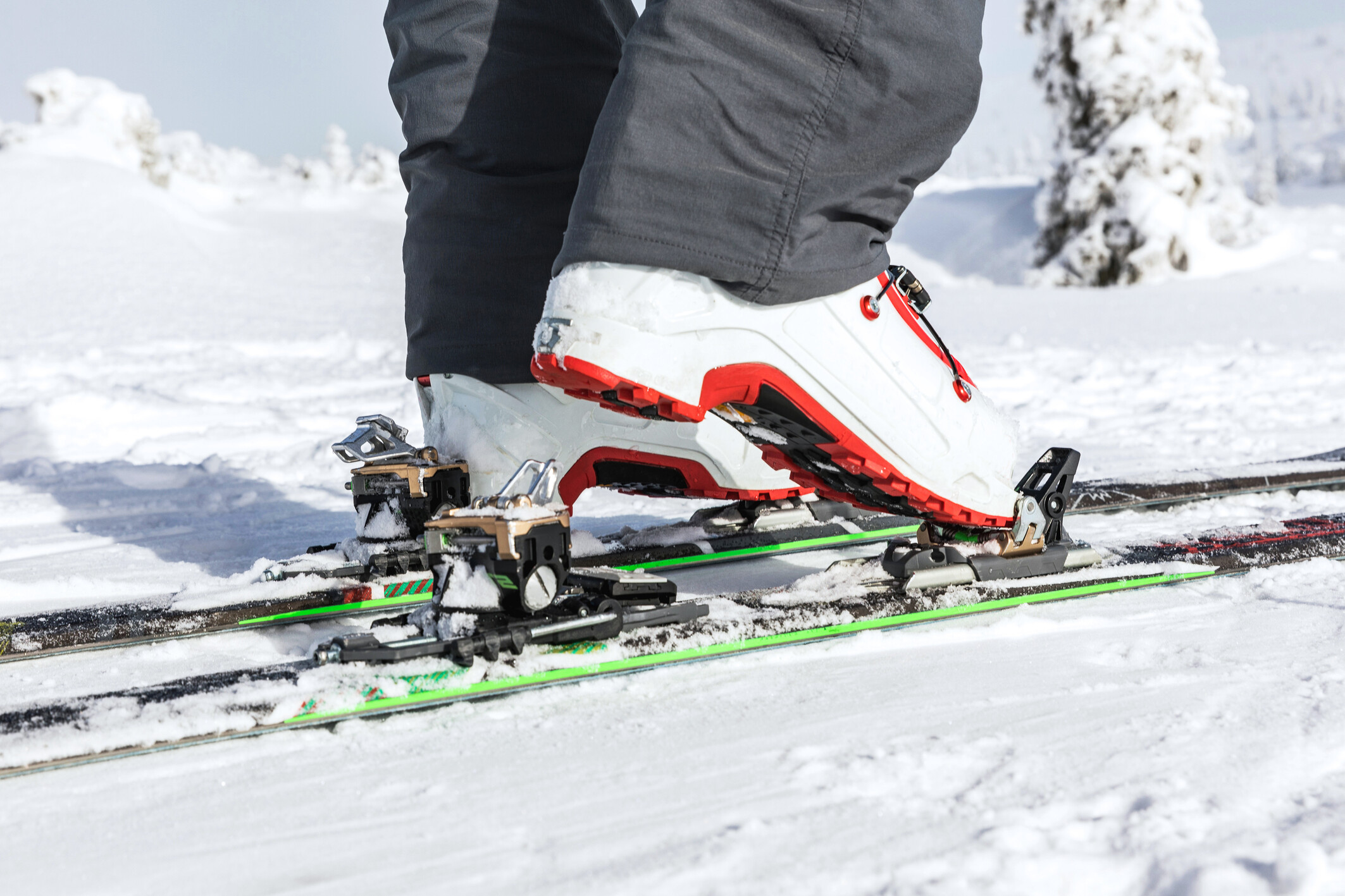
The touring binding allows for efficient ascent thanks to the free heel, as the ski does not have to be lifted with every step. Models from manufacturers such as Salomon or Marker are often designed for downhill performance with high Z-values, which can make the ascent more difficult. Ski tourers should therefore choose their bindings depending on whether they focus on easy ascent or optimal downhill performance.
Ski touring equipment differs depending on whether the focus is on ascent or descent. For a comfortable ascent, skis and bindings should be as light as possible, yet robust enough for the descent. Ascent-oriented bindings, such as ultra-light models with a Pintech system, enable energy-saving ascents thanks to their free heel. These often weigh only around 350 g, but require special ski boots.
Touring ski boots
Ski boots play a crucial role in comfort and performance when ski touring. Touring ski boots must be lightweight to facilitate the ascent, but at the same time provide sufficient stability for the descent. A good pair of touring boots weighs around 1 to 1.5 kg per boot.
Most models feature a ski-walk mechanism that extends the range of motion of the boot in walk mode to 55 to 65°. This makes the ascent much easier.
For the descent, a flex value of at least 110 to 130 should be chosen to ensure sufficient stability. Individually adjustable inner boots increase comfort and improve the fit.
Ski touring poles
Ski touring poles are an indispensable aid for ascents and descents. They should be slightly longer than classic alpine poles in order to make optimum use of the thrust during the ascent. Telescopic poles made of aluminium or carbon that are adjustable in length are particularly practical, as they can be individually adjusted and folded up compactly for the descent. Ski touring poles should also be equipped with large, stable basket feet so that they do not sink into deep snow. Ergonomically shaped handles and hand straps increase comfort and provide additional support on steep passages.
Avalanche transceiver, probe and shovel
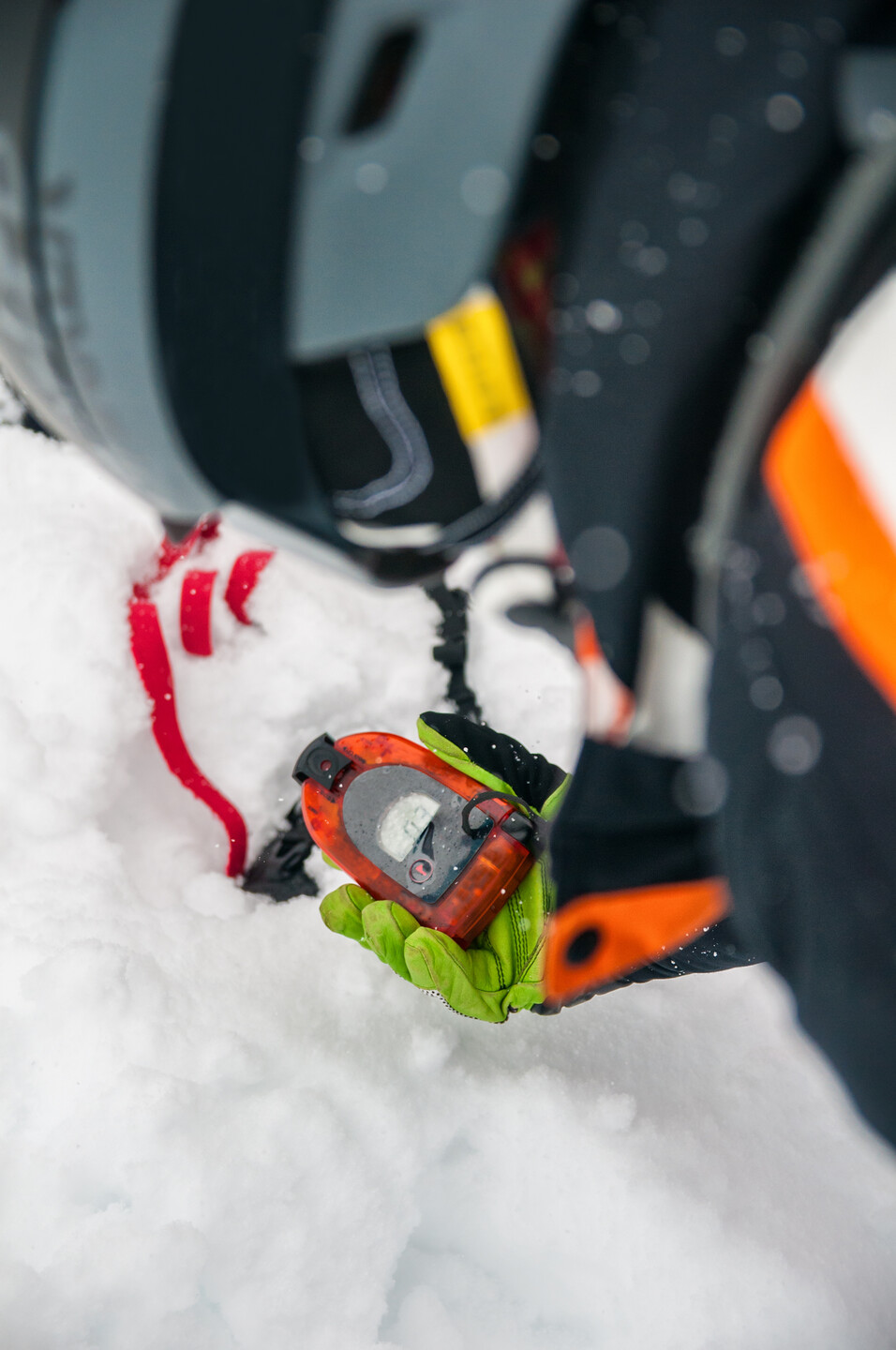
An avalanche transceiver (LVS) emits signals that are used to locate people buried in an avalanche. Before using an avalanche transceiver, the owner should understand how it works and practise regularly so that they can act quickly and efficiently in an emergency. Modern devices have a range of 40 to 80 metres.
Avalanche probes are used to determine the exact location and depth of the buried person. They should be between 240 and 320 cm long. With a little practice, the consistency of the snow can be used to determine whether the buried person is at the probed location.
Finally, the shovel is used for quick and precise rescue. Aluminium shovels weigh between 300 and 600 g and are light and robust, ideal for use in extreme conditions.
Avalanche rucksack with airbag
An avalanche rucksack significantly increases your chances of survival in an avalanche. The integrated airbag inflates quickly within 1 to 3 seconds, providing buoyancy and preventing you from being buried. It is important that the airbag is triggered manually immediately after the avalanche occurs. Modern models have additional storage space with a volume of 20 to 35 litres and ergonomic carrying comfort, making them an indispensable companion. In addition to the airbag, the rucksack should also have space for a first aid kit and a mobile phone.

Ski touring helmets
Ski touring helmets protect against rockfall, falls and avalanches. Good models are lightweight, well ventilated and very sturdy. They are an essential piece of safety equipment. In addition, many helmets can be equipped with headlamps, which makes them particularly useful for early starts or late returns.

Clothing
The right clothing consists of several layers (onion principle):
- Base layer: Breathable functional underwear
- Middle layer: Insulating clothing such as fleece or softshell
- Outer layer: Weatherproof hardshell jacket and trousers
Gloves, hat, ski goggles and helmet are also essential. A change of clothes for the descent should always be carried in your rucksack. Sunglasses with UV protection are also particularly important at higher altitudes.
Important: You should also take sufficient fluids and energy-boosting snacks with you on the tour.

Ski touring for beginners
Beginners should undertake their first ski tours with an experienced mountain guide. This not only helps with orientation, but also with learning the technique and how to use the equipment safely. Numerous ski and alpine schools organise taster courses and guided ski tours of varying degrees of difficulty. The specially trained mountain guides have the necessary knowledge of avalanches, topography and slope conditions to ensure that ski tours for beginners are optimal and safe.
Snow enthusiasts who want to spend several days on the slopes can book ski touring camps instead of day tours. These teach beginners and advanced skiers the basics of ski touring and ensure an educational experience in a beautiful setting.
Ski touring areas & popular ski tours in the Alps
Ski tours in Austria
Austria has a large number of ski touring areas that will delight both beginners and experienced tourers. The Brandnertal valley offers well-marked routes such as the Hinterjöchle circuit, which is characterised by breathtaking panoramas and moderate requirements. The Dachsteinrunde, on the other hand, is a challenge for experienced tourers who want to experience alpine landscapes and technically demanding passages of the Hoher Dachstein. Regions such as the Zillertal also stand out for their excellent infrastructure with huts and mountain railways, which make it easier to get started.

Ski touring in Switzerland
Switzerland is a paradise for ski tourers and offers numerous classics, including the Valais Haute Route from Chamonix to Zermatt. This multi-day tour leads through impressive glacier landscapes and requires a high level of technical skill and fitness. The Bernese Oberland also attracts visitors with spectacular routes such as the tour to the Sustenhorn, which rewards you with magnificent views of the surrounding peaks. For beginners, we recommend the area around Andermatt, which offers varied and less demanding tours.

Ski tours in Germany
The Chiemgau Alps in Germany offer a variety of tours for every level of ability. The route to the Unternberg is ideal for beginners, with easy orientation and gentle slopes. More demanding tourers will find a rewarding challenge on the Hörndlwand: the route requires technical skill and fitness, but rewards you with magnificent views and an exciting descent. Thanks to their easy accessibility and a variety of marked routes, the Chiemgau Alps are a popular destination for day trips.
Ski touring in Italy
Italy delights ski tourers with a wide range of options, especially in the Dolomites. The ski tour to the Eisseespitze in the Ortler Alps combines gentle climbs with impressive panoramas and is particularly popular with leisurely tourers. The Sellaronda in the Dolomites promises a unique experience with views of imposing rock formations and is also a highlight for experienced ski tourers. In addition, regions such as South Tyrol with their cosy huts and culinary specialities invite you to enjoy relaxed and enjoyable tours.
Ski touring packing list
The most important things at a glance:
Equipment
- Touring rucksack or avalanche rucksack
- Touring skis
- Touring ski boots
- Skins
- Ski helmet
- Ski goggles
- Sunglasses
- Touring poles
- Headlamp
- Crampons, if necessary
Avalanche equipment
- Avalanche shovel
- Avalanche probe
- Avalanche transceiver
- Bivouac sack
- First aid kit
Clothing
- Touring trousers & jacket
- Thin gloves for the ascent
- Ski gloves for the descent
- Fleece jacket
- Functional underwear
- Technical socks
- Hat or headband
- Scarf or neckerchief
- Change of clothes
Miscellaneous
- Maps
- Avalanche report
- Mobile
- Sunscreen with high sun protection factor
- Lip balm with sun protection factor
- Water bottle
- Snacks/energy bars
- Tissues
- Small rucksack
- Cash (in local currency, if applicable)
- Identity card
- Alpine Club membership card
- International health insurance documents
- Travel documents and vouchers
- Power bank
- Small rubbish bag
When staying overnight at the hut
- Hut sleeping bag
- Hut shoes
- Earplugs
- Toiletry bag
- Towel
- Change of clothes
Frequently asked questions
What is the most important equipment for ski touring?
The most important equipment consists of touring skis, bindings, skins, avalanche transceiver, shovel and probe. In addition, an avalanche backpack and weatherproof clothing are essential.
How do I plan a safe ski tour?
A safe ski tour requires studying the weather and avalanche reports, choosing a suitable route and using the right equipment. Beginners should undertake tours with experienced mountain guides.
Which ski touring areas are suitable for beginners?
In Austria, for example, the Feldalphorn (1,923 m) in Wildschönau is an ideal ski tour for beginners with gentle climbs and a magnificent summit panorama. In Germany, the Hirschkaser tour (1,390 m) in the Berchtesgadener Land offers an easy introduction with moderate gradients. In Italy, the Seiser Alm in South Tyrol is recommended as it has wide slopes with a gentle gradient. In Switzerland, the Nätschentour near Andermatt is suitable because of its easy and avalanche-safe sections.
When is an avalanche airbag triggered?
The avalanche backpack should be triggered the moment the ski tourer is caught up in the snow masses of an avalanche. The airbag inflates within 1-3 seconds and, ideally, provides buoyancy that prevents burial.
What is the difference between a touring ski and a classic piste ski?
Touring skis are lighter, more flexible and optimised for ascents. Piste skis are designed for downhill skiing on groomed slopes.

