
The allure of skiing – millions of winter sports enthusiasts are captivated by it every year, from professionals to beginners alike. For newcomers, getting to grips with the correct skiing technique can be a particular challenge. But SnowTrex knows that with the right guidance and a little practice, beginners can quickly make progress on the slopes and explore fantastic ski resorts.
Basic skiing techniques for beginners
The correct posture is absolutely essential
Relaxed skiing starts with the correct basic stance for the whole body. Footwork is particularly important here: the knees must be slightly bent, and weight should be distributed evenly between both legs. To achieve this, keep your ankles flexible at all times to optimally compensate for uneven terrain. Active legwork allows you to react perfectly to bumps on the piste or other situations.
Correct posture is supported by keeping the upper body upright yet slightly leaning forwards, ensuring optimal balance and control of the skis. It is also important to keep the shoulders parallel to the slope, the head upright and the arms held out to the sides of the body, roughly at hip height. And last but not least, the dynamic sequence of movements whilst skiing is complemented by holding the ski poles loosely, which also helps to maintain balance.
First the snowplough, then the parallel turn
The snowplough skiing technique, also known as the ‘pizza’, is the foundation for beginners. Here, the tips of the skis are turned inwards, whilst the tails point outwards. This creates a wide, stable base, whilst the width of the ‘pizza slices’ allows you to regulate your speed on the slope perfectly whilst skiing. However, as you don’t always ski in a straight line on the piste, you’ll also need to master turning.

Please also note that by using our services and integrating the YouTube API Services, the YouTube Terms of Service and the YouTube API Services Terms apply and your use of our website is deemed to be acceptance of these terms.
To achieve this, you first shift your weight onto the ski on the outside of the turn, accompanied by a slight turn of the upper body in the direction of travel. Beginners who feel confident with this sequence of movements can then slowly move on to parallel turns. To do this, they gradually reduce the angle of the snowplough technique, whilst ensuring that their weight is distributed evenly at all times. And anyone who finds themselves going too fast with the smaller ‘pizza slice’ may – or indeed must – learn how to brake whilst skiing!
It’s essential to master braking techniques
The simplest technique at this stage is always snowplough braking. This involves pulling the tips of the skis apart evenly, applying pressure to the inner edges of both skis and distributing your weight centrally over the bindings, which allows for controlled braking whilst skiing to a complete stop, even on steeper slopes. And if it’s already too late for that, the only thing that really helps in these situations is to let yourself fall. However, the correct technique is extremely important here too. Beginners who, at this point, position their skis perpendicular to the slope, lean their body towards the side of the slope, roll down compactly and keep their skis and poles close to their body will thereby reduce the risk of injury.
Equipment and safety for beginner skiers
The ideal skiing equipment
For beginner skiers, choosing the right skis for their first runs is absolutely crucial. Advice from experienced winter sports enthusiasts or specialist staff at the ski hire shop is essential. The rule of thumb for beginners regarding ski length is that the skis should be around 10 to 20 cm shorter than your own height. In addition, a medium-width all-round ski with moderate sidecut is recommended, as this type of ski makes it easier to turn on the slopes. A soft to slightly stiff ski will also provide better control.

Please also note that by using our services and integrating the YouTube API Services, the YouTube Terms of Service and the YouTube API Services Terms apply and your use of our website is deemed to be acceptance of these terms.
The same applies when choosing the right ski boots, which should fit snugly but not pinch the ankle, shin or calf. It is also important for beginner skiers that the flex – i.e. the stiffness of the ski boot – is between 60 and 80. Furthermore, the inner boot must be adjustable and comfortable, whilst the buckles must be easy to use and secure at the same time.
Safety, safety and safety once again
Skiing is a fast-paced sport, and no skier should ever go without the right protective kit! It all starts, of course, with a high-quality ski helmet, and a back protector also offers additional protection in the event of a fall. The same applies to wrist guards, especially as the risk of falling is even higher on those very first days on the slopes. Next, a high-quality pair of ski goggles not only protects the eyes from the intense UV radiation on the mountain, but also improves visibility in various weather conditions, which further enhances safety. In addition, skiers must apply reliable sun protection even when the sky is overcast, particularly on the face, to prevent unpleasant sunburn.
As well as the right equipment, however, it is also important to behave appropriately on the slopes, for the safety of all winter sports enthusiasts. This means adhering to the 10 FIS rules for safe skiing. These include showing consideration for other people on the slopes, adjusting your speed to your own ability and the weather conditions, choosing the correct line, maintaining a safe distance when overtaking, and entering and starting off on the slopes with caution.
Practical tips for beginner skiers
Effective warm-up
The key to a successful day’s skiing is a thorough warm-up. Among the most popular and effective exercises is jogging lightly on the spot for two to three minutes to get the blood flowing. The shoulders are then loosened with gentle arm circles, whilst hip rotations improve the mobility of the torso. Squats are also particularly important to prepare the leg muscles for the stresses of skiing.

Balance training also plays a key role, and standing on one leg for 30 seconds on each leg is particularly effective. This is because standing allows you to simulate the skiing position well in advance, and the continuous shifting of weight from one leg to the other also helps develop a better sense of your body.
First steps on skis
At the start of their ‘skiing career’, beginners always have to get used to their ski equipment first. This includes practising how to fasten and unfasten their skis safely, as well as taking their first tentative steps in their ski boots. After that, the snowplough or ‘pizza’ technique is practised whilst standing still before tackling the first few metres on a flat practice slope. The next step is to head for the lifts to get up the mountain. This starts with getting on and off the magic carpet, moves on to the safe use of the T-bar lift, and concludes with learning the correct behaviour on and in the chairlift.
Developing skiing techniques
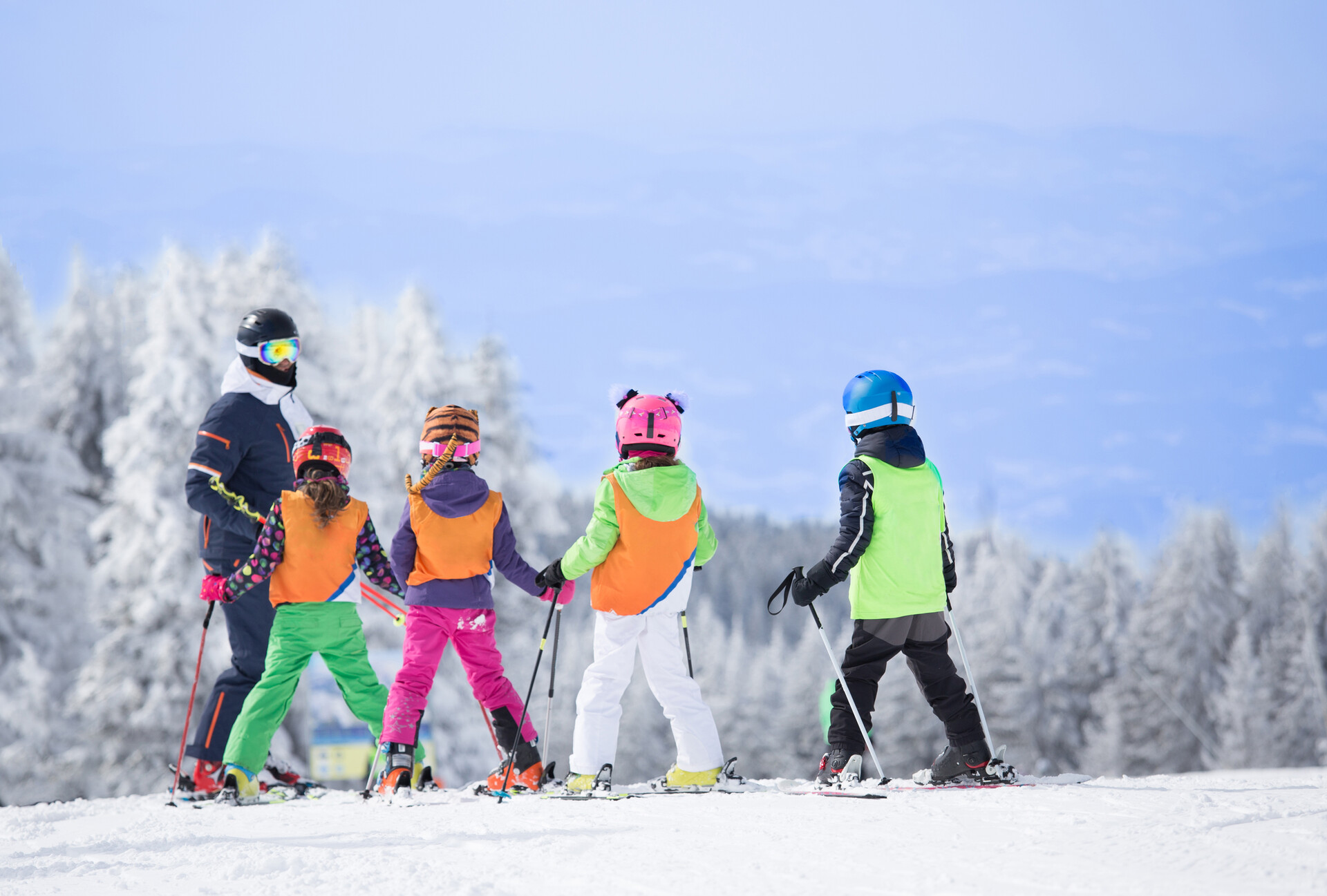
The best way to systematically build up your skiing skills is with the help of a ski instructor. This starts with learning the snowplough on flat terrain, moving on to your first changes of direction and finally to controlled braking. Specialised exercises are used to improve control. For example, the ‘pizza’ turn is first practised in various sizes, before gentle slalom runs around cones or poles help develop a feel for changing direction. The same applies to weight transfer, which is continually refined with every run, until various skiing techniques can eventually be combined fluidly. And the more confident a beginner becomes, the quicker they can work their way up to the crowning achievement: the basic turn with skis parallel.

The challenges of skiing
Beginners on the slopes face challenges time and again, there’s no question about it. To overcome them and spot sources of error straight away, there are a few things to bear in mind. For example, it is important to avoid a posture that is too rigid, as this hinders fluid movements, but this can be corrected through conscious relaxation exercises. Just as when cycling, your gaze should always be directed forwards on the slopes – and not at the tips of your skis – so that you can assess the terrain in good time.
Leaning back is also a no-go in skiing technique, as it can lead to uncontrolled acceleration. Therefore, even weight distribution and, indeed, the right speed are further keys to success. Furthermore, the mental aspect of skiing should not be underestimated. Even flat slopes can seem very steep at first, which can trigger fears – though these gradually fade away. Ultimately, a sense of achievement helps build a great deal of self-confidence, acting as a mental boost. Furthermore, a positive mindset is fostered by setting realistic goals, whilst patience during the learning process pays off in the long run.
Ski resorts for beginners
Beginners should tackle their first few metres on a slope in ski resorts that have long, wide, blue runs as well as modern, easy-to-use ski lifts. Just as important as large practice areas – so-called ‘baby slopes’ – with a gentle gradient are the many qualified ski schools located right in the resort. Among these ski resorts offering ideal learning conditions for beginners are Austrian resorts such as the Zillertal Arena, which has 12 ski schools and 150 kilometres of extensive slopes – 50 km of which are blue runs – at altitudes of up to 2,500 metres.

A hidden gem for beginner skiers is the Wildkogel-Arena ski resort, which, at an altitude of up to 2,150 m, boasts 75 kilometres of perfectly groomed slopes (35 km blue) and six ski schools. A size larger, but also beginner-friendly, is the SkiWelt Wilder Kaiser – Brixental (up to 1,869 m in altitude) with an impressive 270 kilometres of slopes, of which 114 km – almost half – are blue, as well as 12 ski schools. And at Kronplatz in South Tyrol, beginner skiers of all ages will find a total of 121 kilometres of slopes – 58 km of which are blue – at altitudes of up to 2,275 metres, with 18 ski schools.
Practical tips for your day on the slopes
Experienced winter sports enthusiasts know that planning your day in the ski resort effectively can help you make the most of a day’s skiing. That’s why even beginner skiers should make sure to head up the mountain early in the morning, when the slopes are still freshly groomed. Throughout the day, you should take regular breaks, either at a safe distance at the side of the slopes or in a ski hut. It goes without saying that you should always check the latest weather forecast and familiarise yourself with the area using the piste map.
Equally important is taking good care of and preparing your own ski equipment, which extends the life of the gear and ensures it remains in good working order. This includes having your ski bindings checked regularly by qualified staff, drying your skis at the end of the day, maintaining the edges and base, airing out your ski boots, and storing all your equipment properly when the ski season is over.
FAQ on skiing techniques for beginners
What basic techniques do beginner skiers need to learn first?
As a beginner, you’ll start with the so-called ‘snow plough’ or ‘pizza technique’, where the tips of your skis point inwards and the tails point outwards. This technique provides a stable starting position and allows you to control your speed. Once you feel confident with this, you can gradually move on to parallel turns by slowly reducing the angle of the snowplough and ensuring your weight is evenly distributed.
How important is correct posture when skiing for beginners?
Correct posture is fundamental to safe skiing. Your knees should be slightly bent, with your weight evenly distributed between both legs. Your upper body should remain upright but leaning slightly forwards. Your shoulders should remain parallel to the slope, your head upright, and your arms held at hip height to the sides of your body. Flexible ankles help to compensate for uneven terrain.
What safety equipment is essential for beginner skiers?
A high-quality ski helmet is essential to protect against head injuries. A back protector and wrist guards are also recommended, particularly in the early stages when the risk of falling is higher. High-quality ski goggles not only protect against UV radiation but also improve visibility in different weather conditions. Don’t forget sun protection for your face, even on cloudy days.
How do beginners find the right skis?
As a beginner, you should choose a ski that is around 10 to 20 cm shorter than your height. A medium-width all-round ski with a moderate sidecut is recommended, as this is easier to control. The ski should be soft to slightly stiff. Be sure to seek advice from experienced staff at the ski hire shop to find the best equipment for your ability.
Which ski resorts are particularly suitable for beginners?
Ideal ski resorts for beginners feature long, wide blue runs and modern, easy-to-use lifts. Examples include the Zillertal Arena in Austria, with 50 km of blue runs and 12 ski schools; the Wildkogel-Arena, with 35 km of blue runs; and the SkiWelt Wilder Kaiser Brixental, where almost half of the runs (114 km) are marked blue. It’s also important to have large practice areas with gentle gradients – so-called ‘baby slopes’ – and qualified ski schools on site.

