
Cross-country skiing and biathlon captivate hundreds of thousands of sports fans, particularly during the Winter Olympics. These thrilling competitions captivate spectators both live in the stadiums and at home in front of their screens. However, the rules, disciplines and, in particular, the differences between the two winter sports are not always easy to understand. So it’s time for SnowTrex to clarify the differences between cross-country skiing and biathlon and to introduce all the key disciplines of both sports.

What’s the difference between cross-country skiing and biathlon?
Cross-country skiing and biathlon are closely related winter sports in which performance on the cross-country track plays a central role in both. However, whilst cross-country skiing focuses entirely on skiing, biathlon is about optimally combining two disciplines: cross-country skiing and shooting. Nevertheless, the two sports are very similar due to their shared sporting focus. The same applies to much of the equipment. There are also parallels throughout the season, as the World Championships and the Winter Olympics are the most important highlights for cross-country skiers and biathletes in any given year, complemented, of course, by the World Cup throughout the season.
Yet, despite all their similarities, the two sports also differ significantly. And the crucial difference lies precisely in the shooting aspect of biathlon. Depending on the competition format, athletes complete two to four shooting rounds during a race, in which they must hit five targets with a small-bore rifle. Any misses result in penalty loops or time penalties. In cross-country skiing, on the other hand, only performance on the track counts.
Another difference lies in the skiing technique. In biathlon, the focus is exclusively on the skating technique, in which athletes push off sideways with their skis and then glide across the snow. In many cross-country skiing disciplines, however, the classic style is still required, in which athletes ski in parallel tracks.
Individual disciplines in biathlon
Biathlon naturally comprises various disciplines, all of which, however, involve a combination of cross-country skiing and shooting. They differ, however, in their rules, the distances to be covered and the number of participants. A basic distinction is made between individual and team disciplines, which ultimately results in different competition formats and tactical requirements.
Individual
- Distance: 20 km (men), 15 km (women)
- Shooting: four rounds (prone, standing)
- In the Olympic programme since: 1960 (men), 1992 (women)

Please also note that by using our services and integrating the YouTube API Services, the YouTube Terms of Service and the YouTube API Services Terms apply and your use of our website is deemed to be acceptance of these terms.
The individual event is the oldest discipline in biathlon. As the name suggests, athletes start one at a time and compete solely against the clock. Men cover 20 km on the cross-country course and women 15 km, spread over five laps. They visit the shooting range a total of four times, firing alternately from the prone and standing positions. Unlike in all other disciplines, there are no penalty laps for missed shots in the individual event; instead, one penalty minute is added to the finishing time for each miss. This makes shooting particularly important here, as every missed shot can have an even greater impact on the final result.
Sprint
- Distance: 10 km (men), 7.5 km (women)
- Shooting: twice (prone, standing)
- Olympic event since: 1980 (men), 1992 (women)

The sprint is the shortest biathlon discipline, with the men covering a distance of 10 km on the cross-country course and the women 7.5 km. However, there are only two shooting rounds: one prone and one standing. For every miss, the athletes must then complete a 150-metre penalty loop before they are allowed back on the course. The athletes start individually and one after the other, so that the fastest overall time determines the winner. The sprint also has special significance, as the 60 best-placed athletes qualify for the subsequent pursuit, which is always held one or two days later.
Pursuit
- Distance: 12.5 km (men), 10 km (women)
- Shooting: four rounds (prone, prone, standing, standing)
- Olympic event since: 2002
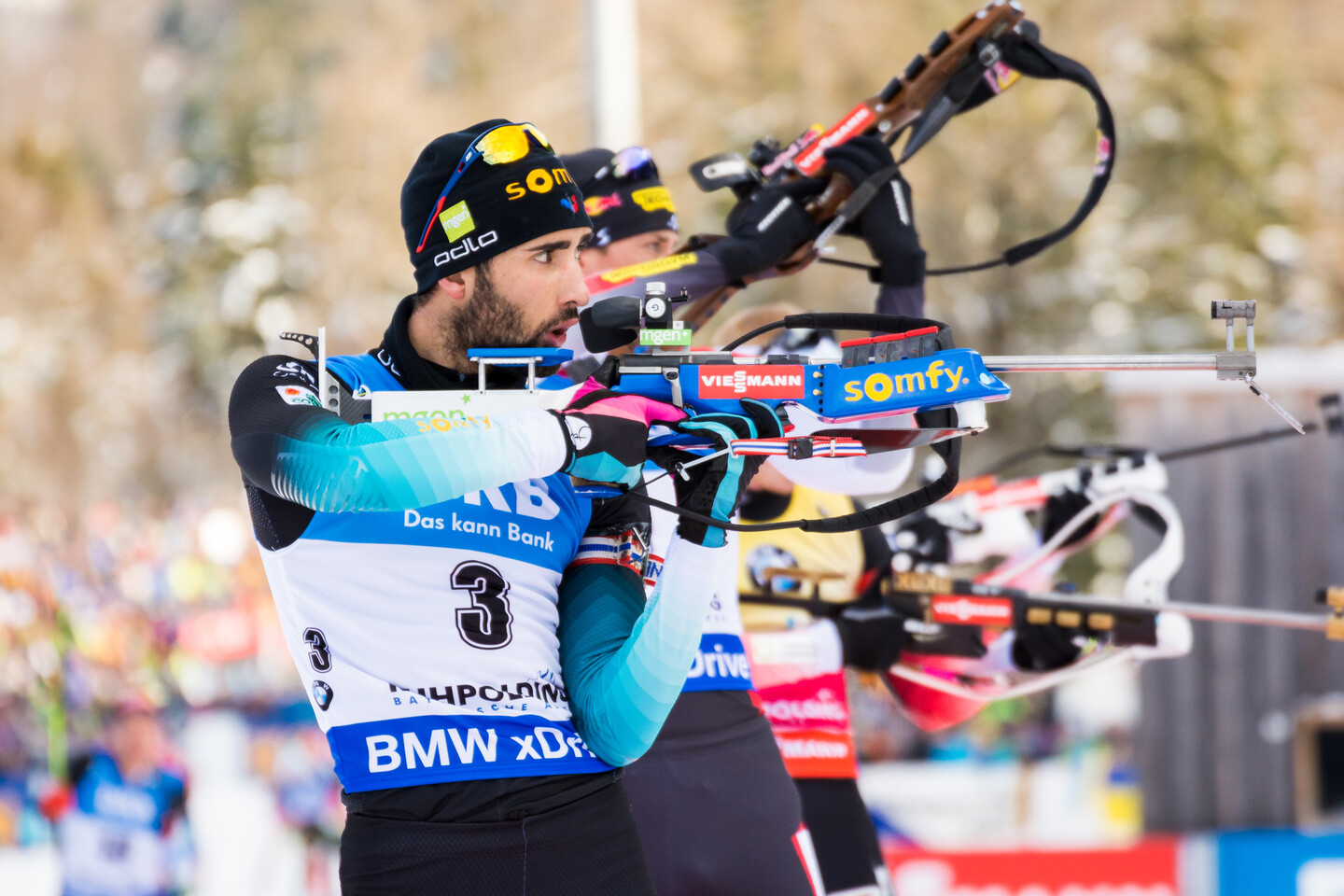
The pursuit is the third thrilling biathlon discipline, in which the starting order is determined by the results of the sprint. The men race 12.5 km and the women 10 km, with four shooting rounds in each: two prone and two standing. Every missed shot results in a 150-metre penalty lap, so the winner is the first to reach the finish line. Speed, accuracy and strategy are therefore crucial here.
Mass start
- Distance: 15 km (men), 12.5 km (women)
- Shooting: four rounds (prone, prone, standing, standing)
- Olympic event since: 2006
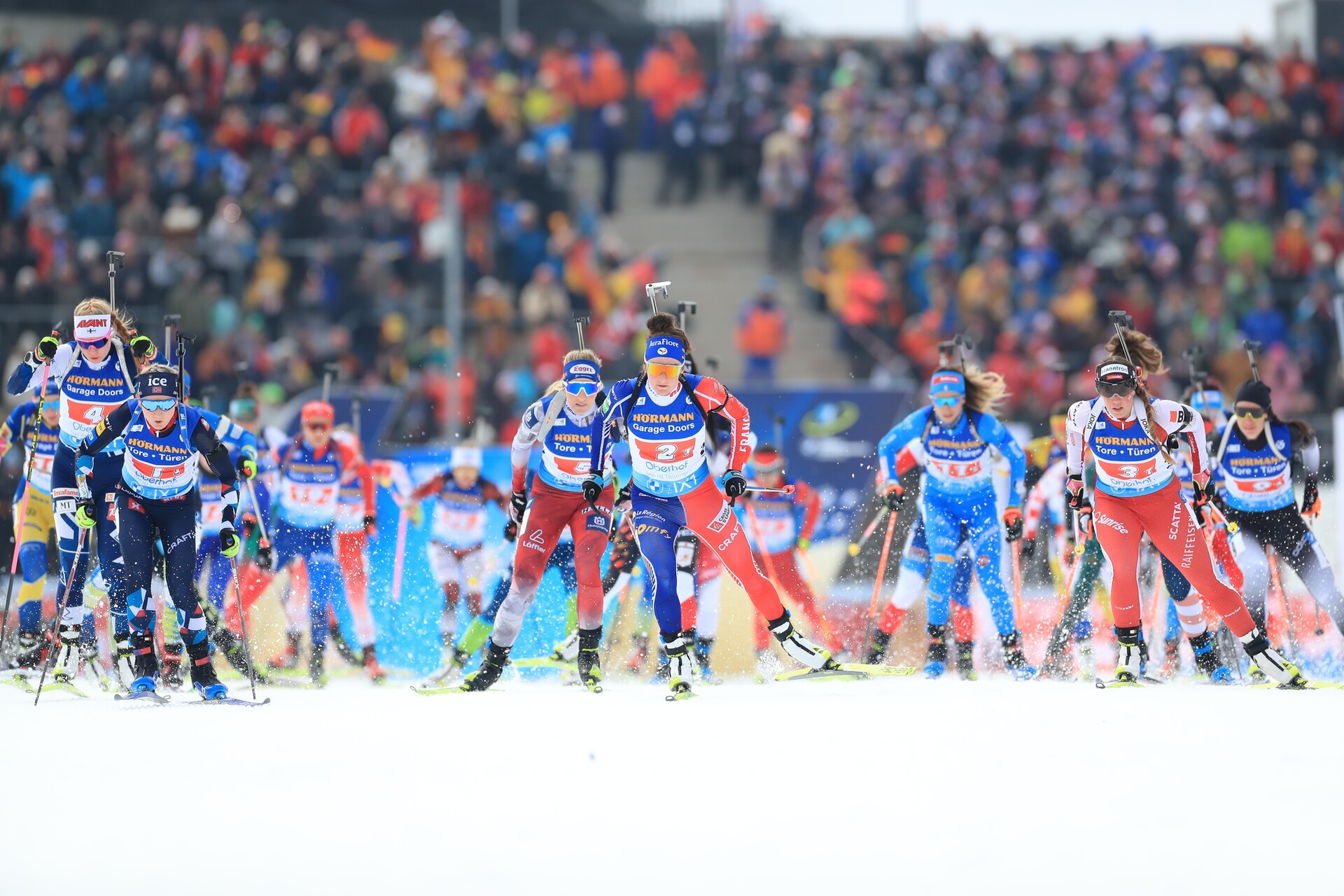
The mass start is the final individual discipline in biathlon and the only one in which all athletes start at the same time. The race is 15 km long for men and 12.5 km for women. In total, they complete four shooting rounds in the following order: prone, prone, standing, standing. The rules are similar to those of the pursuit, but the mass start leads to direct battles for position on the course. Only the 25 highest-ranked athletes in the overall World Cup standings and the five athletes with the most points from the respective event are eligible to compete. This means the field of competitors is very limited and particularly strong.
Team events in biathlon
In addition to the four individual events, biathlon also features three relay events in which athletes compete as part of a team. Teams are formed on the basis of nationality, either as all-male or all-female teams, or as mixed teams. As in the mass start, the first runners from each team set off at the same time.
Relay
- Distance: four rounds of 7.5 km (men), four rounds of 6 km (women)
- Shooting: two rounds each (prone, standing)
- Olympic sport since: 1968 (men), 1992 (women)

Please also note that by using our services and integrating the YouTube API Services, the YouTube Terms of Service and the YouTube API Services Terms apply and your use of our website is deemed to be acceptance of these terms.
In the oldest biathlon relay event, teams consist of four athletes from the same country and of the same gender. The women cover four 6 km legs and the men four 7.5 km legs. After one lap on the cross-country course, the first shooting takes place in the prone position, followed by a standing shooting after the next lap, before the final lap begins. The baton is passed to the next runner by physical contact. Unlike in individual competitions, three spare rounds are available for each shooting stage in the relay. Only if a target is missed after these have been used must a 150-metre penalty lap be completed.
Mixed relay
- Distance: four rounds of 6 km
- Shooting: two rounds each (prone, standing)
- Olympic event since: 2014

Please also note that by using our services and integrating the YouTube API Services, the YouTube Terms of Service and the YouTube API Services Terms apply and your use of our website is deemed to be acceptance of these terms.
In the mixed relay, each national team fields two women and two men. The rules are the same as for the classic relay, with the two women each covering 6 km before the two men then have to run 7.5 km each.
Single mixed relay
- Distance: 13.5 km
- Shooting: four rounds each (prone, standing, prone, standing)
- Olympic event since: not part of the programme
The third and most recent variation of the biathlon relay is the single mixed relay. In this event, each team consists of one woman and one man per nation. The race takes place over a 1.5 km loop, with each athlete shooting once in the prone position, then once in the standing position, then once in the prone position again, and finally once more in the standing position at each changeover. There are a total of two changes in this relay. A missed shot results in a penalty lap, which is, however, only 75 metres long.
Currently, all seven biathlon disciplines are contested as part of the Biathlon World Cup and the World Championships. With the exception of the single mixed relay, all disciplines are also included in the programme at the Winter Olympics.
Short-distance events in cross-country skiing
Cross-country skiing has evolved over the years and now comprises six disciplines for both men and women at major competitions. These can be divided into short-distance and endurance disciplines.
Sprint
- Distance: 1.5 km
- Style: classic/freestyle (alternates between World Championships and the Olympics)
- Olympic event since: 2002

In cross-country skiing, the individual sprint and the team sprint are short-distance disciplines. In the individual sprint, athletes compete on a track no longer than 1.5 km. In each race, the distance is covered once and the time achieved qualifies the athlete for the next higher-level race. The cross-country skiers compete in various races, starting with the qualifying round, followed by the quarter-finals, the semi-finals and finally the final, in which the six best athletes battle it out for victory.
Team sprint
- Distance: six laps of 1.5 km
- Technique: classic/freestyle (varies between World Championships and the Olympics)
- Olympic event since: 2006

Please also note that by using our services and integrating the YouTube API Services, the YouTube Terms of Service and the YouTube API Services Terms apply and your use of our website is deemed to be acceptance of these terms.
In this event, two athletes compete together as a pair. They must each complete three laps on a track up to 1.5 km long. In this second sprint discipline, the entire field of competitors starts directly in two semi-finals. The ten fastest teams qualify for the final, where they must give it their all one last time. Regarding the number of teams per nation, the rule at the Olympic Games and World Championships is that each country may field only one sprint team. This rule does not apply at the Cross-Country Skiing World Cup.
Endurance events in cross-country skiing
In addition to the fast-paced races over shorter distances, which primarily test the athletes’ speed, there are also longer races that focus on endurance. In these cross-country disciplines as well, a distinction is made between individual and team competitions.
Individual
- Distance: 10 km
- Technique: classic/freestyle (alternates between World Championships and the Olympics)
- Olympic event since: 1924 (men), 1952 (women)
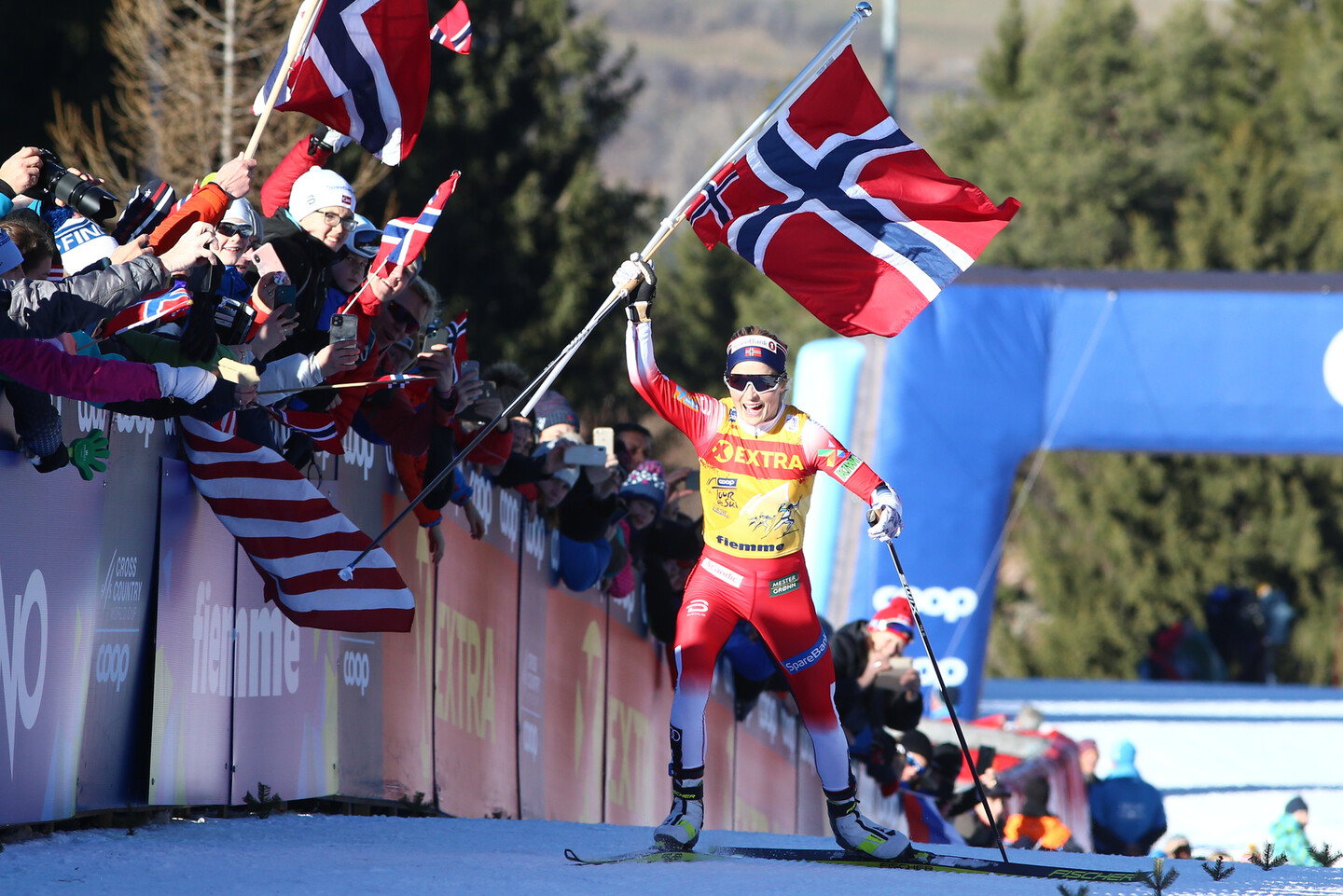
One event is the individual start, in which the women and men each race 10 km. In this event, the athletes set off at 30-second intervals. The winner is the cross-country skier who finishes with the fastest time.
Mass start
- Distance: 50 km
- Technique: classic/freestyle (alternates between World Championships and the Olympics)
- Olympic event since: 1924 (men), 1984 (women)
Just like in biathlon, cross-country skiing also features the mass start discipline. The main feature of this discipline is that all skiers start at the same time. However, the cross-country mass start is a true marathon—or even more—since both women and men must complete 50 km! As is so often the case, the winner is the one who crosses the finish line first.
Skiatholon
- Distance: 20 km
- Style: 10 km classic/10 km freestyle
- Olympic event since: 1992

Please also note that by using our services and integrating the YouTube API Services, the YouTube Terms of Service and the YouTube API Services Terms apply and your use of our website is deemed to be acceptance of these terms.
In the skiathlon, an endurance event, athletes start individually and compete using both classic and freestyle techniques. As in all other cross-country skiing competitions, the distances for men and women have now been standardised, so that the race consists of 10 km of classic skiing followed by 10 km of freestyle skiing after a ski change. The change of technique divides the course into two sections. The entire field starts at the same time, similar to a mass start, and the winner is the first to reach the finish line. Because of this change, the skiathlon is also known as the ‘double pursuit’ and is considered the historical successor to the traditional pursuit, in which there was always a break between the two races.
Relay
- Distance: four 7.5 km legs
- Technique: two classic/two freestyle
- Olympic event since: 1936 (men), 1956 (women)
Of course, cross-country skiing also features men’s and women’s relays, in which teams of four compete for their respective nations. Each athlete covers 7.5 km on the trail. The first runners start in a mass start, followed by the remaining team members who complete their legs one after another. The handoffs take place in the stadium via physical contact. A unique feature is that the first two runners use the classic technique, while the last two use the skating style. As a result, a variety of techniques, strategy, and team coordination are crucial to the relay’s success.

Please also note that by using our services and integrating the YouTube API Services, the YouTube Terms of Service and the YouTube API Services Terms apply and your use of our website is deemed to be acceptance of these terms.
At the Winter Olympics and World Championships, separate winners are determined for each discipline. In the Cross-Country Skiing World Cup, however, the International Ski Federation (FIS) distinguishes between the Sprint World Cup and the Distance World Cup. The Sprint World Cup comprises the individual sprint races, whilst the Distance World Cup covers all longer distances of 10 km or more. At the end of the season, a winner is crowned in both disciplines. In addition, there is the overall World Cup standings, which incorporates all results from sprint and distance races. This determines an overall World Cup winner. In this way, both specialised performances, such as in the Tour de Ski, and consistent success across various disciplines are recognised and honoured.
Travel tips for biathletes and cross-country skiers
In the Alps, winter sports enthusiasts will find ideal conditions for Nordic sports such as cross-country skiing and biathlon. Many ski regions offer well-groomed trails, some stretching for several hundred kilometres, where advanced skiers and professionals can practise and perfect their technique. Beginners can learn cross-country skiing step by step in special beginners’ courses and gain their first experience on the trails.
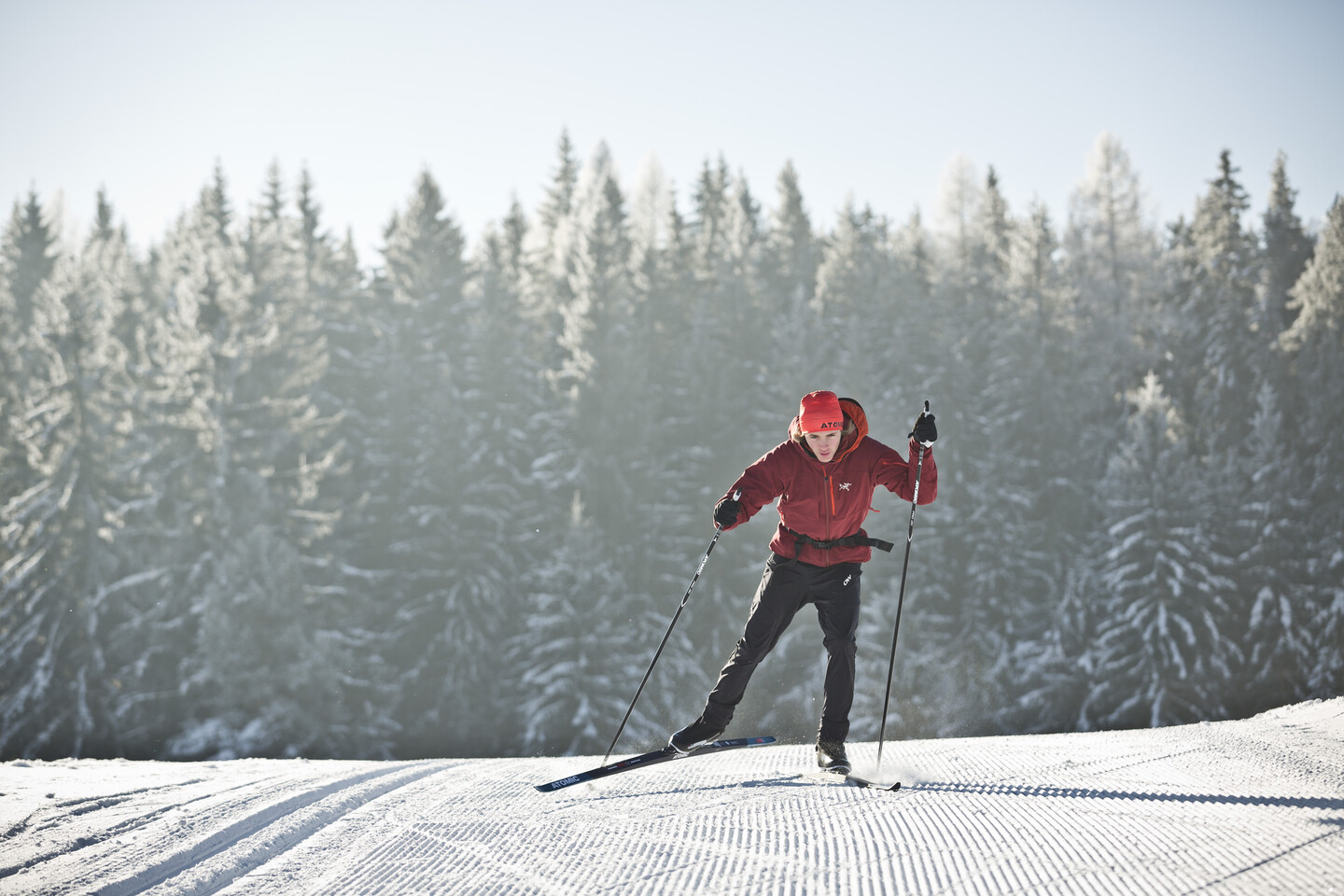
And anyone wishing to try their hand at biathlon shooting can do so at shooting ranges in biathlon stadiums under professional guidance and using laser rifles, often supplemented by workshops for beginners. SnowTrex can recommend some of the best regions for a cross-country skiing holiday in the Alps and the European low mountain ranges, almost all of which also have their own biathlon stadiums:
- Garmisch-Partenkirchen and Oberhof in Germany
- Obertauern and Hochfilzen in Austria
- Anterselva and Dobbiaco in Italy
- Lenzerheide in Switzerland
FAQ’s on Cross-Country Skiing and Biathlon
What is the difference between cross-country skiing and biathlon?
The key difference between cross-country skiing and biathlon is that biathlon involves shooting as well as cross-country skiing. Whilst in cross-country skiing performance on the track is the sole focus, biathletes must complete several shooting stages during the race. Missed shots are penalised with penalty loops or time penalties, making the race more tactically demanding. Furthermore, only the skating technique is used in biathlon, whereas in cross-country skiing both the classic and freestyle techniques are permitted.
What do cross-country skiing and biathlon have in common?
Both cross-country skiing and ski jumping are Nordic winter sports and place high demands on endurance, technique and strength. As skiing plays a central role in both disciplines, the training methods and parts of the equipment are similar. Furthermore, both sports have a comparable competition structure, featuring World Cup series, World Championships and events at the Winter Olympics.
What disciplines are there in biathlon?
There are four individual disciplines in biathlon: individual, sprint, pursuit and mass start. In addition, there are three relay events: the classic relay with four athletes of the same gender, the mixed relay with two women and two men, and the single mixed relay with one woman and one man per team. All disciplines combine cross-country skiing and shooting, but differ in terms of distance, start format and rules.
What disciplines are there in cross-country skiing?
There are six main disciplines in cross-country skiing. The short-distance races include the sprint and the team sprint. In the endurance category, there is the individual start, the mass start, the skiathlon with a change of technique, and the relay. Depending on the competition, races are held in classic style or freestyle.
What competitions are there in biathlon?
The most important international biathlon competitions include the annual World Cup and the World Championships. Biathlon is also a regular feature of the Winter Olympics. The international series are organised by the International Biathlon Union (IBU), which also compiles the overall World Cup standings and the discipline rankings.
What cross-country skiing competitions are there?
The most important cross-country skiing competitions are the World Cup, the Nordic World Ski Championships and the Winter Olympics. The World Cup, organised by the Fédération Internationale de Ski (FIS), includes both sprint and distance events, as well as an overall World Cup standings.
Where is biathlon broadcast live on TV or via streaming?
In Germany, biathlon competitions are regularly broadcast alternately by ARD and ZDF. In addition, Eurosport shows many races live on TV and via the Discovery+ streaming service. In Austria, coverage is provided by ORF, and in Switzerland by SRF. The exact broadcasting rights may vary depending on the season.

