
The profession of a mountain guide is synonymous with responsibility, experience and a deep passion for the mountains, in both summer and winter. After all, his clients must be able to trust him as he guides them through challenging terrain covered in deep snow, sharing his knowledge and enabling them to experience nature at first hand. Georg Leithner from Pinzgau is a true, passionate mountain guide who has been working in the profession for over 20 years and offers fascinating insights into his daily life and the appeal of his job. SnowTrex knows exactly what the work of a mountain guide entails and what these experts in deep snow and ski touring must always bear in mind.

The evolution: From trail guide to state-certified mountain guide
In modern winter tourism, a state-certified mountain guide no longer acts merely as a companion – for ski tourers, for example – but also as a qualified risk manager and technical expert. In countries such as Austria and parts of Germany – namely Bavaria – the professional title is, by regulation, closely tied to strict qualification standards, which are harmonised internationally by the International Federation of Mountain Guide Associations (German: IVBV). Whereas the traditional mountain guide was often a local expert on the trails, today’s professional must be a jack-of-all-trades, equally at home on rock, ice and in powder snow.

Qualifications for mountain guides
What not everyone realises is that not every mountain guide is automatically a ‘mountain guide’. This is because those who accompany clients in the mountains do not always have the same authorisation as their colleagues. For example, a mountain walking guide is legally restricted to marked trails and moderate terrain. Furthermore, they are not permitted to lead ski tours or use rope safety techniques. This is in fact reserved for state-certified mountain guides, who are authorised to lead tours in all alpine disciplines, such as ski touring.
| Qualification | Main focus of training | Authority in winter |
|---|---|---|
| Mountain and ski guides | Rock, ice, skiing, avalanche awareness and guiding techniques | Ideal for ski touring, freeriding and high-altitude mountaineering |
| Mountain hiking guides | Orientation, flora and fauna, and basic first aid | Snowshoe walking on easy trails |
| State-certified ski instructors | Skiing methodology and piste technique | Ski school lessons in controlled terrain (slopes) |
| Army and police mountain guides | Military and police mountain rescue, and tactics | Official duties, not private school management |
Training: From Trainee to Expert
Training to become a mountain and ski guide is one of the most demanding vocational training programmes in the Alpine region. This is because, even before the first day of training begins, candidates must already have many years’ experience in the mountains. Mountain guide expert Georg Leithner describes this path as a ‘calling’ that requires meticulous preparation (video in German).

Please also note that by using our services and integrating the YouTube API Services, the YouTube Terms of Service and the YouTube API Services Terms apply and your use of our website is deemed to be acceptance of these terms.
Aptitude and technical hurdles
Before the mountain guide training begins, candidates must first sit a three-day aptitude test. To pass this, candidates must demonstrate a confident command of alpine climbing up to the upper VII difficulty grade (UIAA) and be able to handle themselves with confidence on ice. Skiing ability is also essential. Prospective mountain guides are required to have skiing skills equivalent to those of a state-certified ski instructor. This means that candidates must be able to ski with technically sound form and in an energy-efficient manner in all snow conditions.

Three-Year Mountain Guide Apprenticeship
The aptitude test is followed by approximately three years of theoretical and practical training modules:
- Guiding Techniques: This module teaches how to guide guests safely through rough terrain, organise rope teams and apply rescue techniques.
- Teaching and Methodology: Particularly in settings such as ski touring camps, the mountain guide must be able to convey their knowledge of avalanche awareness and skiing technique in a clear and understandable way.
- Theoretical Foundation: The scientific basis of the profession comprises meteorology, navigation, geology and avalanche dynamics.
- Work Placement: A 36-day work placement at a mountain school enables trainee mountain guides to gain practical experience in dealing with clients under supervision.
The cost of hiring a mountain guide
Winter sports enthusiasts who wish to hire a mountain guide should be aware of the various pricing models available. These vary, however, depending on the region and the difficulty level of the tour. In general, it’s important to note that the fees are not merely “wages,” but also cover the significant liability risk, insurance costs, and continuing education for the mountain guides.
Daily rates in Alpine countries
| Region | Average Daily Rate | Particularities |
|---|---|---|
| Switzerland (Valais/Graubünden) | approx. 650 - 850 Swiss francs (CHF) | The guide's expenses often have to be covered in full |
| Austria (Tyrol/Salzburg) | approx. 480 - 520 euros (plus 20% for each additional person) | Closely based on the UIAA difficulty scale |
| Germany (Upper Bavaria) | approx. 450 - 650 euros (to be agreed individually) | Package deals are often available through alpine schools |
| Italy (South Tyrol) | approx. 450 - 550 euros (group rates are common) | Fee rates that have evolved over time |
Safety management for mountain guides
Anyone who hires a mountain guide can be sure that, on the way to the summit, these experts will always be guided by their professional risk assessment. In an environment where there is no such thing as absolute safety, the mountain guide uses methods such as statistical risk reduction to minimise residual risk wherever possible.

The Munter Reduction Method
Werner Munter revolutionised avalanche science by shifting the focus from the assessment of individual slopes to statistical probability. This ‘reduction method’ takes into account both the danger level from the Avalanche Bulletin (LLB) and the steepness of the terrain. Today, however, professional mountain guides use refined versions of this method, such as the ‘Stop or Go’ system developed by the Austrian Alpine Club (ÖAV).
The ‘Stop or Go’ method
This model consists of two key checks:
- Check 1 – Danger level vs. slope angle: At level 3 (significant), for example, the threshold is a slope angle of 35 degrees. Anything above this results in a provisional ‘Stop’.
- Check 2 – Hazard patterns: Here, the slope is inspected directly for five patterns: fresh snow, drift snow, settling noises, fresh avalanches and severe moisture penetration. If any of these patterns are found, the ‘Stop’ remains in place.
The ‘Go Anyway’ factors
An experienced mountain guide recognises situations in which safe skiing is possible despite a theoretical risk:
- Heavily tracked slopes: A dense network of tracks can stabilise the snowpack, but only if there are no deep weak layers present.
- Dense woodland: A forest where the trees are spaced about 5 m apart offers protection from avalanches.
- Ridges and crests: Terrain shaped by the wind, which is often snow-free or blown clear, offers safe routes for ascent.
Emergency equipment for mountain guides
Technology has made enormous strides in recent years, particularly in the fields of electronics and materials science. As a result, a mountain guide in the Alps would never leave safe terrain without their ‘holy trinity’ – an avalanche transceiver, probe and shovel.
Avalanche transceivers
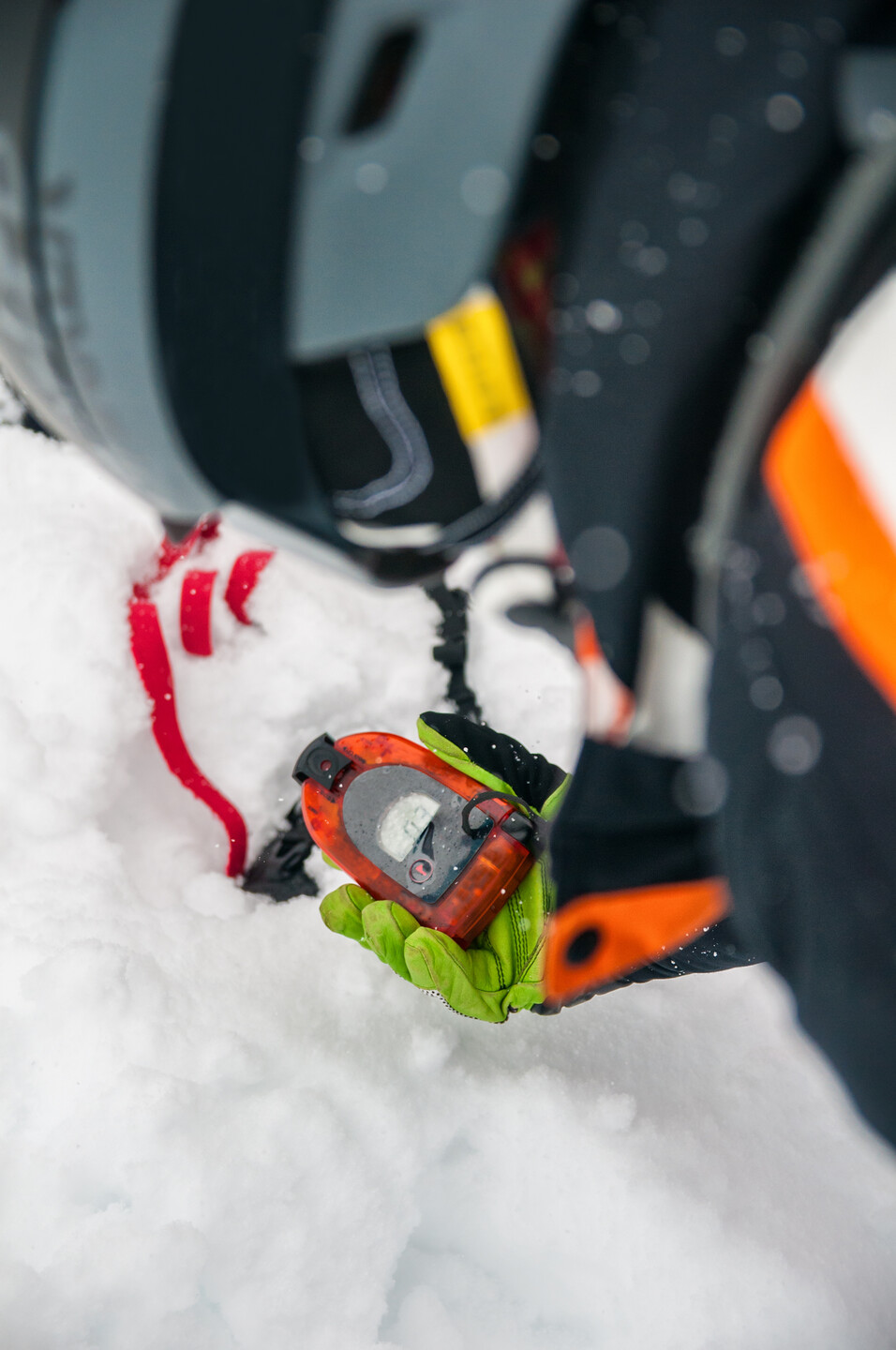
Modern 3-antenna devices with digital signals are now standard. They enable a more precise search and better marking of buried victims. However, electromagnetic interference (EMI) presents a new challenge in avalanche rescue. This is because devices such as smartphones, action cameras or even heated gloves can interfere with the sensitive search signal.
Avalanche airbags
Avalanche airbags increase the chances of survival by utilising the principle of ‘inverse segregation’. This ensures that larger objects remain on the surface within a moving mass. Today, mechanical systems (gas cartridges) are extremely reliable, whilst electronic systems (fans) offer the advantage of being able to deploy multiple times and pose no problems during transport.

Interview with mountain guide Georg Leithner
Mr Leithner, what was your personal journey to becoming a mountain guide?
I’ve always been in the mountains. Ever since I was a child, I’ve been climbing Austria’s high mountains with my father. One day I took up climbing and found myself out in the mountains even more often. Eventually, in 1998, I joined the mountain rescue service and worked there for several years. One day, someone there asked me: “When are you actually going to do the mountain guide training? You’re in the mountains so much and know your way around everywhere – it would be right up your street.”
I took this suggestion to heart, did some research and found out what the requirements were for the aptitude test. Before that, I’d always thought I’d have to be an exceptional mountaineer, and I’d considered myself more of an average one. For five years, I then prepared meticulously for the training whilst working full-time as a metalworker in the mining industry on shift work.
What qualifications must winter sports enthusiasts have in order to work as a mountain guide?
As a mountain guide, they must demonstrate a very high standard in all aspects of mountaineering. For the entrance exam to the training programme, a specific level must be achieved in all areas. For example, applicants must be able to free climb to the upper 7th grade in alpine climbing, demonstrate ski touring experience in normal grassy mountains and on glaciers, and be proficient in ice and rock climbing up to difficulty grades 5 and 6. In addition, they must be able to ski at the level of a state-certified ski instructor for the entrance exam – this is where most fail.
Is your job the perfect combination of passion and profession?
If mountaineering is your passion and you want to turn it into a career, becoming a mountain guide is, of course, a great option! However, many people undertake the mountain guide training for a different reason: it is the highest level of training in mountaineering that they can achieve. That is why many mountaineers use the training to put the finishing touches to their skills and become perfect alpinists. After all, they can no longer get that from the Alpine Club. The profession itself, however, does not interest them at all. Some also complete the training to fund their studies in the summer by leading guided tours. So it’s fair to say that out of every 20 to 25 fully qualified mountain guides, only about five actually practise the profession.
As mountain guides, they’re probably on the move extremely often and spend little time at home …
That’s just part and parcel of the job. As they get older, however, and if they have a partner or a family, they try to work closer to home. As long as candidates are unattached and don’t have a family, it doesn’t matter whether they’re on the road for weeks on end, travelling to South America in the off-season or leading trekking tours in Nepal. Once they’ve established a certain standard of living, however, they naturally want to spend more time at home. Even so, I need to get away every now and then – I can’t stay in one place for 365 days a year!
I now spend the winter at home. Here, I know every slope and can keep track of the weather and snow conditions throughout the season. This makes it much easier to assess the snow conditions. In other places, on the other hand, I have to spend a long time preparing, finding out about the snow and first working out the potential hazards. That’s much more demanding than at home.
Winter or summer? Which is your favourite?
In both seasons, a mountain guide experiences all facets of mountaineering, and the organisation of tours and route-finding are identical. In summer, however, there are passages that are more technically demanding in terms of climbing. For me, summer is the easier season in which to practise my profession, as there is no risk of avalanches. Nevertheless, winter is cool too! The ski touring camps in particular are great fun. In winter, ideally there should be a good mix of alpine training, ski touring and freeriding.
What is it that makes ski touring so fascinating for you?
Being outdoors – at one with nature. Surrendering to the forces of nature, namely avalanches. Left to my own devices, I am in a position to make decisions that can mean the difference between life and death. I am also struck by the fascinating landscapes created by the interplay of snow and light. You don’t see that in summer. In winter, the diffuse light creates completely different contours and a whole new landscape. On a leisurely and adventure-filled ski tour, customers can recharge their batteries in the great outdoors and enjoy the tranquillity of winter and nature.
Can anyone go ski touring, and what are the requirements for a guided ski tour?
In principle, anyone who can ski and is reasonably fit can go ski touring. The crux of the matter – where enjoyment often turns to misery – is skiing ability. Often, the ascent goes well enough, but by then the participants are already tired. If their skiing ability is only average or poor, not only does it stop being fun, but it also becomes dangerous as the risk of injury increases. A solid short-turn technique is therefore essential, so that you can cope with snow conditions of varying difficulty. Many people say they go ski touring just for the ascent, but I also really enjoy the descent!
What advice would you give to beginners in ski touring?
I recommend some basic training near the slopes for the ascent. This allows participants to familiarise themselves with the equipment, such as touring skis, and practise the movements. The next step is to work on improving their skiing ability near the slopes. One day, the time will come when winter sports enthusiasts want to head off-piste. Then they have to decide: what am I going to do, where, and with whom? A ski touring camp is a promising way to learn what else is important in ski touring apart from the equipment: meteorology, snow science, avalanche awareness and group dynamics. Participants get to learn all of this thoroughly at such camps!
I therefore recommend that everyone attends such a camp to gain a basic understanding and avoid blindly following someone else. If I do end up following someone, I can at least critically assess afterwards whether everything they’re doing up front is correct.
When can winter sports enthusiasts venture out into the backcountry on their own?
However, I reckon it takes at least five to ten years of regularly going on ski tours with experienced people before they’re able to plan their own ski tours in an area they’ve already visited a few times. I don’t think it makes sense simply to travel to a different place and go on a ski tour there. Even for us mountain guides, it’s a challenge to complete the tour safely. Especially when I’m not even familiar with the area in summer.
Otherwise, it depends on the individual: how quickly and intuitively they can take in and apply all the relevant factors, and whether they tend to be cautious or risk-taking. If they stick to the basic rules, they can undertake easy ski tours quite early on, provided these are not too far from a safe area. More challenging expeditions, on the other hand, require a great deal of experience. Many factors come into play when planning: map reading, equipment procurement, avalanche reports – a ski tourer must be very confident in their abilities. Or they can push their limits and increase their risk level. As athletes, that is entirely up to them.
Do you consider ski touring to be a dangerous sport?
It’s only as dangerous as the individual ski tourer makes it. That said, you can go about this sport very, very safely. With basic risk-reduction methods such as those developed by Werner Munter, you can ski at a high level of safety, leaving only a few per cent of unavoidable risk. Using such strategies, which define a socially acceptable residual risk, you can go on safe ski tours. If something does happen, it’s simply bad luck.
The problem, however, is that there is no obligation to use these methods. As a result, it is often impossible to determine in retrospect whether an accident occurred due to residual risk or whether it was actually the result of recklessness.
What appeals to you most about your job and about mountaineering?
The most brilliant thing about mountaineering is that, out in nature, you are reduced to just yourself. The mountain is not a piece of sports equipment. It doesn’t matter what kit people have with them here or how technically skilled they are: if the weather doesn’t play along, they have to turn back humbly, having achieved nothing.

When you’re in the middle of the mountains, as in Nepal, and there’s not a soul to be seen for a hundred kilometres, you might find yourself thinking: who needs other people anyway? Nature is so wonderful – even without people. Experiencing that is simply sensational. Apart from that, mountaineering is a school of life; you form friendships that last a lifetime and people have fun together. It’s brilliant!
A stark contrast to the solitude of the mountains …
Exactly – on the one hand, this ‘nothingness’, and on the other, a group of like-minded people who also love the fact that there’s nothing up there. As a mountain guide, showing them that they can move safely through the mountains and enjoy them is always a real experience! It’s also a real sense of fulfilment when, after a successful tour, the participants arrive back in the valley safe and sound, have a beer together and finally say goodbye as good friends.
Legal aspects for mountain guides
The mountain guide contract
From a legal perspective, this is a contract for services. The mountain guide is not obliged to ensure that participants reach the summit, but is obliged to provide professional guidance in accordance with current best practice. His duties are therefore as follows:
- Equipment check: The mountain guide must ensure that guests have functional emergency equipment.
- Aptitude assessment: The mountain guide must not take any guests on tours whose abilities exceed the demands of the tour.
- Authority to give instructions: Guests are obliged to follow the guide’s instructions. In the event of non-compliance, the guide’s liability for any resulting damage ceases.
Insurance cover: What is actually covered?
A mountain guide is covered by professional indemnity insurance. However, this insurance only applies if culpable misconduct can be proven. Guests are responsible for general life risks or accidents not caused by the fault of others. However, for those travelling with a private tour group, the most experienced participant – the so-called ‘de facto guide’ – is liable if they take charge of decision-making without exercising the necessary care. This is known as the ‘guide acting out of courtesy’ principle.
Sustainability in ski touring
Mobility and consumption
The journey to the destination is the biggest factor in the carbon footprint of a ski holiday. New approaches to ski touring therefore now focus on a combination of travelling by train to the ski resort, using e-bikes and skiing, in order to minimise the ecological footprint. Mountain guides also play a key role here by offering tours in areas easily accessible by public transport and raising their clients’ awareness of nature conservation.
Equipment and Repairability
Another trend is conscious consumption. The best piece of equipment in terms of sustainability is the one that ski tourers already own and can therefore repair themselves. Brands such as Ortovox and Mammut, for example, are increasingly focusing on fair production and repair services, and mountain guides, as key influencers, are passing this information on to their clients.
FAQ’s on mountain guides
What exactly does a mountain guide do?
They plan, lead and ensure the safety of tours in alpine terrain, and responsibly guide guests through challenging mountain landscapes. In doing so, they continuously assess risks such as the weather, terrain and avalanche danger, whilst also imparting knowledge about technique, navigation and safe behaviour in the mountains.
Why should winter sports enthusiasts book a mountain guide for ski touring?
A mountain guide significantly increases safety, as they possess in-depth knowledge of avalanche awareness, route selection and risk management. Particularly in deep snow and away from secured slopes, their experience ensures that dangers are identified early and decisions are made professionally.
What training does a mountain guide need?
A mountain guide undergoes a very demanding training programme lasting several years, which usually takes around three years. It comprises extensive practical and theoretical preparation. Prerequisites include many years’ mountain experience and passing a difficult aptitude test. The training covers guiding techniques, avalanche awareness, meteorology and alpine rescue techniques.
How much does a mountain guide cost per day?
In the Alps, a mountain guide usually costs between 400 and 700 euros per day, depending on the region, the type of tour and the size of the group. In addition to the guiding service itself, this price also covers aspects such as liability risk, insurance cover, ongoing professional development and the guide’s high level of qualification.
Is being a mountain guide a dangerous job?
Whilst this profession does involve certain risks, these can be systematically reduced through professional methods. Mountain guides work with recognised decision-making and safety protocols, such as the Munter reduction method or ‘Stop or Go’, to assess and minimise avalanche risks and other hazards as effectively as possible.
What equipment is essential for mountain guides in winter?
Standard equipment includes the ‘holy trinity’ of an avalanche transceiver, probe and shovel. In an emergency, this enables a rapid rescue. This safety equipment is often supplemented by additional aids such as avalanche airbags to further increase the chances of survival in the event of an accident.

