
Funicular railways are among the most fascinating means of transport in the mountains. For snow lovers, mountain enthusiasts and winter sports fans interested in technology, these facilities, which are a fascinating combination of engineering, comfort and closeness to nature, are a real highlight. SnowTrex now explains and shows what funicular railways in ski resorts are all about, how they differ from gondolas or chairlifts, and where visitors can find some of the most famous routes of this kind in the Alps.
The history of funicular railways
Funicular railways in the mountains also have a long tradition. The first systems of this kind were developed as early as the 15th century and were already being used in many places in Europe and overseas in the mid-19th century as an efficient means of transporting goods to the peaks. This is why they eventually became interesting for passenger transport in the Alpine region and thus also for tourism.
How funicular railways work
Structure and mechanism
Funicular railways are usually operated with two carriages connected by a steel cable. While one carriage travels uphill, the other travels downhill, making the system energy-efficient and economical. The drive unit is usually located at the upper station, where the cable runs over a large drive sheave.
Differences from other cable car systems
Unlike gondolas or chairlifts, funicular railways do not move freely, but on rails. This gives them greater stability and makes them ideal for particularly steep sections of track. They can also be used in almost all weather conditions, especially in high winds, unlike many other cable car systems.
Safety of funicular railways
Funicular railways are considered extremely safe. Their construction is robust, the cable system is secured multiple times, and modern monitoring technology ensures smooth operation. And should a malfunction occur, automatic braking systems intervene immediately.
These are the advantages of funicular railways
Climbing ability on the steepest terrain
Thanks to their design, funicular railways can also negotiate extreme gradients. This enables designers to access altitudes that would be virtually impossible to reach with other means of transport, making the systems ideal for ski resorts with large differences in altitude.
Comfort and accessibility
Large cabins, level access and a smooth ride make funicular railways particularly comfortable. Barrier-free access is also possible with ski equipment, prams or wheelchairs.
Panoramic views and the experience factor
Many funicular railways pass through spectacular landscapes, such as directly past rugged cliffs, through tunnels or over open snowfields. This turns the journey into a panoramic experience that goes far beyond mere transport through snow-covered mountains.
Funicular railways are so versatile
Transport for ski tourists
Funicular railways play a central role in ski resorts, as they efficiently transport winter sports enthusiasts from the valley stations to the ski area, serve as a connection between piste areas or replace classic chairlifts in heavily frequented sections.
Connection between valley and summit
Funicular railways are also a popular means of transport for non-skiers, such as winter hikers. They provide year-round access to mountain restaurants, viewing platforms and hiking trails in the ski resort, even in heavy snowfall.
Tourist attraction with technical charm
Many funicular railways are attractions in their own right. Historic facilities, modern architecture or record-breaking routes make them a highlight of the excursion programme for technology-loving travellers in both summer and winter.
Well-known funicular railways in the Alps
Zermatt-Sunnegga funicular railway (Switzerland)
Route length: 1,521 m
Elevation difference: 689 m
Year of construction: 2013
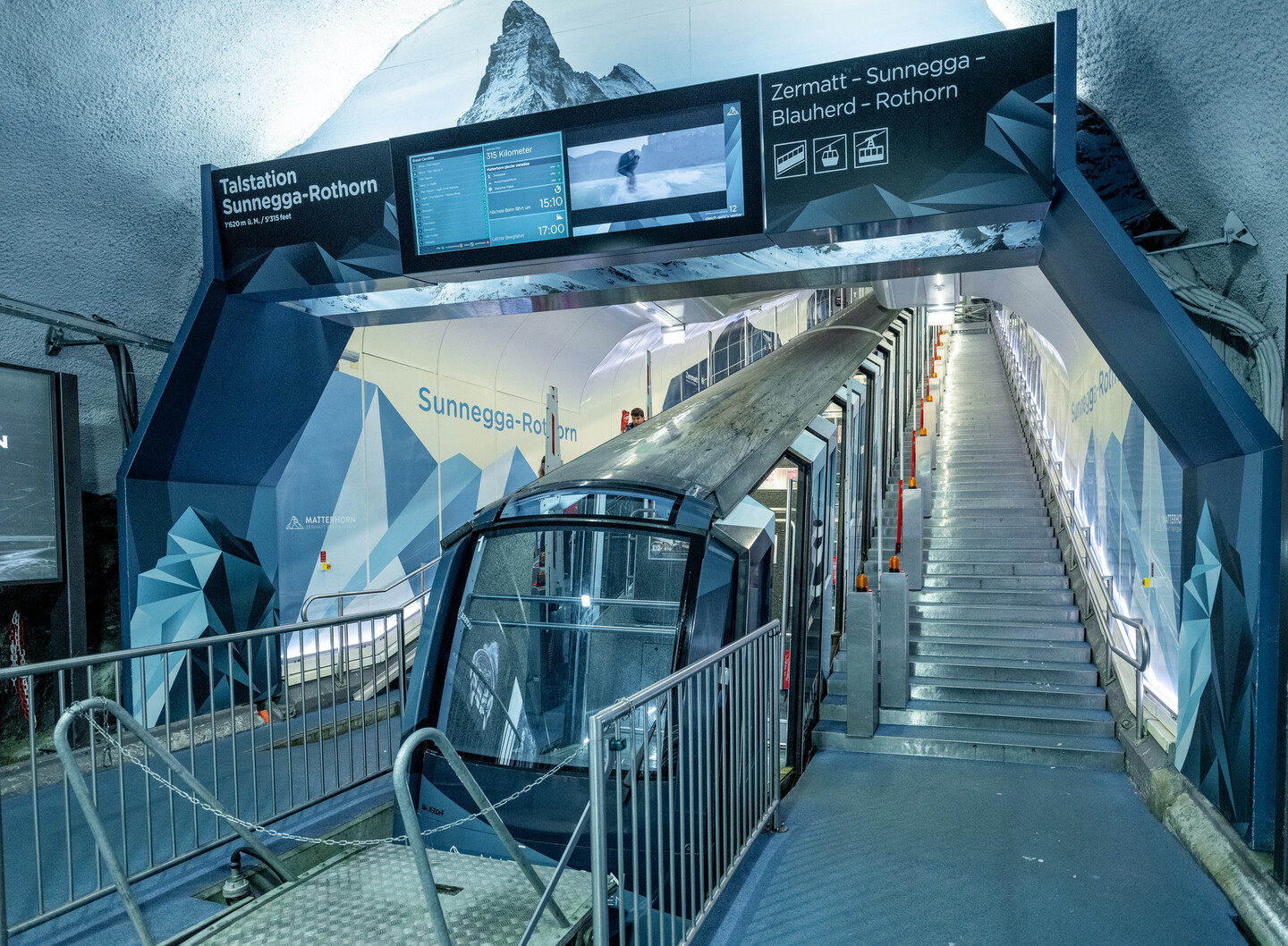
The Sunnegga funicular railway runs from Zermatt and takes passengers underground in just a few minutes to the sun terrace of the same name, right in the heart of the Zermatt ski area. Here, winter sports enthusiasts can enjoy not only 200 kilometres of slopes, but also the highest mountain station in Europe and Switzerland at an altitude of 3,899 metres on the Klein Matterhorn.
“Funival” Val d’Isère (France)
Route length: 2,292 m
Height difference: 892 m
Year of construction: 1986
The “Funival” route runs from La Daille near Val d’Isère for almost 2.3 km up to the Rocher de Bellevarde mountain station, a central point in the Tignes/Val d’Isère ski area. Winter sports enthusiasts who want to try out the 300 kilometres of slopes here in France at an altitude of up to 3,456 metres will find that the funicular railway is a means of transport that runs mostly inside the mountain, making it largely independent of the weather and offering a high capacity (2,200 people per hour).
Hungerburgbahn Innsbruck (Austria)
Route length: 1,800 m
Elevation difference: 288 m
Year of construction: 2007

Please also note that by using our services and integrating the YouTube API Services, the YouTube Terms of Service and the YouTube API Services Terms apply and your use of our website is deemed to be acceptance of these terms.
A funicular railway runs to Innsbruck’s Nordkette mountain range, providing an ideal link between the city centre and the alpine panorama. Not only is the landscape around the Hungerburgbahn fascinating, but so is the facility itself, which owes its futuristic design to star architect Zaha Hadid.
Kaprun Glacier Shuttle (Austria)
Route length: 257 m
Height difference: 101 m
Year of construction: 1990

The shortest funicular railway on this list is also one of the most spectacular. The cabins of the Kaprun Glacier Shuttle travel against the backdrop of the Kitzsteinhorn (3,203 m) to the highest point in the Kitzsteinhorn/Maiskogel – Kaprun ski area at 3,029 m, where some of the 61 kilometres of slopes begin.
Chantarella–Corviglia funicular railway (Switzerland)
Route length: 1,660 m
Height difference: 478 m
Year of construction: 1985
In St. Moritz, the most sophisticated of all ski resorts, the funicular railway, built in 1985, connects the village with the Corviglia ski area, as its name suggests. With its modern facilities and central location, the system is ideal for winter sports enthusiasts who want to get to the ski area with its 155 kilometres of slopes at an altitude of up to 3,022 metres quickly and comfortably.
Funiculaire Arc en Ciel (France)
Route length: 2,885 m
Height difference: 813 m
Year of construction: 2019

Please also note that by using our services and integrating the YouTube API Services, the YouTube Terms of Service and the YouTube API Services Terms apply and your use of our website is deemed to be acceptance of these terms.
In terms of sustainability, the Funiculaire Arc en Ciel funicular railway sets new standards on the route from the valley to the Les Arcs/Peisey-Vallandry ski area. After all, it enables winter sports enthusiasts to travel directly from the Bourg-Saint-Maurice TGV station to the cable cars in Arc 1600 in just a few minutes. This promotes car-free travel and the option of taking the train to the ski resort, with 200 kilometres of slopes at an altitude of up to 3,226 metres, like almost nowhere else in the Alps.
Schwyz-Stoos funicular (Switzerland)
Route length: 1,738 m
Height difference: 743 m
Year of construction: 2017
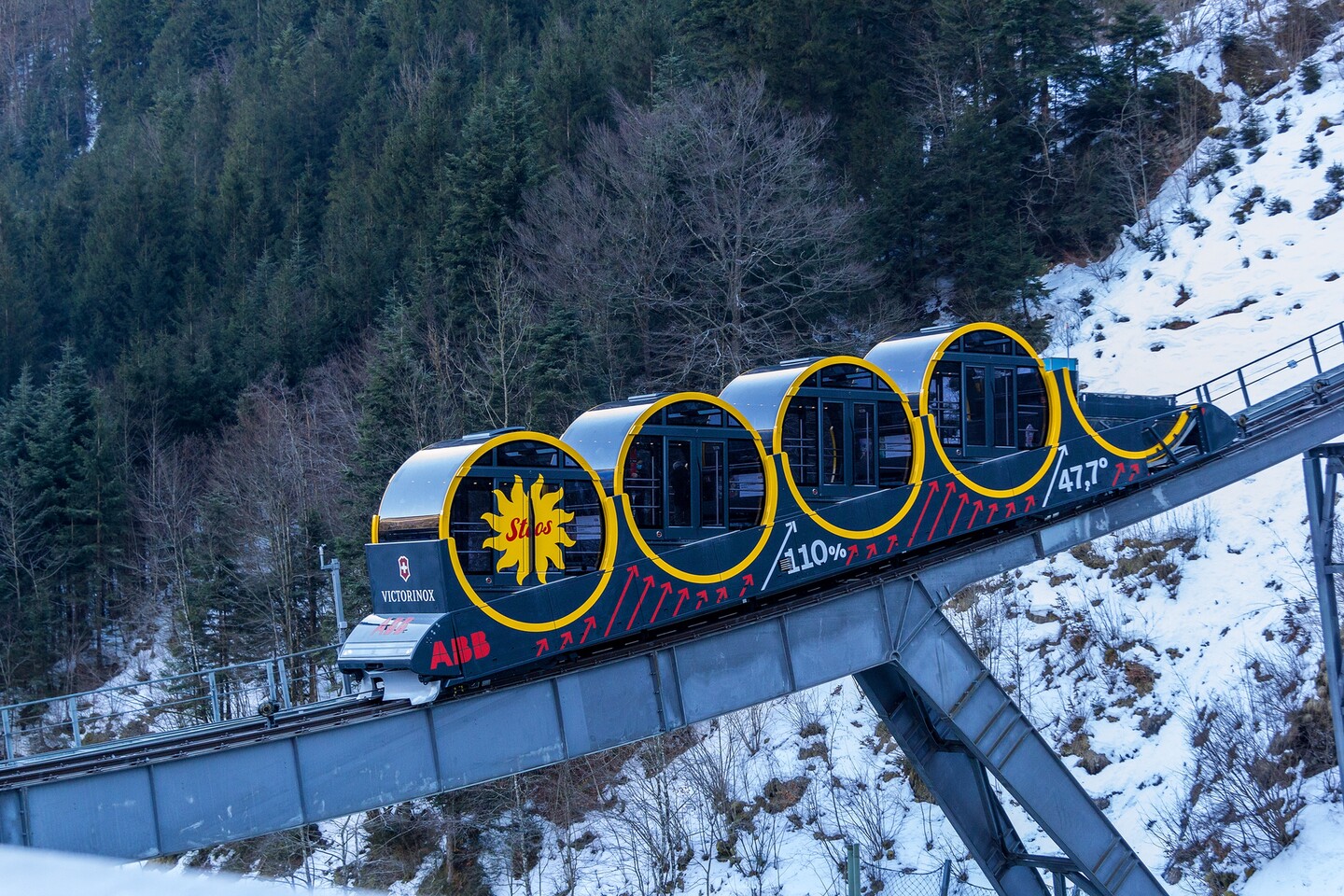
From Schwyz in the canton of the same name, the world’s steepest funicular railway takes winter sports enthusiasts up to the car-free Stoos plateau. The round cabins and innovative design of the system give the funicular railway a futuristic look. It climbs gradients of up to 110 per cent, setting a new Alpine record.
Parsennbahn Davos (Switzerland)
Route length: 4,086 m
Elevation difference: 1,105 m
Year of construction: 2002

Please also note that by using our services and integrating the YouTube API Services, the YouTube Terms of Service and the YouTube API Services Terms apply and your use of our website is deemed to be acceptance of these terms.
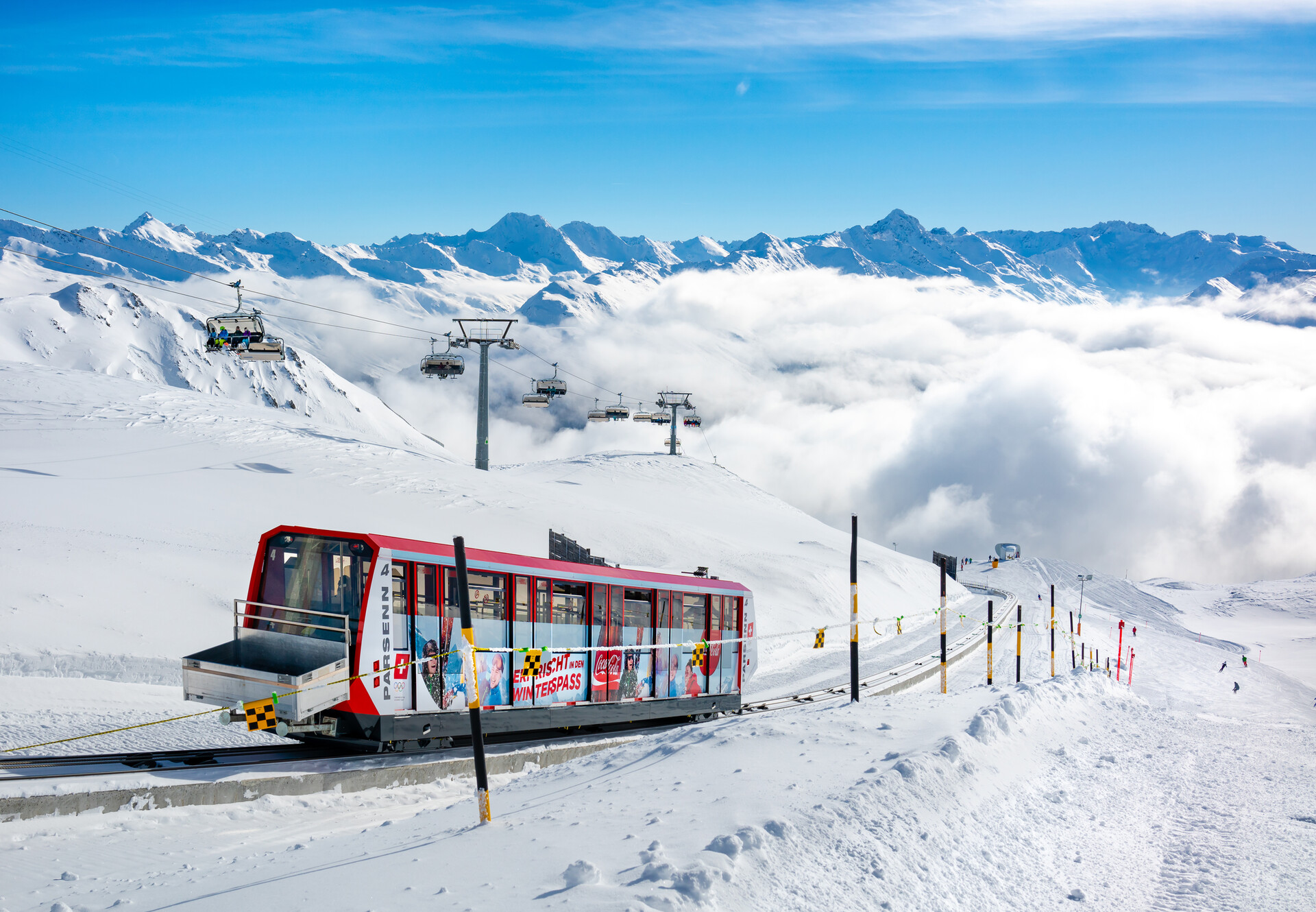
The Parsennbahn is one of the most famous funicular railways in the Alps. For over 90 years, skiers and snowboarders have been transported from Davos Dorf to the Weissfluhjoch on the 4 km long route, which consists of two sections. There, the facility, which was modernised in 2002, opens up the heart of the Davos Klosters Mountains ski area with its 211 kilometres of slopes at an altitude of up to 2,844 m.
FAQs about funicular railways
What are the advantages of funicular railways in ski resorts over gondola lifts or chairlifts?
Funicular railways run on rails and are therefore particularly stable, making them ideal for steep routes and difficult weather conditions. Unlike gondolas or chairlifts, they do not float freely but are firmly guided. This makes them particularly weather-independent, efficient and comfortable, a real advantage especially in strong winds.
How does a funicular railway in a ski resort work technically?
Funicular railways usually consist of two carriages connected by a cable. While one cabin travels uphill, the other travels downhill, acting as a counterweight system that saves energy. The drive unit is usually located in the mountain station and provides the movement via a large drive wheel.
Which funicular railways in the Alps are particularly interesting for winter sports enthusiasts?
The best known are the Sunnegga funicular in Zermatt, the Parsenn funicular in Davos, the Funival in Val-d’Isère and the Funiculaire Arc en Ciel in Les Arcs. They provide direct access to the core areas of large ski resorts and enable quick and convenient access to hundreds of kilometres of slopes.
Do funicular railways also operate in heavy snowfall or wind?
Yes, funicular railways really come into their own in extreme weather conditions. Their fixed track on rails and largely underground or covered route make them particularly robust. Examples such as the underground Funival or the Kaprun glacier shuttle show how reliably funicular railways operate even in alpine conditions.
Which funicular railway in the Alps has the longest route and the greatest difference in altitude?
The Parsennbahn in Davos is one of the most impressive systems of its kind, with a route length of 4,086 m and an altitude difference of 1,105 m. It provides direct access to the Davos Klosters ski area from the valley and takes winter sports enthusiasts quickly and comfortably to the Weissfluhjoch, which is over 2,800 m high.

