
No ski runs, no skiing fun. Every winter sports enthusiast knows this, because if you want to carve perfect turns in the snow with your favourite skis, you need a suitable run. Yet in the mountains in winter, no two ski runs are the same: flat, steep, wide, long, ungroomed or groomed. But what makes a good run? Are there other types of run besides alpine slopes? And where can ski enthusiasts find the world’s best slopes? SnowTrex aims to answer all these questions.
What are ski slopes?
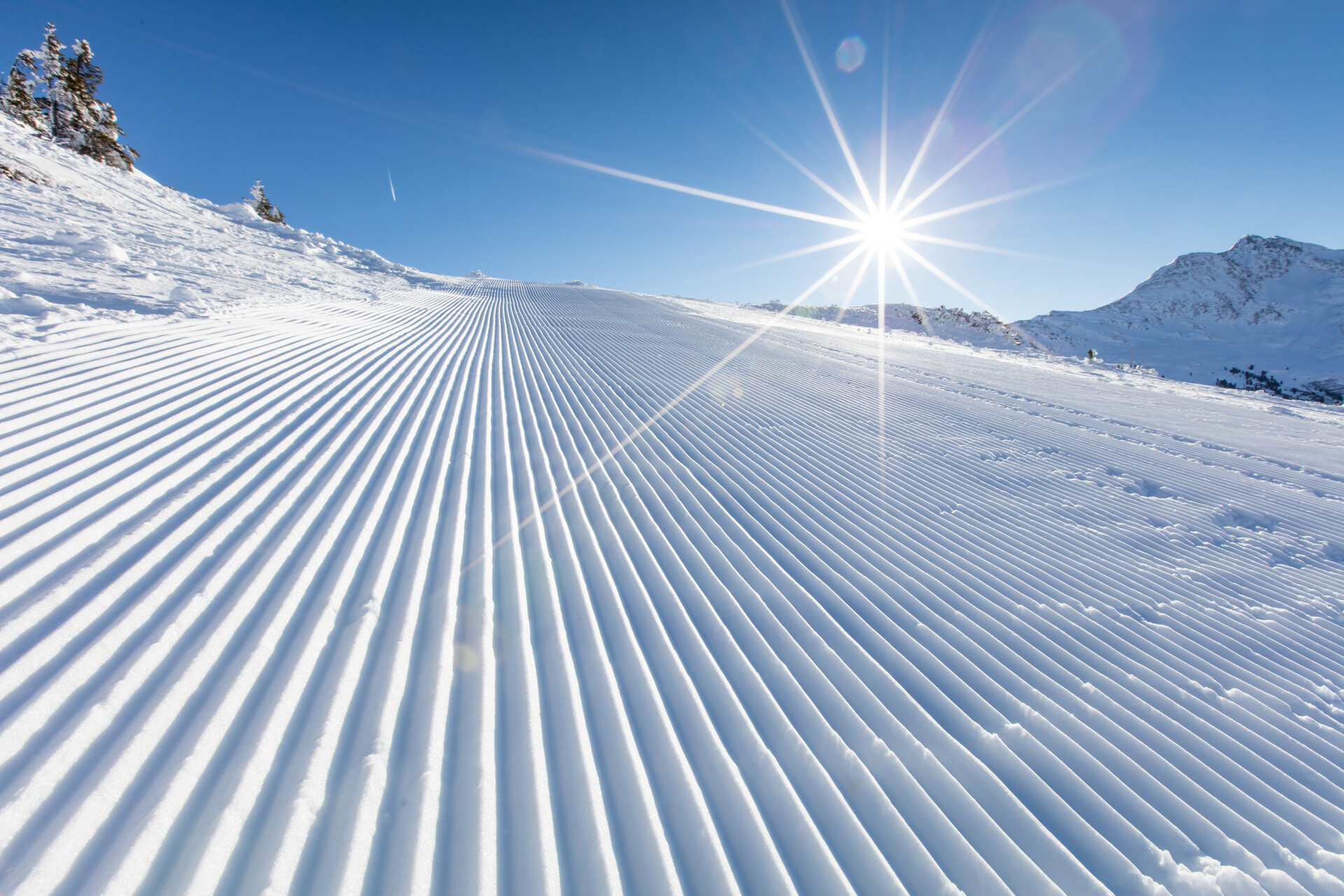
Ski slopes can be found in every ski resort around the world. In winter, the mountain slopes are specially groomed for skiers and snowboarders so that winter sports enthusiasts can carve their turns into the snow. Each ski run varies in gradient, width and difficulty, making each one unique and able to cater to the different needs of ski enthusiasts of all ages. These runs are important not only for recreational skiers and snowboarders, but also for professionals who compete on some of the world’s most challenging and famous slopes.
The slopes are always clearly marked with different coloured markings indicating the level of difficulty, and are secured with nets or mats at critical points. To help winter sports enthusiasts find their way around, the runs are now also shown on digital and printed piste maps.
The following types of ski runs exist
Downhill runs
By far the most common type of slope is the downhill run. These are used by skiers and snowboarders. The runs are usually groomed daily during the winter, are sometimes illuminated at night by slope lighting, and offer a wide range of difficulty levels:
- Blue/Green: Easy slopes with a gentle gradient, ideal for beginners. In the European Alps, around 50 per cent of all slopes are marked blue – and in France, green as well. These slopes are usually wide and allow beginners to practise their first turns in safe terrain.
- Red: Medium-difficulty slopes for advanced skiers. Around 40 per cent of the slopes in the Alps fall into this category. They challenge skiers with plenty of variety without being too difficult.
- Black: Difficult slopes with steep gradients for experienced skiers. Around 10 per cent of all ski runs in the Alps are marked black. These steep runs require technical skill and courage and, due to their gradient, are not always groomed, meaning that icy sections or mogul runs present additional difficulties.

Clear piste markings help skiers find the right run whilst also improving safety. To this end, all ski resorts use a standardised colour system of blue/green, red and black, as well as numbers to provide guidance and indicate the difficulty level of the run. In addition, piste rules and other information signs ensure further safety.
Freestyle slopes
Freestyle slopes, better known as snowparks, are slopes reserved for winter sports enthusiasts who wish to perform tricks on skis or snowboards, using obstacles such as kickers, rails and boxes on the slopes. An average snow park consists of ten to twenty such features, which are regularly renewed and adjusted by staff known as ‘shapers’. Among the best-known snow parks in the Alps are the Laax Snow Park in Switzerland, home to the world’s largest halfpipe, and the Absolut Park in Flachauwinkl, Austria. As well as competitions and other events, these parks attract tens of thousands of freestyle fans every winter.
Cross-country ski trails
Cross-country ski trails offer an experience close to nature and differ significantly from downhill slopes. Classic trails are groomed for the diagonal stride, whilst skating trails are designed for the skating technique. In total, there are over 5,000 km of trails in the Alps for both techniques. The trails often wind through picturesque landscapes and offer a peaceful yet immersive experience of nature. There are trails of varying lengths and levels of difficulty, ensuring that both beginners and experts get their money’s worth. For example, the Seefeld region in Austria offers more than 245 km of cross-country trails, ranging from easy to challenging routes. Furthermore, there are numerous cross-country skiing centres offering specialised courses and training sessions.

How ski slopes are maintained and made safe
Slope grooming
Using heavy machinery, ski resort staff work daily throughout the winter to ensure that the slopes are perfectly groomed for winter sports enthusiasts. State-of-the-art snow groomers are used for slope maintenance, and in the interests of sustainability, some ski resorts are already converting their fleets to electric vehicles. As well as natural snow, the snow groomers also spread large quantities of artificial snow, with hundreds of snow cannons in the major ski resorts producing, in some cases, thousands of cubic metres every night. This ensures that, even in adverse weather conditions, skiers are guaranteed the best possible slope conditions with an even snow cover. In the St. Anton ski resort, for example, snow groomer operators prepare over 50 km of ski slopes every day. The interplay between heavy machinery, snow cannons for covering the slopes and staff is now coordinated by computer programmes that ensure the optimal allocation of resources.

Safety measures
Safety fences and nets provide additional protection and guide skiers safely down the slopes. Many ski resorts have more than 10 km of safety nets along their slopes. These measures are particularly important in areas with difficult terrain or steep slopes. Rescue services are on standby at all times to provide rapid assistance in an emergency. Slope rules ensure everyone can enjoy the slopes safely together. In the Alps, an average of more than 20 piste rescue teams per ski resort ensure the safety of visitors. They are well-trained and can respond quickly in the event of accidents or medical emergencies.
The most famous ski runs in major ski resorts worldwide
In the Alps
Wengen, Switzerland
The Grindelwald/First & Kleine Scheidegg/Männlichen ski resort is a true skier’s paradise with 151 kilometres of varied slopes at altitudes of up to 2,500 metres. One of the most popular runs for skiers and snowboarders in Wengen is the Lauberhorn run. But be warned: it is one of the longest, fastest and most difficult World Cup runs of all! On many easy and gentle slopes, ski enthusiasts can enjoy the breathtaking panoramic views of the Eiger, Mönch and Jungfrau in glorious weather.
Mayrhofen, Austria
Hardly any other ski region in Austria is as popular as the Zillertal. This is also home to the Mayrhofen & Hippach ski area, which, alongside a lively après-ski scene, is renowned for its 142 kilometres of fantastic slopes at altitudes of up to 2,500 metres above sea level. One of the biggest challenges on the slopes in Mayrhofen is the ‘Harakiri’, which, with a gradient of up to 78 per cent, is one of the steepest runs in the world!

Please also note that by using our services and integrating the YouTube API Services, the YouTube Terms of Service and the YouTube API Services Terms apply and your use of our website is deemed to be acceptance of these terms.
Les 2 Alpes, France
Nestled in the heart of the French Alps lies the Les 2 Alpes ski resort, which, at an altitude of up to 2,560 m, is one of the highest-altitude ski resorts in France. Among the highlights of the 200 kilometres of slopes is the “Lauze” run. Stretching 17 km from the Dôme de la Lauze (3,568 m) to the village of Mont de Lans (1,280 m), it offers skiers and snowboarders one of thelongest valley runs in the Alps.
Via Lattea, Italy
The “Milky Way”, or the Via Lattea ski area, is Italy’s largest ski resort with 400 kilometres of slopes. The highest mountain station here is at 2,789 m, and the ski runs are correspondingly long, some of which end below the tree line. Consequently, some of the lower slopes are lined with larch and other conifers. On their way down to the valley stations of the cable cars, skiers can enjoy carving turns on magnificent forest runs.
In North America
Whistler Blackcomb, Canada
With 200 kilometres of slopes starting at an altitude of up to 2,284 metres, the Whistler Blackcomb ski resort is one of the largest of its kind in North America. It was not only the venue for the alpine events at the 2010 Vancouver Winter Olympics. Winter sports enthusiasts will also find some of Canada’s most beautiful ski runs in Whistler, including the “Peak to Creek” run, which covers a total of 1,530 metres in altitude over a distance of 11 km.

Aspen Snowmass, USA
What St. Moritz is to the Alps in Europe, Aspen is to the USA. Namely, the most luxurious ski resort in the Rocky Mountains. In the Snowmass ski area, not only Hollywood stars but also ‘everyday skiers’ can enjoy over 230 kilometres of slopes at an impressive altitude of up to 3,418 metres. As 95 per cent of the runs here are classified as intermediate (red) or advanced (black), the ski area – featuring the popular, almost 1.5 km-long ‘Bull Run’ run – also presents a challenge for expert skiers.
Tips for skiers on the slopes
Equipment and clothing
To enjoy skiing on the slopes to the full, good skiing equipment and the right clothing – above all, weatherproof clothing – are an absolute must. You simply can’t get by on the mountain without skis, ski boots, poles, a ski helmet and ski goggles. Modern ski clothing, such as ski gloves, ski jackets and ski trousers, should also be made from high-quality materials that ensure the clothing remains breathable and waterproof in wintry temperatures. This is the only way to guarantee optimum comfort on every run. At the end of the skiing season, it’s also important to wash your ski clothing and have your ski equipment serviced by professionals, so that both are well looked after over the summer and are ready for use again straight away next winter.
Safety rules and behaviour
Skiing is all about speed, and as the risk of injury to yourself and others should not be underestimated, you should always adhere to the applicable piste rules. Otherwise, winter sports enthusiasts should ski defensively and anticipate potential hazards to avoid accidents. This means always adjusting your speed to visibility conditions, giving way to skiers ahead of you and avoiding risky manoeuvres.
Preparation and training
Skiing is a sport that engages the whole body. Therefore, a certain amount of training and good physical fitness are essential for all skiing enthusiasts who want to enjoy themselves on the slopes. Popular activities to do before skiing include or fitness training. Regular endurance, strength and stretching exercises also help prepare the body for the physical demands of skiing.
Why ski slopes are so important
No ski slopes, no skiing fun – every winter sports enthusiast knows that. Ski slopes are essential for skiers and snowboarders to carve their turns into the snow. Every slope is unique, as they all differ in gradient, width and difficulty. From gentle blue runs for beginners, through red runs for intermediate skiers, to black runs for experts, there’s something for everyone. Careful grooming and comprehensive safety measures ensure optimal skiing conditions. International ski resorts such as Mayrhofen, Les 2 Alpes and Whistler Blackcomb offer some of the world’s best slopes and guarantee unforgettable winter experiences.
FAQ on ski slopes
What are ski slopes and why are they important for winter sports enthusiasts?
Ski slopes are runs in ski resorts that have been specially groomed for skiers and snowboarders. They vary in gradient, width and difficulty to meet the different needs of winter sports enthusiasts. Ski slopes are important for providing skiers with safe and optimal conditions for their runs.
What types of slopes are there?
The different types of slopes are: downhill runs, freestyle slopes (snow parks) and cross-country trails. Downhill runs are categorised by difficulty level as blue/green (easy), red (medium) and black (difficult). Snow parks feature obstacles for tricks and jumps, whilst cross-country trails are groomed for classic style and skating.
How are ski slopes maintained and groomed?
Ski slopes are groomed daily by snowcats, which ensure an even snow cover. Snow cannons also produce artificial snow to guarantee optimal conditions. Safety measures such as safety fences and nets protect skiers. In large ski resorts, these tasks are supported by well-coordinated teams and state-of-the-art technology.
Where are some of the best ski slopes in the world?
Some of the best ski slopes are found in well-known ski resorts such as Wengen (Switzerland), Mayrhofen (Austria), Les 2 Alpes (France) and Whistler Blackcomb (Canada). These resorts offer a wide variety of runs of all difficulty levels and are renowned for their excellent snow conditions and breathtaking scenery.
What should you bear in mind regarding equipment and safety on the slopes?
Good equipment and weatherproof clothing are essential for enjoying skiing. Skis, ski boots, poles, a helmet and ski goggles are all part of the basic kit. Safety rules such as maintaining an appropriate speed, giving way to others and avoiding risky manoeuvres are important for preventing accidents. The 10 FIS rules provide a good guide to behaviour on the slopes.

