
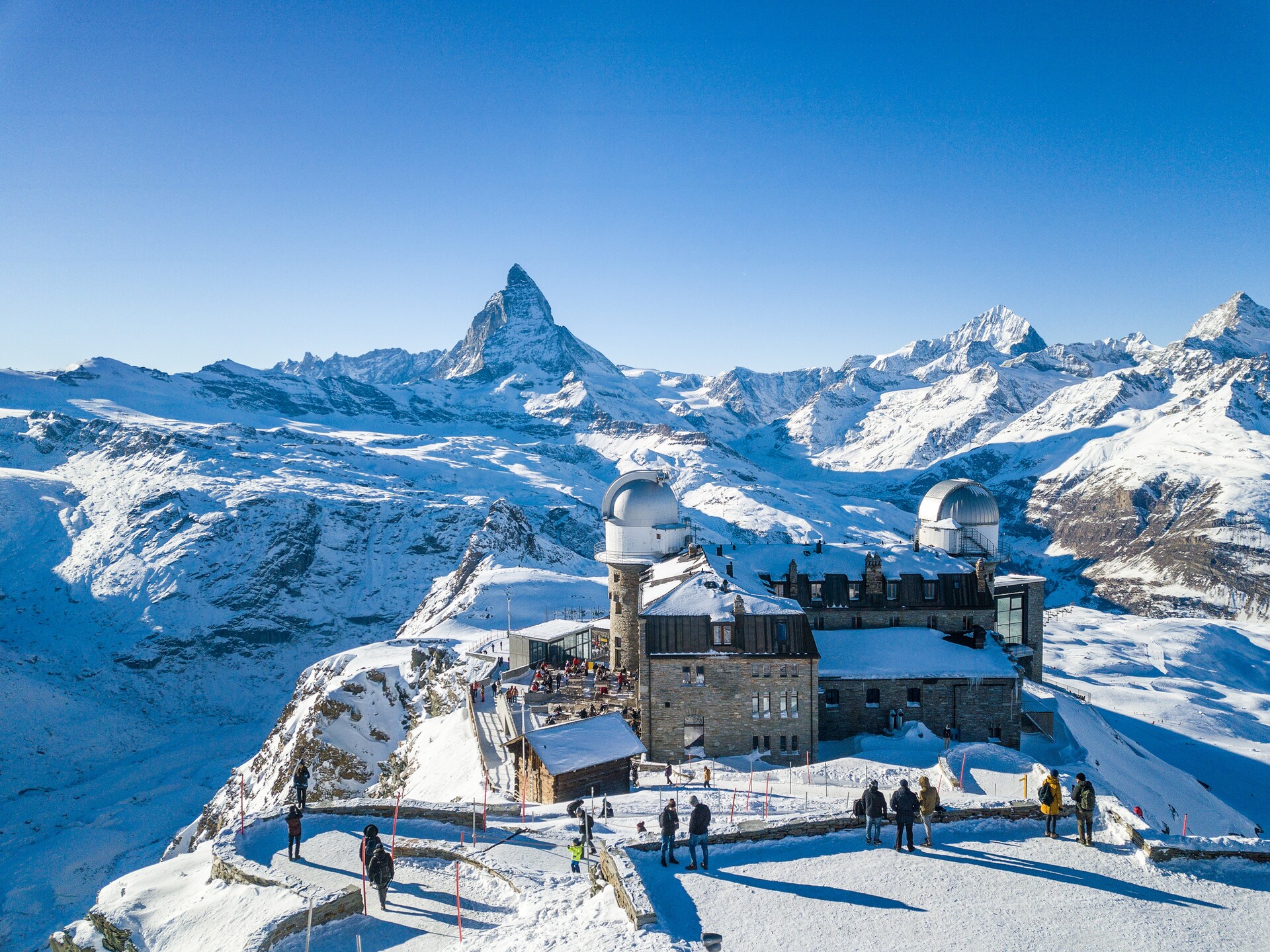
Skiing on perfectly groomed slopes in Switzerland, surrounded by iconic 4,000-metre peaks such as the Matterhorn, relaxing in charming ski resorts and enjoying local culinary specialities such as raclette and fondue. This is the dream of many winter sports enthusiasts. And to ensure it stays that way, the Swiss Confederation has launched ‘Swisstainable’. SnowTrex explains how the sustainability programme works, what ski resorts are doing to support it, and what benefits it offers travellers.
What is Swisstainable?
Swisstainable is Switzerland Tourism’s sustainability programme, which aims to ensure that tourism in Switzerland is sustainable and in harmony with nature, not just in winter but throughout the year. It is based on three pillars: protecting the environment, promoting local culture and creating an authentic holiday experience for visitors. To implement these principles in the long term, Swisstainable seeks to minimise the impact of tourism on nature whilst offering visitors a sustainable and high-quality travel experience. The fact that Switzerland has always placed great importance on environmental protection and quality of life is demonstrated by the simple fact that the air here is so clean that the whole country considers itself a climatic health resort.
Swisstainable in winter
For travellers who prioritise sustainability, Swisstainable offers numerous benefits. They can be confident that eco-friendly ski resorts in Switzerland bearing the Swisstainable label utilise carbon-neutral technologies, such as low-emission ski lifts and resource-efficient snow cannons, which significantly reduce their environmental footprint. On site, many accommodation providers also operate with sustainability in Swiss tourism firmly in mind. For example, hotels and holiday apartments prioritise eco-friendly construction methods, energy-saving technologies and the use of local, environmentally friendly products. Furthermore, climate-friendly travel is a top priority at these destinations. If they do not have their own railway station, the ski resorts either offer seamless connections to public transport or shuttle services to the accommodation.
Sustainable travel by train
Anyone wishing to travel to a ski resort by train and wanting to know just how seriously Switzerland takes its rail network need only compare investment in this area with that of Germany, for example. Whilst Switzerland spends just under 450 euros per capita on rail infrastructure each year, the figure in Germany is a mere 110 euros. This enables the approximately 3,000 km-long rail network in Switzerland to be maintained in excellent condition. This enables Swiss Federal Railways (SBB) to operate more than 11,000 trains a day, transporting 1.1 million passengers to their destinations on time every 24 hours. Another advantage of the world’s densest rail network is that even the most remote ski resorts can be reached by train via spectacular routes through the mountains.
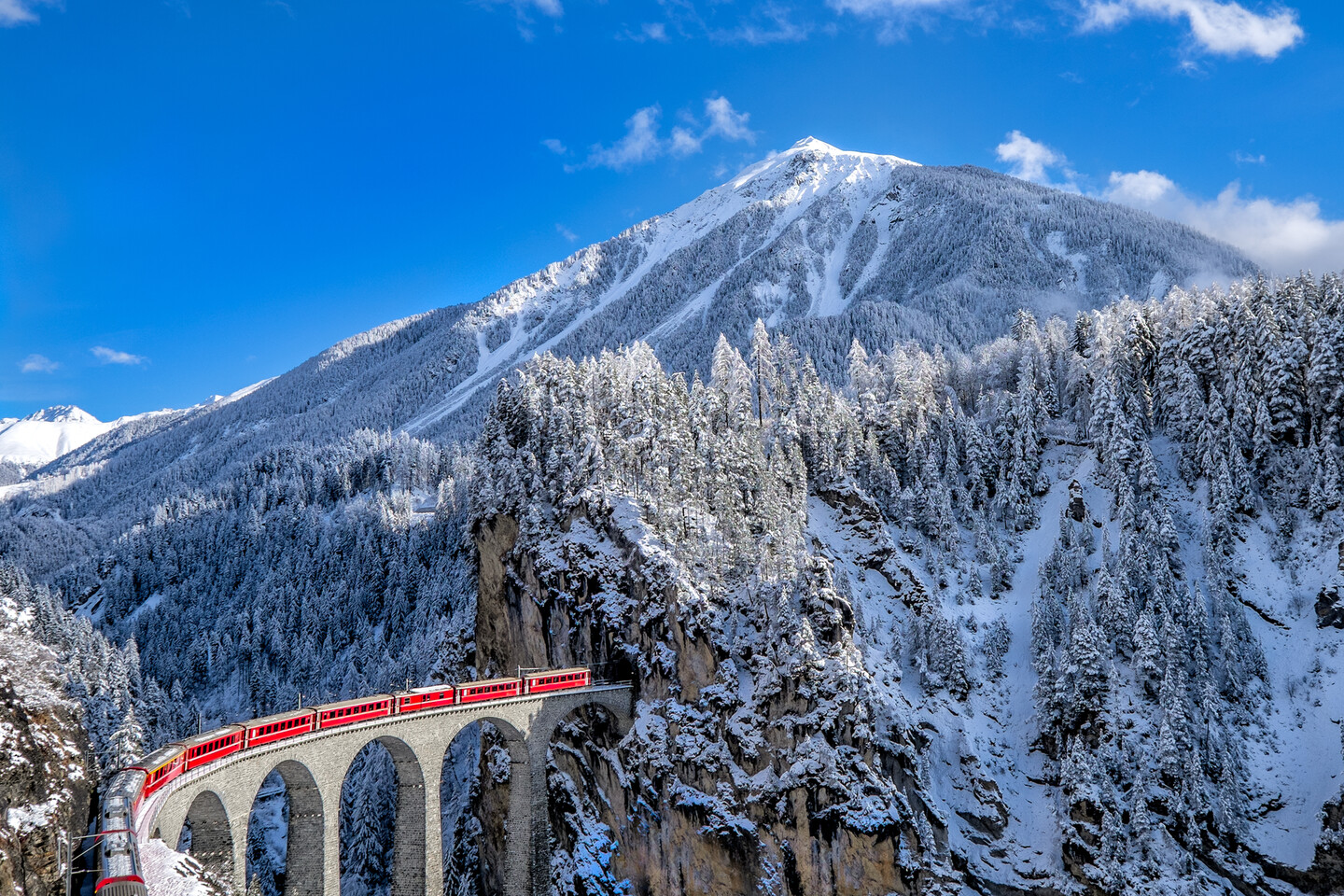
Winter sports enthusiasts travelling by ICE from their own front door to major Swiss cities such as Basel or Zurich can switch to the Swiss Travel Pass there. With this ticket, you can travel unlimitedly across the entire Swiss rail network for 3, 4, 6, 8 or 15 days, and children under 6 even travel for free! The Travel Pass even includes famous panoramic trains such as the Glacier Express, the Bernina Express and the Gotthard Panorama Express. The only additional cost is for seat reservations. Also included in the ticket: use of local public transport in 90 towns and cities, as well as free entry to 500 museums – which is sure to delight culture lovers.
Swisstainable-committed: Ski destinations are committed to sustainability
As well as major cities such as Basel, Zurich and Lucerne, a number of mountain destinations are now firmly committed to Swisstainable. Overall, the sustainability programme is divided into three levels for all participants.
- Level 1 – committed: a commitment to sustainable corporate management and the development of sustainability
- Level 2 – engaged: as per Level 1, but with verification
- Level 3 – leading: recognised proof of sustainability covering all aspects of the topic, which is regularly audited by an external body
The destinations certified by Swisstainable include many ski resorts linked to some of Switzerland’s most famous slopes. There, guests can not only enjoy top-class winter sports, but can also be sure that the protection of the Alpine landscapes in which they are skiing is a top priority for the local authorities responsible. These include:
Engelberg
Sustainability has long been a top priority in the Engelberg ski resort. At the foot of the Titlis Glacier, there are 82 kilometres of slopes served by 29 lifts, including the spectacular Titlis-Rotair cable car, which is powered 100 per cent by hydroelectricity and is therefore almost carbon-neutral. The slopes at Brunni, which are very popular with families, are in fact Switzerland’s only certified climate-neutral ski resort! Since 2016, the electricity for snowmaking on the slopes has been generated by a solar power plant at the middle station, and the Brunni-Bahnen are the first cable car operator ever to use exclusively LED lights to illuminate the slopes for night skiing.

Davos
The Davos-Klosters ski resort is firmly convinced that investments in energy efficiency and environmental protection pay off. It is no coincidence that, in the name of sustainability, Davos has in the past invested tens of millions in the construction of solar panels on buildings and mountain railways within the ski resort, which generate 203,000 kilowatt-hours (kWh) of electricity annually, equivalent to the annual electricity consumption of around 180 households. Added to this are the two hydroelectric power stations at Jakobshorn and Rinerhorn, which generate over 2 million gigawatt-hours (GWh) of electricity over the same period for mountain restaurants, cable cars and households in Davos. Furthermore, guests wishing to enjoy skiing at altitudes of up to 2,888 metres on 211 kilometres of slopes are encouraged to leave their cars at home when travelling to and from the resort and to use the excellent Swiss rail network instead. After all, a train journey from Zurich to Davos alone produces 25 times less CO₂ here.
Arosa Lenzerheide
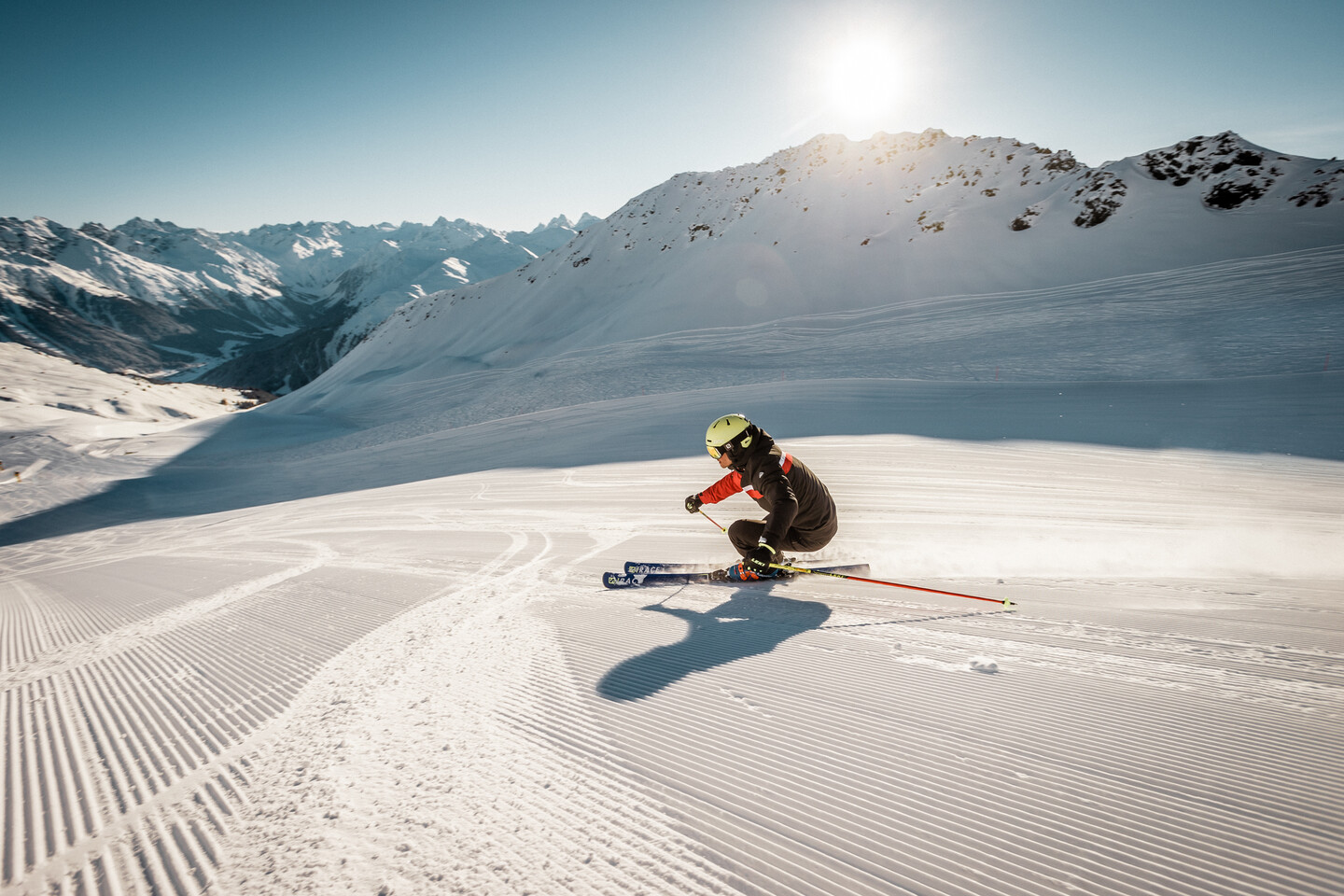
Reducing energy consumption without compromising on skiing enjoyment. That is the plan at the Arosa Lenzerheide ski resort when it comes to balancing ski tourism with environmental protection. This means that whilst skiers and snowboarders let off steam here at altitudes of up to 2,865 metres across a total of 225 kilometres of slopes, they are barely aware of how energy is being saved behind the scenes. Five solar power systems also play a part in this; the energy they generate is sufficient to power the Stätzerhorn and Täli ski lifts throughout the winter. And when it comes to grooming the slopes, it’s no longer just one electric snow groomer that’s being used. Thanks to satellite-controlled snow depth management, the snowcat operators always know exactly where there is snow and how much, which saves on diesel. Furthermore, computer-optimised snowmaking significantly reduces water and electricity consumption.
Flims-Laax-Falera
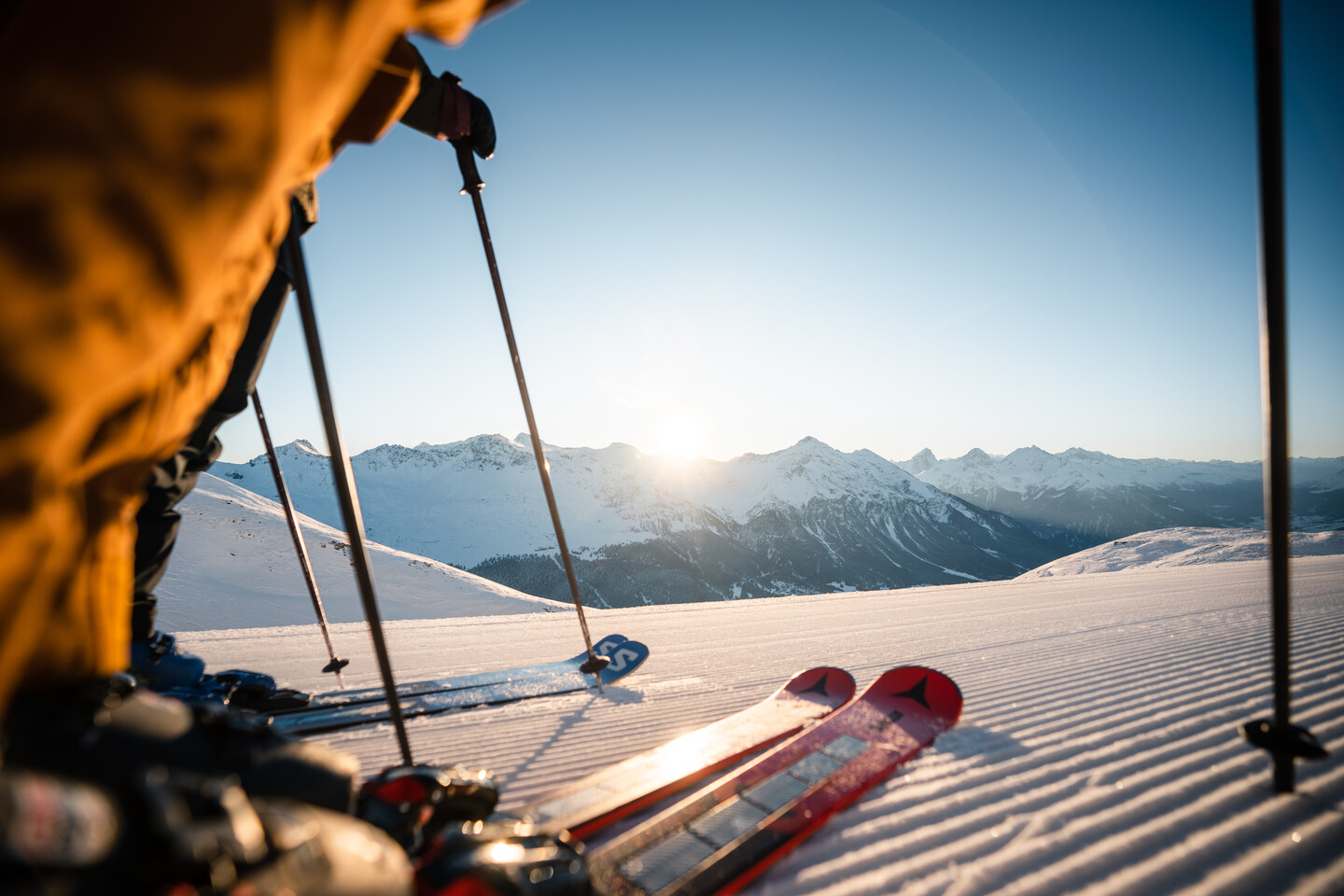
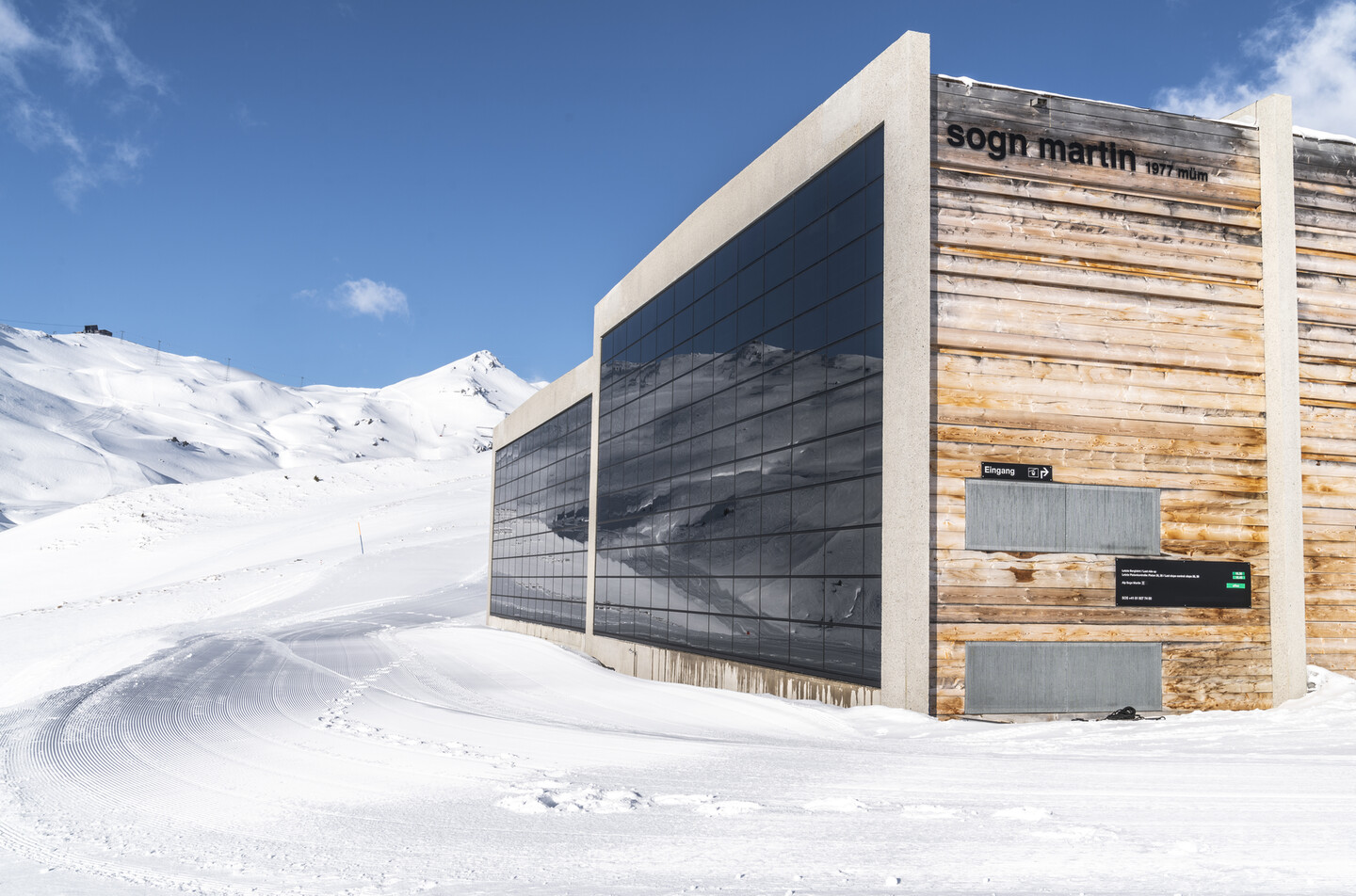
Flims-Laax-Falera is a pioneer in sustainability in Switzerland – one of the most climate-friendly ski resorts in Europe. The magic word across 188 kilometres of slopes at altitudes of up to 3,018 metres is ‘Greenstyle’. The ski resort’s sustainability initiative focuses precisely on the areas with the greatest potential for CO₂ savings: building services and transport. A seven-point plan aims to transform the three ski resorts into the world’s first self-sufficient Alpine destination. Flagship projects include, on the one hand, the plan to meet 100 per cent of the total energy demand with regionally produced renewable energy, and, on the other, the refurbishment of the Crap Sogn Gion mountain station. This iconic building, dating from 1968, is being completely refurbished for the 21st century and will ultimately be converted from an energy consumer into an energy producer.
Saas Fee
The Saas-Fee ski resort is open 365 days a year. On the Feegletscher, both amateur and professional skiers can enjoy consistently excellent snow conditions at altitudes of up to 3,573 metres across 100 kilometres of slopes. To ensure this remains the case in future, Saas-Fee has been committed to sustainability in line with the Swisstainable initiative for decades. As a result, this village in the Valais is not only traditionally car-free, but – together with the mountain railways – also sources 100 per cent of its electricity from hydropower. Among the ambitious energy-saving projects in the ski resort is the photovoltaic system on the Kreuzboden in Saas-Grund, which supplies the cable car with electricity and will save 570 tonnes of CO₂ over the next 25 years. Another example is the “ProKilowatt” project, which the Saastal Bergbahnen are carrying out in collaboration with the Swiss Federal Office of Energy and which aims to reduce the heating energy required by the snow-making systems by up to 75 per cent.

Please also note that by using our services and integrating the YouTube API Services, the YouTube Terms of Service and the YouTube API Services Terms apply and your use of our website is deemed to be acceptance of these terms.
Jungfrau Region
To preserve the natural beauty surrounding the Eiger, Mönch and Jungfrau, sustainability is also a top priority in the Jungfrau Region. In one of Switzerland’s most beautiful mountain regions, protecting the environment is just as much a priority as the enjoyment of skiing on up to 208 kilometres of slopes at an altitude of 2,970 metres. For years now, the ski lifts operated by the Swisstainable-certified Jungfraubahnen Group have been powered by 100 per cent renewable electricity, predominantly from hydropower. To reduce water consumption without compromising snow reliability, the snow-making systems on the slopes are equipped with environmentally friendly technologies for more efficient operation. And anyone visiting the Jungfrau Region will quickly realise just how seriously waste prevention is taken. Awareness campaigns promote the correct handling of waste; in the hospitality sector, reusable systems for crockery and cutlery have been introduced.

Swisstainable – Enjoying sustainability
And, of course, Swisstainable doesn’t end here, away from the slopes – quite the opposite, in fact. As well as entire ski resorts, individual establishments such as hotels or restaurants can also take part in the Swiss sustainability programme and achieve Levels 1 to 3. To date, over 1,400 hotels, youth hostels, mountain huts and holiday apartments have been certified. Not only do they rely on modern technology to boost energy efficiency and use environmentally friendly building materials, but the accommodation is also optimised for people with reduced mobility. After all, inclusion is another key aspect of Swisstainable, in line with its holistic understanding of sustainability.

The same applies to sustainable cuisine. In Switzerland, regional produce has played a central role in local cuisine for centuries, which is traditionally characterised by specialities such as cheese fondue and raclette. These classic comfort dishes are not just there for winter sports enthusiasts to enjoy during the cold season. They also have significant environmental benefits, as their preparation – thanks to low meat consumption and the use of regional ingredients – actively contributes to reducing CO₂ emissions. This is an approach that thousands of catering establishments across Switzerland have now adopted. In addition, over 5,000 restaurants across the country are taking part in the ‘Too Good To Go’ initiative, which aims to reduce food waste, or are introducing ‘Veggie Days’ on their own initiative, whilst other restaurants have completely removed meat from their menus.
FAQ on Swisstainable
What is Swisstainable?
Swisstainable is a sustainability programme that aims to make tourism in Switzerland more environmentally friendly. Ski resorts bearing the Swisstainable label, for example, rely on carbon-neutral technologies such as low-emission ski lifts and resource-efficient snow cannons. In addition, many accommodation providers have been built using eco-friendly construction methods and also utilise energy-saving technologies or prioritise the use of local products. This enables winter sports enthusiasts to enjoy a sustainable skiing holiday without compromising on comfort or quality.
What benefits does Swisstainable offer winter sports enthusiasts?
Swisstainable-certified ski resorts enable skiers to experience an environmentally friendly winter holiday. These resorts feature CO₂-neutral ski lifts, climate-friendly snow cannons and sustainable accommodation. This means winter sports enthusiasts can be sure that their holiday has a minimal impact on the environment. Furthermore, the ski resorts place great importance on climate-friendly travel, for example through direct train connections or free shuttle services.
Does sustainable travel by train play a major role for Swisstainable?
In short: yes. After all, Switzerland has always invested heavily in its rail infrastructure and can therefore boast one of the densest rail networks in the world, which connects even remote ski resorts to major cities via spectacular routes. With the Swiss Travel Pass, winter sports enthusiasts can travel through Switzerland comfortably, on time and entirely without a car, as numerous ski resorts are directly accessible by train. In this way, they help to reduce their own carbon footprint whilst enjoying a stress-free journey.
What sustainable measures are in place at Swisstainable-certified ski resorts?
Ski resorts certified by Swisstainable all prioritise sustainable measures such as renewable energy and state-of-the-art technologies. In Engelberg, for example, the Titlis-Rotair cable car is powered by hydroelectricity, and the Brunni area is Switzerland’s first climate-neutral ski resort. In the Davos-Klosters ski resort, solar panels and hydroelectric power stations generate the electricity needed for the ski lifts and mountain huts. Arosa Lenzerheide uses satellite-controlled snow depth management and electric snow groomers to reduce energy consumption. And Flims-Laax-Falera is aiming for a self-sufficient energy supply by powering all its facilities with regionally produced renewable energy.
How important is sustainable cuisine on a skiing holiday within the Swisstainable framework?
Very important. Because in ski destinations certified by Swisstainable, regional and sustainable food plays a central role simply because of tradition. Classic Swiss dishes such as cheese fondue and raclette have always been prepared with local ingredients, which means they generate lower CO₂ emissions, for example. In addition, over 5,000 restaurants are taking part in initiatives such as ‘Too Good To Go’ to reduce food waste, or are introducing ‘Veggie Days’ to cut down on meat consumption.

