Skiing in Alpe d’Huez thrives on perfect high-alpine winter conditions and a diverse sports and cultural programme in the heart of the French Alps. Around this traditional ski resort in the Isère department, varied slopes for all ability levels at altitudes of up to 3,330 m await, along with relaxation off the pistes. SnowTrex presents 10 great reasons why a winter ski trip to Alpe d’Huez is definitely worth it.
1. Pure Slope Paradise with 250 km of Runs
- The ski area connects five valley villages with 250 km of pistes and 72 lifts
- Altitude difference of 2,000 m between Pic Blanc (3,300 m) and Enversin d’Oz (1,389 m)
- Over 100 varied pistes for beginners, intermediates, and experts
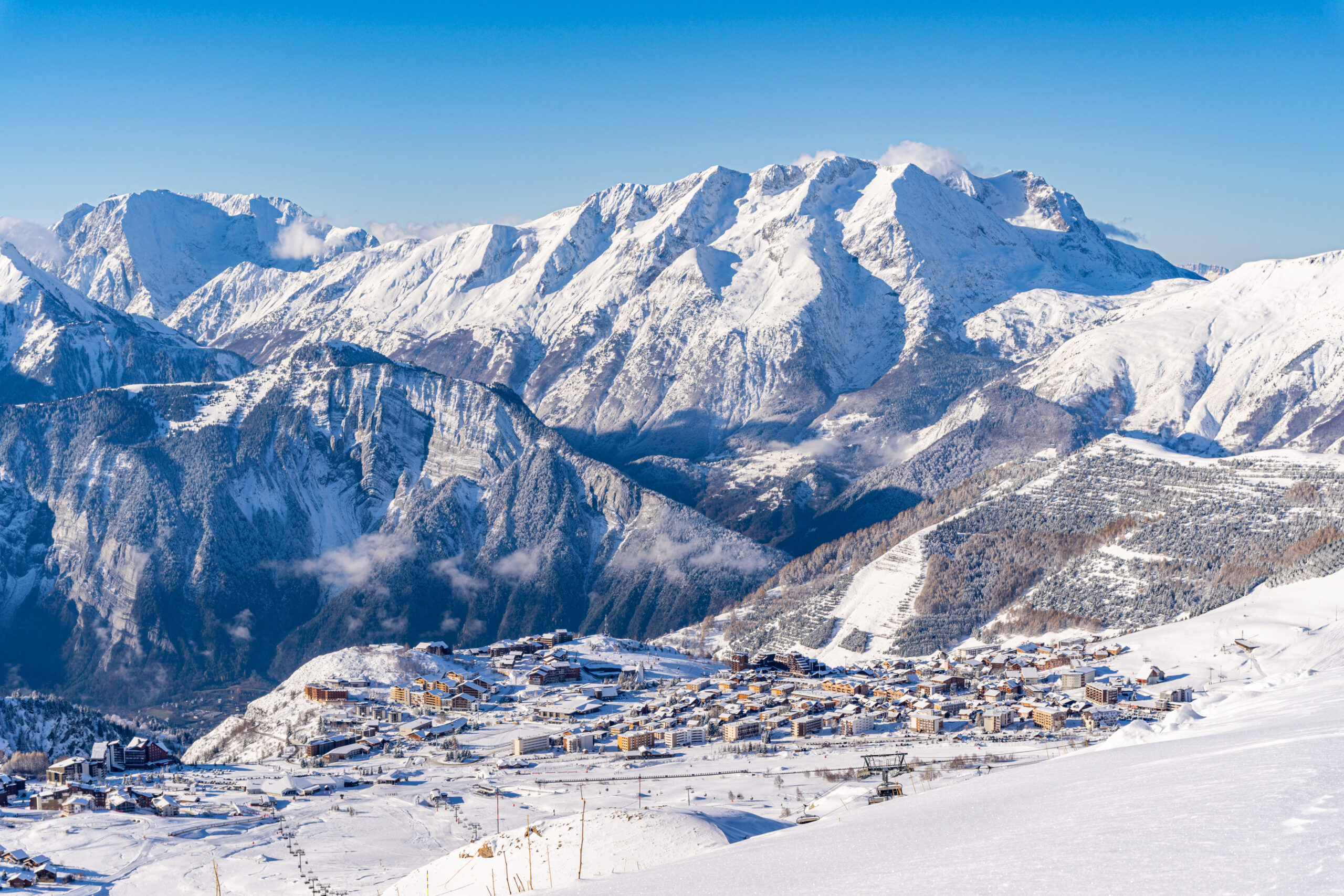
The Alpe d’Huez ski area boasts 250 kilometres of pistes at altitudes of up to 3,300 m, linking five ski resorts to form one of the most prominent winter sports regions in France. Around this ski station, famous well beyond its Tour de France acclaim, skiers and snowboarders can choose from over 100 marked and perfectly groomed pistes, divided into more than 30 green, nearly 30 blue, almost 30 red, and around 15 black runs. Thanks to 72 lifts and cable cars, many of which are state-of-the-art, it is also easy to glide effortlessly between the valley villages of Alpe d’Huez, Auris-en-Oisans, Villard-Reculas, Oz 3300, and Vaujany.

Please also note that by using our services and integrating the YouTube API Services, the YouTube Terms of Service and the YouTube API Services Terms apply and your use of our website is deemed to be acceptance of these terms.
From the highest point of the ski area at Pic Blanc (3,330 m) down to L’Enversin d’Oz (1,125 m), you can conquer an impressive vertical drop of over 2,000 metres. From the villages down in the valley, modern cable cars like the “Eau d’Olle Express” take you back in just a few minutes to the higher sectors of Alpe d’Huez, which offer even greater snow security. Overall, the terrain in one of France’s largest ski areas is split between gently sloping, sunny hillsides near the base and steep corries and couloirs in the high-alpine summit zone.
Leisurely skiers can carve wide turns into the grippy snow on wide runs like the “Boulevard des Marmottes”, while ambitious skiers can test their skills on the steep descents in the “Signal” or “Grandes Rousses” sectors.
2. Legendary Runs at the Col de la Sarenne and Le Tunnel
- At 16 km, “Sarenne” is the longest black run in Europe
- The “Le Tunnel” run leads straight through solid rock and features an incline of up to 70 percent
- Direct access to top runs right from the summit of Pic Blanc at 3,330 m
The “Sarenne” and “Le Tunnel” runs are among the most demanding pistes in the entire Alpine region and represent genuine challenges even for expert skiers. One of the ultimate descents in Europe’s highest mountain range starts right at the top station of the Pic Blanc cable car at 3,330 m. Against a dramatic backdrop of rugged rock faces, skiers drop into the “Sarenne”, carving their way down over a distance of 16 km and around 1,800 metres of vertical descent into the quiet Sarenne Gorge at 1,510 m.

Please also note that by using our services and integrating the YouTube API Services, the YouTube Terms of Service and the YouTube API Services Terms apply and your use of our website is deemed to be acceptance of these terms.
Strong leg muscles are required especially on the steep glacier slopes of the upper section before the run transitions into gentler gliding sections through the middle and lower parts. On the descent, particularly under glorious bluebird skies, skiers can soak up the alpine scenery along a frozen mountain stream winding through an almost untouched high valley completely free of lift pylons or infrastructure. It is precisely this uninterrupted route that makes the “Sarenne” one of the longest valley runs in the world.
A stark contrast to the “Sarenne” is the “Le Tunnel” run. Its entrance is a 200-metre-long tunnel carved into the rock face, giving the descent its name. Exiting the shaft, skiers, and snowboarders are greeted by a sheer, 70-percent-incline face densely packed with massive moguls. Consequently, first-class skiing technique is required on this demanding passage, as “Le Tunnel” easily ranks among the steepest pistes on the planet. Yet “Sarenne” and “Le Tunnel” are not the only classics in Alpe d’Huez: black runs like the “Piste du Glacier” and “Clocher de Macle” offer further thrills for expert winter sports enthusiasts.
→ Plan your Alpine getaway and find the best Alpe d’Huez deals at SnowTrex
3. Guaranteed Snow at Altitudes of up to 3,330 m
- Altitudes of up to 3,330 m at Pic Blanc
- 1,071 snow cannons cover 88 km of pistes with artificial snow
- A long ski season from early December to late April
With altitudes reaching up to 3,330 m at Pic Blanc and its proximity to the Sarenne Glacier, Alpe d’Huez is among the most snow-reliable ski resorts in the Isère department. Most of its pistes lie well above the tree line at over 2,000 m, where consistently cold temperatures ensure a solid snow base. Cold mountain winds at this altitude also preserve dry powder on the north- and west-facing slopes throughout the winter.
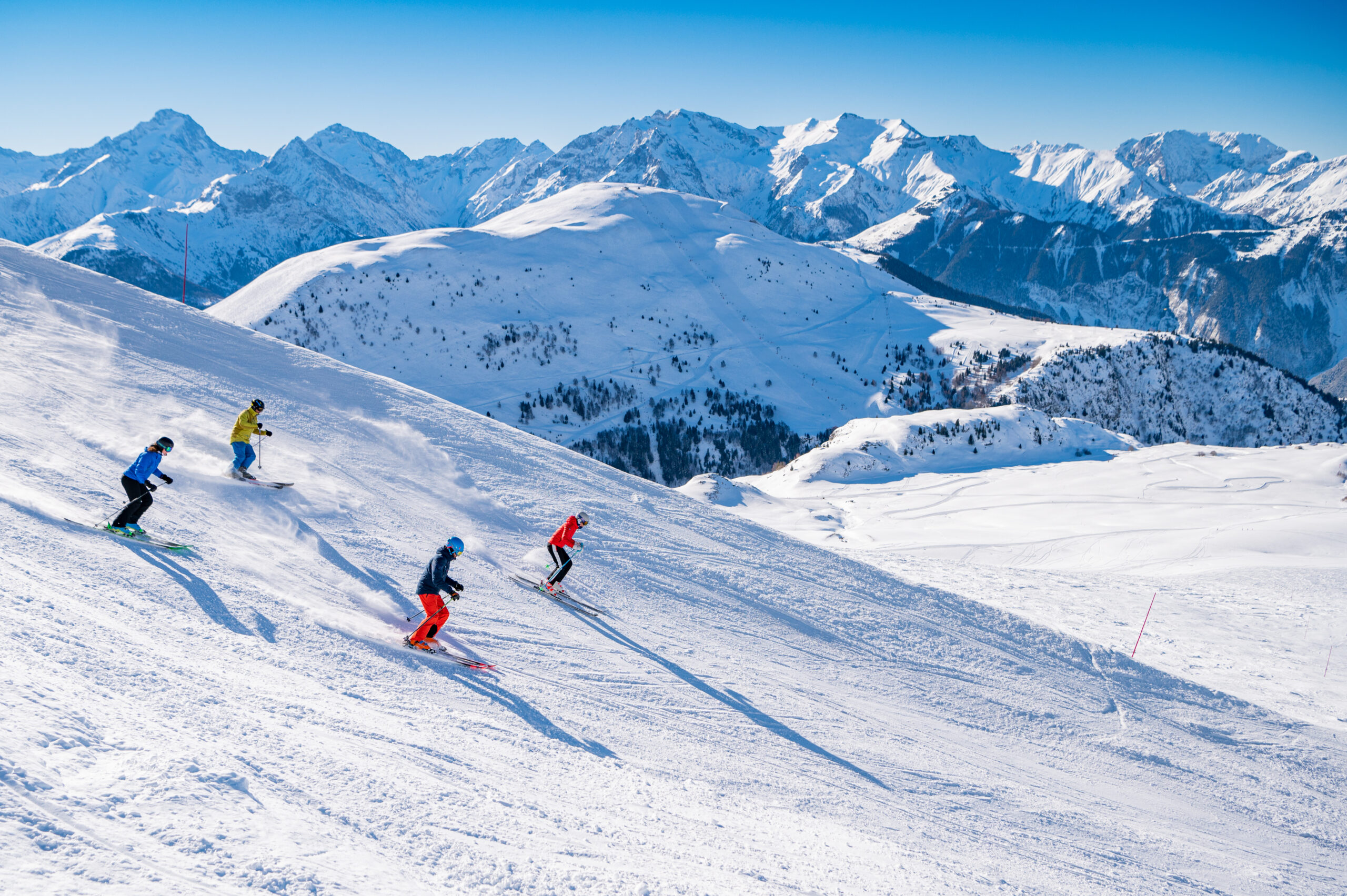
To ensure excellent snow quality on the lower slopes as well, the valley runs are backed by a network of 1,071 snow cannons covering a total of 88 kilometres of pistes. This ensures that valley links to Vaujany (1,250 m) and Villard-Reculas (1,500 m) remain open throughout the entire ski season, which typically runs from early December until late April or even into May.
SnowTrex Tip: With the SnowTrex Snow Guarantee, holidaymakers can book their stay risk-free. If there is a lack of snow at your chosen destination, you can easily rebook to an alternative destination free of charge.
4. Sunny High-Altitude Climate and Dream Panoramas from Pic Blanc
- South-facing slopes grant Alpe d’Huez around 300 days of sunshine a year and the nickname “L’Île au Soleil”
- Must-visit sun terraces, such as the one at Salle Hors-Sac at 2,100 m
- 360-degree panoramic views from Pic Blanc taking in one-fifth of France’s mainland territory
Averaging around 300 days of sunshine per year, Alpe d’Huez boasts fantastic weather conditions even in the heart of winter, rightfully earning its moniker “L’Île au Soleil” (“Island of the Sun”). The plateau hosting the resort itself sits at 1,860 m, facing south over the Romanche Valley. As a result, skiers and snowboarders can soak up the warming winter sun on the runs or on the terraces of mountain huts from early morning until late afternoon.
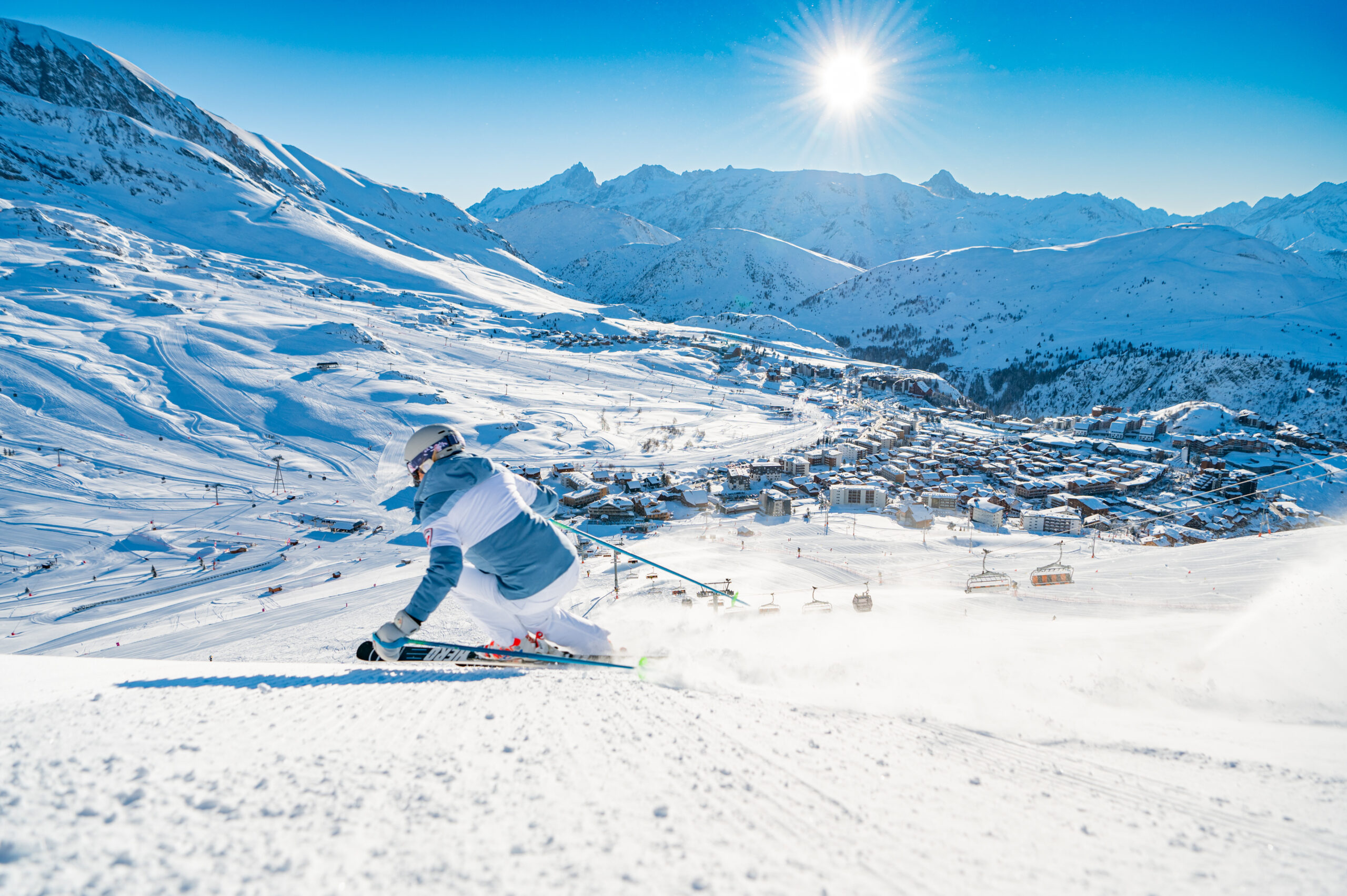
The greatest panorama, however, unfolds from the summit of Pic Blanc at 3,330 m, with a 360-degree view taking in the highest massifs of the French Alps. On a clear day, it is not uncommon to see from Mont Blanc (4,806 m) over the jagged teeth of the Aiguilles d’Arves (3,514 m) to the glaciated peak of La Meije (3,984 m), effectively taking in roughly a fifth of France’s mainland territory from this single viewing platform.
Guests can secure these breathtaking views via the “Pass Direct au Pic” service, which allows visitors to reserve dedicated time slots in advance to avoid queuing for the summit cable car. In addition, the sun terraces around the mountain stations, such as the “Salle Hors-Sac” at 2,100 m, are a must-visit, offering a chance to enjoy hot and cold drinks outdoors behind wind-sheltered panoramic glass.
→ Secure unforgettable ski moments in Oisans with SnowTrex now
5. Family-Friendly Deals and Adventure Zones
- Alpe d’Huez has been awarded the prestigious French “Famille Plus” seal of approval
- Free beginner lifts and magic carpets right in the village
- Three playfully designed themed pistes and funslopes for kids and beginners
Alpe d’Huez has held the renowned French “Famille Plus” seal of approval since 2013, offering a top-tier infrastructure tailored to families with children. Right in the valley, three lifts await young visitors: the Tapis Grenouille, the École 1 drag lift, and the Tapis du Petit Rif Nel, all of which can be used completely free of charge without a ski pass. Dedicated and marked beginner zones in the “Les Bergers” and “Grandes Rousses” sectors allow children to practice their first turns safely away from the busier slopes.
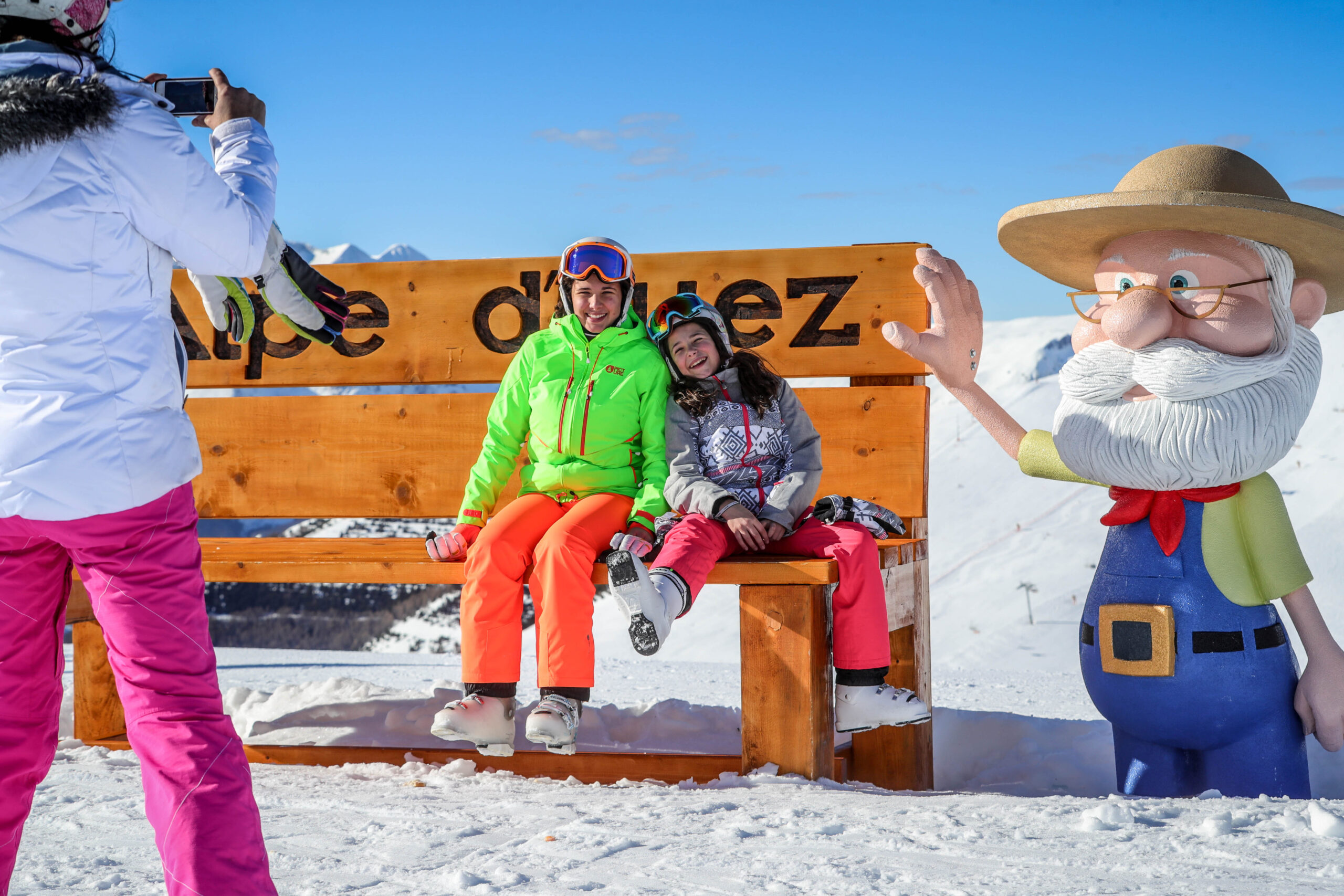
For kids who have already mastered the basics, three lovingly designed adventure trails and funslopes with obstacles, banked turns, and features are dotted across the resort. On the “Marcel’s Farm” piste at the Signal, children glide past colourful characters and through a snow tunnel, while the “Chez Roger” run in the Jeux sector and “Jacques le Bûcheron” in the forests of Auris-en-Oisans complete the child-friendly offerings.
The local ski schools round off the family experience with tailored courses and exclusive practice parks, such as the “Magic Marmotte Park” run by the “Easyski” school for children aged three and above. At the “Chalet des Enfants” run by the French ski school “ESF” at Rif Nel, ski lessons are combined with professional full-day childcare for toddlers aged two and a half and up. Best of all: children under five receive a free lift pass at the ticket counters upon presentation of proof of age.
SnowTrex Tip: Many accommodations in Alpe d’Huez offer special family rooms with separate sleeping areas. In addition, SnowTrex offers discounted ski passes included in the booking package.
6. Freeride Routes and Deep Powder Descents in the High Mountains
- Glacier descent across the Grand Sablat with a 2,000 m vertical drop
- Numerous marked off-piste itineraries in high-alpine terrain
- DVA Park for avalanche safety and rescue training
Around the Grandes Rousses massif and in the shadow of its highest peak at 3,465 m, freeriders can explore over 200 km of off-piste itineraries in unsecured, high-alpine terrain. The scenic highlight is undoubtedly the descent across the Grand Sablat Glacier, dropping over 2,000 vertical metres through untouched deep powder from Pic Blanc all the way to Clavans. Due to its remote nature, local mountain guides from Alpe d’Huez often refer to this wild route in the Oisans region as the little “sister” of the Vallée Blanche in Chamonix.
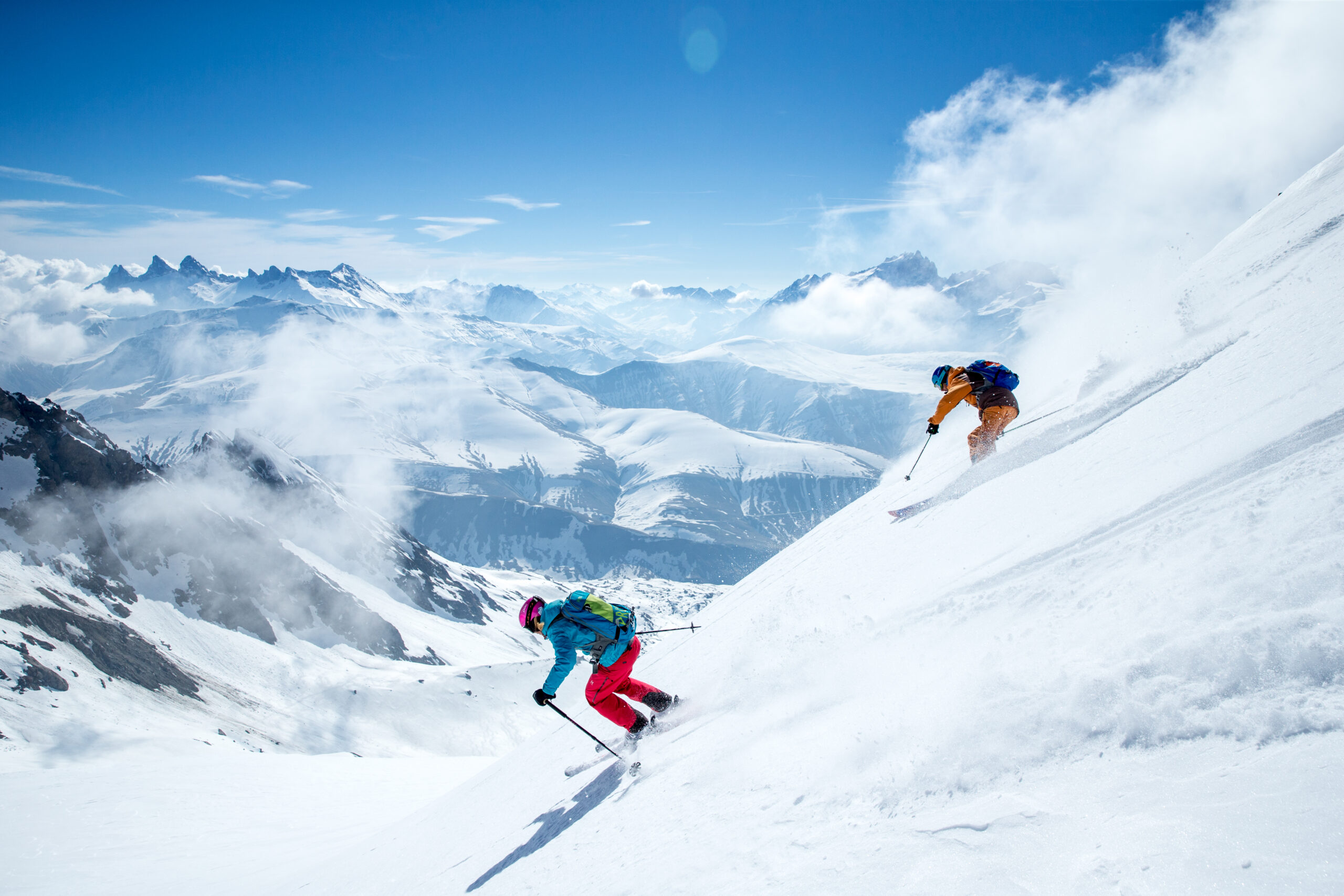
Other popular freeride routes in the ski area include shady faces like the “Combe Charbonnière” or the steep gullies of the Col de la Pyramide. However, navigating these vast powder fields and narrow couloirs requires an excellent sense of orientation and flawless skiing technique. To prepare for backcountry tours, off-piste enthusiasts should definitely visit the DVA Park in Alpe d’Huez, which offers hands-on training for using avalanche transceivers.
Guided day tours with certified local mountain guides also depart from the “Bureau des Guides et Accompagnateurs” at the ESF Grandes Rousses chalet. Guides to ensure that all participants enter the terrain properly equipped with avalanche gear (transceiver, probe, and shovel) so they can enjoy their freeride adventures safely.
→ Discover the French Alps with SnowTrex now
7. Cross-Country Trails and Winter Hiking Paths in the Espace Nordique
- 49 km of groomed trails for classic cross-country and skating
- 35 km of cleared winter hiking paths with panoramic benches
- High-altitude trails offering unobstructed views of the Belledonne Massif (2,977 m)
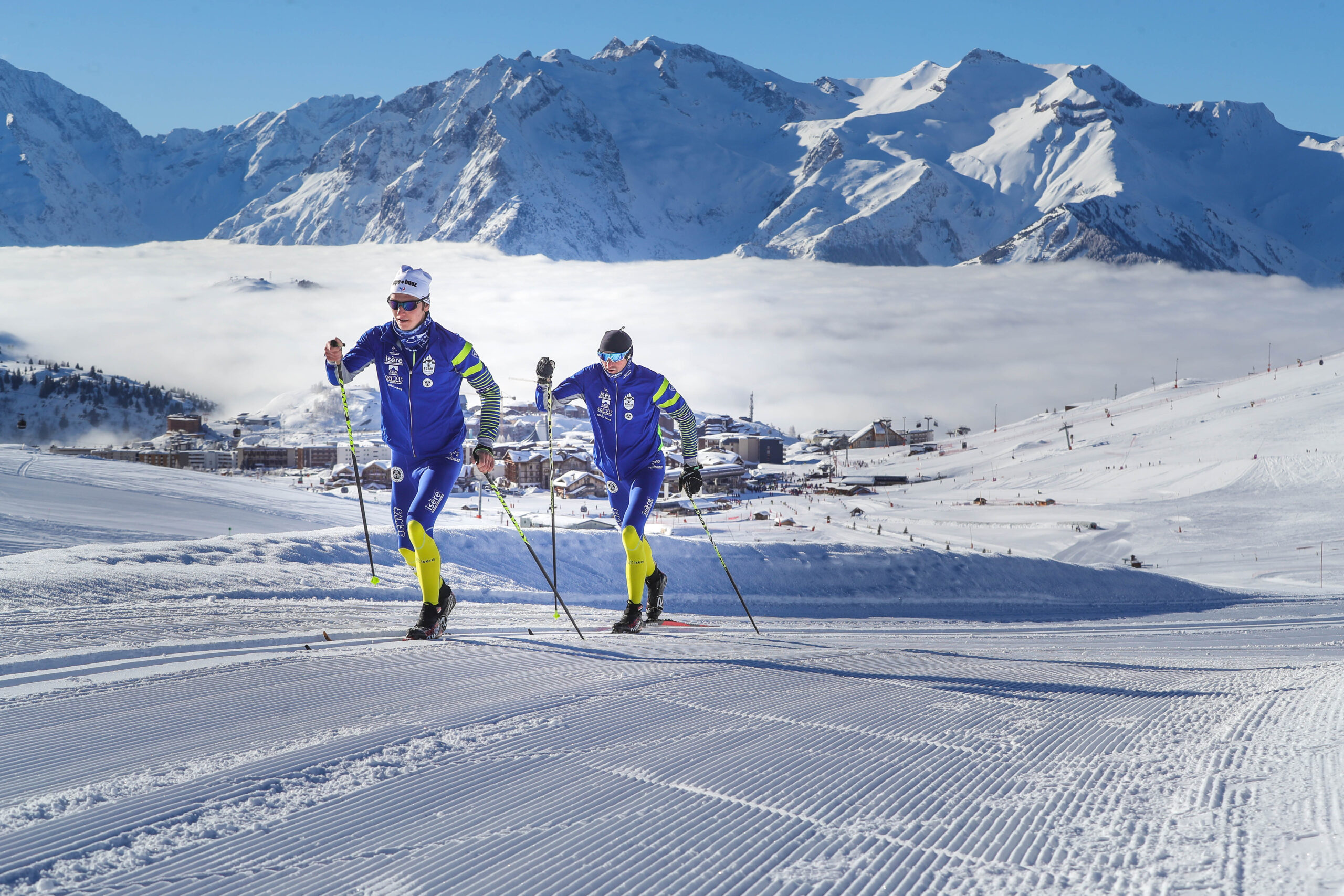
As the name suggests, the “Espace Nordique” is the home of Nordic winter sports fans in Alpe d’Huez. Here, 49 km of groomed cross-country tracks and 35 km of prepared hiking trails await. Located between 1,800 m and 2,100 m, the trails enjoy excellent snow conditions throughout the winter for both classic cross-country skiing and skating. The trails are easily accessible via lifts like the “Pic Blanc” cable car, the “Alpauris”, or the “Télémixte des Jeux”.
Cross-country beginners should start on the 1.5 km “Nordic Park” practice loop in the “Grandes Rousses” sector, while experienced skiers can tackle the blue 10 km “Boucle de Poutran” trail or the challenging 18 km “Boucle des Lacs” loop. Gliding along the tracks, you’ll be treated to stunning views of frozen mountain lakes and the jagged peaks of the Belledonne Massif.
Winter walkers can explore 35 km of marked hiking trails, which are regularly groomed by piste bashers and fitted with benches for scenic rests. A favourite among winter hikers in Alpe d’Huez is the 5.6 km circular route between Besson and Alpette, which takes roughly two hours to complete and treats walkers to sweeping views of deep snow-covered slopes. Non-skiers can also purchase pedestrian passes to ride the resort’s gondolas and access high-altitude viewpoints with ease.
→ Plan your Alpine getaway and find the best Alpe d’Huez deals at SnowTrex
8. Leisure and Culture Away from the Slopes
- 625-metre-long all-weather alpine coaster “Luge sur rails” in the Bergers district
- Artfully carved ice cave “Grotte de Glace” at 2,700 m
- AgorAlp sports centre and historical sights in the village
Not only on the slopes, but off them as well, Alpe d’Huez offers an extensive range of outdoor activities for all ages. In the Bergers district, the 625-metre-long “Luge sur rails” alpine coaster snakes its way down across curves, bridges, and waves, with the option of wearing virtual reality goggles during the ride. Classic, permanent toboggan runs on slopes like the “Rif Nel” or “Les Jeux” are also available for traditional sledging fun.
Adrenaline junkies can also take to the slopes of the “Grandes Rousses” sector on steerable mountain karts, featuring two wheels at the rear and a ski runner at the front. During the holidays, these descents are open on select evenings under floodlights on the “Piste de Roger”, the resort’s go-to run for night skiing. Those who fancy taking to the air can book a tandem paragliding flight from the Henri Giraud Altiport, gliding down over a vertical drop of up to 2,300 m accompanied by an experienced pilot.
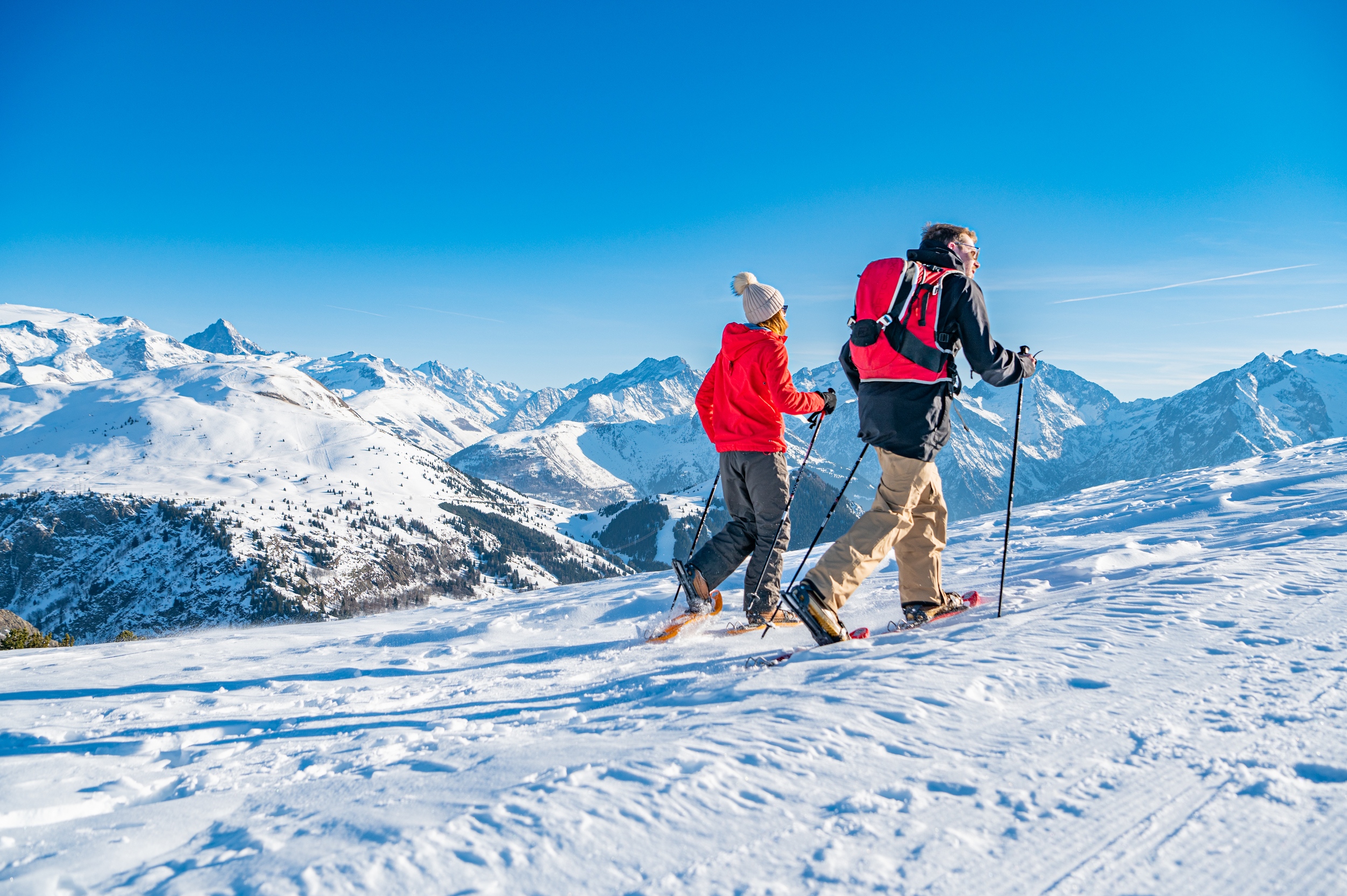
A calmer experience can be found at 2,700 m inside the “Grotte de Glace”, an ice cave where local mountain guides carve new ice sculptures based on changing themes directly into the snow every year. Equally, peaceful are traditional dog sledding rides and guided snowshoe hikes through snow-laden larch forests.
The AgorAlp sports and cultural centre on Avenue de Brandes, along with a heated outdoor pool on Avenue des Jeux, provides perfect post-sport relaxation. Right next to the pool, an open-air ice rink invites visitors to skate under the stars. Culture enthusiasts can visit the church of Notre-Dame des Neiges (consecrated in 1969) with its thirteen colourful stained-glass windows created by the artist Arcabas, or explore archaeological finds from the medieval Brandes silver mine at the Musée d’Huez et de l’Oisans.
→ Secure unforgettable ski moments in Oisans with SnowTrex now
9. Culinary Specialities and Delicacies in the Isère Department
- Traditional cheeses: Saint-Marcellin and Bleu du Vercors-Sassenage
- Sweet delicacies such as nutty walnut cake made with regional ingredients
- Herbal Chartreuse liqueur crafted from over 130 alpine plants
Naturally, the gastronomy in Alpe d’Huez reflects the rich culinary heritage of the Isère department, spoiling foodies with the unmistakable specialities of the French Alps. Cheese lovers will appreciate creamy, cow’s-milk Saint-Marcellin PGI, often served oven-baked and bubbling in cosy mountain restaurants. Equally characteristic is Bleu du Vercors-Sassenage PDO, a mild blue cheese from the Vercors plateau that lends a subtle, nutty flavour to alpine dishes.

These specialities are served on sun terraces and in traditional mountain inns such as the “Chalet du Lac Besson”, where chefs also whip up hearty Gratin Dauphinois or steaming cheese fondues. These comforting dishes are among the most beloved classics of alpine dining. Local bakeries in Alpe d’Huez also bake traditional walnut cake made with famous walnuts from Grenoble.
To round off a sumptuous meal of local specialities, guests are often served a glass of the world-famous Chartreuse liqueur, whose secret recipe is guarded to this day by Carthusian monks. Distilled from 130 different alpine herbs, the liqueur offers a complex aromatic profile of mint, aniseed, and wild mountain herbs.
SnowTrex Tip: In the delicatessens along Avenue des Jeux, you can purchase wheels of artisan cheese and local specialities vacuum-packed to take home as tasty holiday souvenirs.
→ Discover the French Alps with SnowTrex now
10. World-Famous Events and Mountain Après-Ski
- “Tomorrowland Winter” draws music fans from all over the world to Alpe d’Huez in March
- Non-stop après-ski, e.g. on the sun terrace of “La Folie Douce”
- High-calibre cultural programme, such as the “Festival International du Film de Comédie”
In addition to its legendary (if irregular) visits from the Tour de France during the summer, Alpe d’Huez is globally renowned in winter for one major highlight: every March, the ski resort hosts Tomorrowland Winter! For this alpine edition of the iconic Belgian EDM festival, tens of thousands of music and ski fans flock to the resort for the world’s ultimate high-altitude electronic music festival. In the main tent, across smaller village venues, and on open-air stages right on the slopes, superstar DJs like Steve Aoki and Charlotte de Witte take to the decks to celebrate a massive mountain music spectacle (set to take place from 20 to 27 March 2027).

Please also note that by using our services and integrating the YouTube API Services, the YouTube Terms of Service and the YouTube API Services Terms apply and your use of our website is deemed to be acceptance of these terms.
The epicentre of classic slope side après-ski in Alpe d’Huez is located at Plat des Marmottes by the top station of the “Marmottes 1” chairlift. We are, of course, talking about La Folie Douce! On its expansive sun terrace, live performers, musicians, and DJs create an unforgettable open-air party atmosphere with views of the snow-capped 4,000-metre peaks of the French Alps.
For those looking for a quieter wind-down after a day on the slopes, Savoyard specialities like fondue or tartiflette can be savoured in traditional alpine huts like the “Chalet du Lac Besson”. Later in the evening, the party moves into the centre of Alpe d’Huez, where “Smithy’s Tavern”, the “Underground Bar”, and the “Discothèque Igloo” are lively nightlife hubs. January brings a cultural highlight to the station with the renowned “Festival International du Film de Comédie”, where filmmakers showcase new comedy films at the AgorAlp cinema.
→ Plan your Alpine getaway and find the best deals in the French Alps at SnowTrex
FAQ for Skiing in Alpe d’Huez
How many kilometres of pistes are there in the Alpe d’Huez ski area?
The ski area features 250 kilometres of pistes across 109 marked descents. A total of 72 lifts provide access to slopes for all skill levels at altitudes ranging from 1,125 m (L’Enversin d’Oz) to 3,330 m (Pic Blanc). Uninterrupted runs allow skiers to cover a vertical drop of nearly 2,000 m in one single descent.
What makes the Sarenne run in Alpe d’Huez so special?
At 16 km long and with a vertical drop of around 1,800 m, the Sarenne is the longest black run in the French Alps. It starts right at the Pic Blanc cable car station at 3,330 m and finishes in the Sarenne Gorge at 1,510 m. Steep pitches across the upper glacier section give way to gentle gliding stretches along an untouched alpine valley.
Is Alpe d’Huez suitable for beginners and families?
Yes, thanks to its “Famille Plus” certification and child-friendly infrastructure, Alpe d’Huez is ideal for beginners and families. In the valley area, three lifts with magic carpets and separate beginner areas are available free of charge. Adventure slopes like “Marcel’s Farm”, ski school courses, and dedicated childcare from two and a half years of age complete the family offering.
How snow-reliable is Alpe d’Huez in winter?
Alpe d’Huez offers outstanding snow reliability thanks to slopes reaching up to 3,330 m on Pic Blanc and the fact that most of the ski area lies above 2,000 m. On the north- and west-facing slopes, cold alpine winds reliably preserve powder snow. In addition, 1,071 snow cannons cover approximately 88 kilometres of pistes, ensuring ski operations run smoothly from early December to late April.
What activities are available in Alpe d’Huez besides skiing?
Away from the pistes, Alpe d’Huez offers an extensive activity programme combining outdoor sports, nature, culture, and alpine flair. Guests can ride the 625-metre-long “Luge sur rails” alpine coaster, drive mountain karts, go snowshoeing, or explore the “Grotte de Glace” ice cave at 2,700 m. Relaxation can be found at the AgorAlp sports centre with its heated outdoor pool, or during a visit to the Notre-Dame des Neiges church. Traditional mountain restaurants also serve regional specialities like Saint-Marcellin cheese, Gratin Dauphinois, walnut cake, and herbal Chartreuse liqueur.
When does the “Tomorrowland Winter” festival take place in Alpe d’Huez?
The festival takes place every year in March in the Alpe d’Huez ski resort. During the event (scheduled for 20 to 27 March 2027), international DJs perform across multiple stages in the resort centre and directly on the slopes, allowing winter sports enthusiasts and music fans to combine high-alpine skiing with world-class live concerts.